

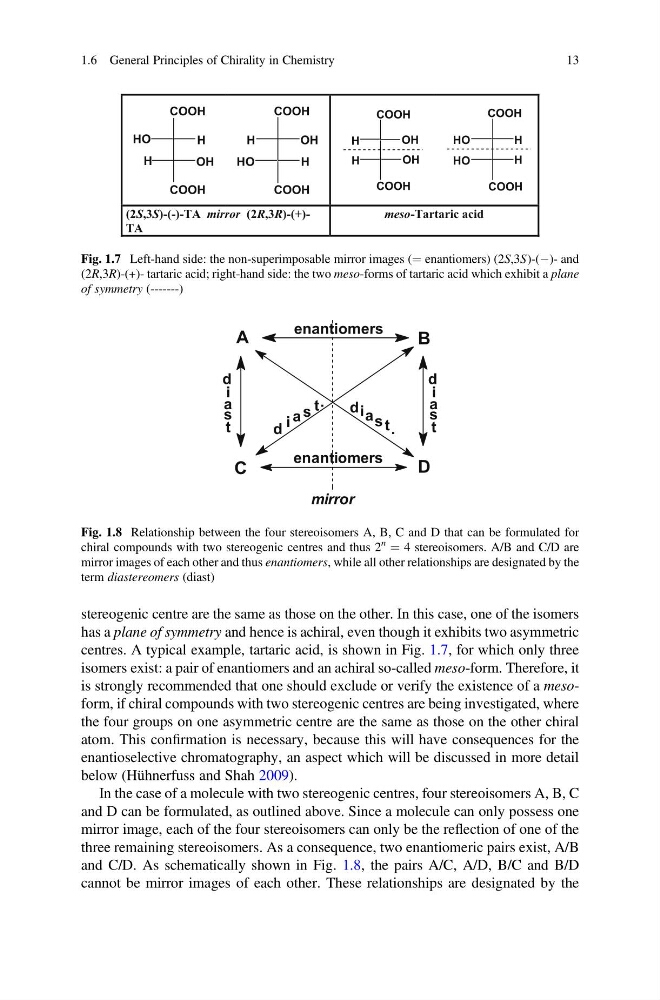
stereogenic centre are the same as those on the other. In this case, one of the isomers
has a plane of symmetry and hence is achiral, even though it exhibits two asymmetric
centres. A typical example, tartaric acid, is shown in Fig. 1.7, for which only three
isomers exist: a pair of enantiomers and an achiral so-called meso-form. Therefore, it
is strongly recommended that one should exclude or verify the existence of a mesoform, if chiral compounds with two stereogenic centres are being investigated, where
the four groups on one asymmetric centre are the same as those on the other chiral
atom. This confirmation is necessary, because this will have consequences for the
enantioselective chromatography, an aspect which will be discussed in more detail
below (Hühnerfuss and Shah 2009).
In the case of a molecule with two stereogenic centres, four stereoisomers A, B, C
and D can be formulated, as outlined above. Since a molecule can only possess one
mirror image, each of the four stereoisomers can only be the reflection of one of the
three remaining stereoisomers. As a consequence, two enantiomeric pairs exist, A/B
and C/D. As schematically shown in Fig. 1.8, the pairs A/C, A/D, B/C and B/D
cannot be mirror images of each other. These relationships are designated by the
(2S,3S)-(-)-TA mirror (2R,3R)-(+)TA
meso-Tartaric acid
COOH
COOH
OH
HO
H
H
COOH
COOH
OH
HO
H
H
H
H
OH
OH
COOH
COOH
H
H
HO
HO
COOH
COOH
Fig. 1.7 Left-hand side: the non-superimposable mirror images (¼ enantiomers) (2S,3S)-(À)- and
(2R,3R)-(+)- tartaric acid; right-hand side: the two meso-forms of tartaric acid which exhibit a plane
of symmetry (-------)
i
d
a
s
t
i
d
D
A
B
C
mirror
enantiomers
d
a s t .
.
i a s t
enantiomers
i
d
a
s
t
Fig. 1.8 Relationship between the four stereoisomers A, B, C and D that can be formulated for
chiral compounds with two stereogenic centres and thus 2
n ¼ 4 stereoisomers. A/B and C/D are
mirror images of each other and thus enantiomers, while all other relationships are designated by the
term diastereomers (diast)
1.6 General Principles of Chirality in Chemistry
13
has a plane of symmetry and hence is achiral, even though it exhibits two asymmetric
centres. A typical example, tartaric acid, is shown in Fig. 1.7, for which only three
isomers exist: a pair of enantiomers and an achiral so-called meso-form. Therefore, it
is strongly recommended that one should exclude or verify the existence of a mesoform, if chiral compounds with two stereogenic centres are being investigated, where
the four groups on one asymmetric centre are the same as those on the other chiral
atom. This confirmation is necessary, because this will have consequences for the
enantioselective chromatography, an aspect which will be discussed in more detail
below (Hühnerfuss and Shah 2009).
In the case of a molecule with two stereogenic centres, four stereoisomers A, B, C
and D can be formulated, as outlined above. Since a molecule can only possess one
mirror image, each of the four stereoisomers can only be the reflection of one of the
three remaining stereoisomers. As a consequence, two enantiomeric pairs exist, A/B
and C/D. As schematically shown in Fig. 1.8, the pairs A/C, A/D, B/C and B/D
cannot be mirror images of each other. These relationships are designated by the
(2S,3S)-(-)-TA mirror (2R,3R)-(+)TA
meso-Tartaric acid
COOH
COOH
OH
HO
H
H
COOH
COOH
OH
HO
H
H
H
H
OH
OH
COOH
COOH
H
H
HO
HO
COOH
COOH
Fig. 1.7 Left-hand side: the non-superimposable mirror images (¼ enantiomers) (2S,3S)-(À)- and
(2R,3R)-(+)- tartaric acid; right-hand side: the two meso-forms of tartaric acid which exhibit a plane
of symmetry (-------)
i
d
a
s
t
i
d
D
A
B
C
mirror
enantiomers
d
a s t .
.
i a s t
enantiomers
i
d
a
s
t
Fig. 1.8 Relationship between the four stereoisomers A, B, C and D that can be formulated for
chiral compounds with two stereogenic centres and thus 2
n ¼ 4 stereoisomers. A/B and C/D are
mirror images of each other and thus enantiomers, while all other relationships are designated by the
term diastereomers (diast)
1.6 General Principles of Chirality in Chemistry
13