

experimental details can be inferred from an earlier publication (Jantunen et al.
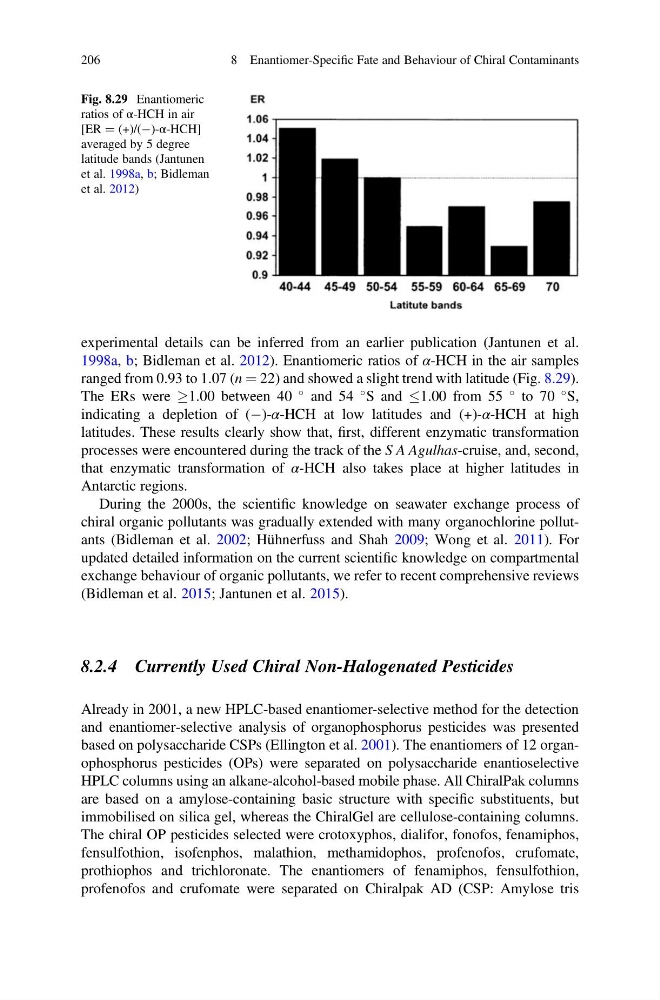
1998a, b; Bidleman et al. 2012). Enantiomeric ratios of α-HCH in the air samples
ranged from 0.93 to 1.07 (n ¼ 22) and showed a slight trend with latitude (Fig. 8.29).
The ERs were !1.00 between 40
and 54
S and 1.00 from 55
to 70
S,
indicating a depletion of (À)-α-HCH at low latitudes and (+)-α-HCH at high
latitudes. These results clearly show that, first, different enzymatic transformation
processes were encountered during the track of the S A Agulhas-cruise, and, second,
that enzymatic transformation of α-HCH also takes place at higher latitudes in
Antarctic regions.
During the 2000s, the scientific knowledge on seawater exchange process of
chiral organic pollutants was gradually extended with many organochlorine pollutants (Bidleman et al. 2002; Hühnerfuss and Shah 2009; Wong et al. 2011). For
updated detailed information on the current scientific knowledge on compartmental
exchange behaviour of organic pollutants, we refer to recent comprehensive reviews
(Bidleman et al. 2015; Jantunen et al. 2015).
8.2.4 Currently Used Chiral Non-Halogenated Pesticides
Already in 2001, a new HPLC-based enantiomer-selective method for the detection
and enantiomer-selective analysis of organophosphorus pesticides was presented
based on polysaccharide CSPs (Ellington et al. 2001). The enantiomers of 12 organophosphorus pesticides (OPs) were separated on polysaccharide enantioselective
HPLC columns using an alkane-alcohol-based mobile phase. All ChiralPak columns
are based on a amylose-containing basic structure with specific substituents, but
immobilised on silica gel, whereas the ChiralGel are cellulose-containing columns.
The chiral OP pesticides selected were crotoxyphos, dialifor, fonofos, fenamiphos,
fensulfothion, isofenphos, malathion, methamidophos, profenofos, crufomate,
prothiophos and trichloronate. The enantiomers of fenamiphos, fensulfothion,
profenofos and crufomate were separated on Chiralpak AD (CSP: Amylose tris
Fig. 8.29 Enantiomeric
ratios of α-HCH in air
[ER ¼ (+)/(À)-α-HCH]
averaged by 5 degree
latitude bands (Jantunen
et al. 1998a, b; Bidleman
et al. 2012)
206
8 Enantiomer-Specific Fate and Behaviour of Chiral Contaminants
1998a, b; Bidleman et al. 2012). Enantiomeric ratios of α-HCH in the air samples
ranged from 0.93 to 1.07 (n ¼ 22) and showed a slight trend with latitude (Fig. 8.29).
The ERs were !1.00 between 40
and 54
S and 1.00 from 55
to 70
S,
indicating a depletion of (À)-α-HCH at low latitudes and (+)-α-HCH at high
latitudes. These results clearly show that, first, different enzymatic transformation
processes were encountered during the track of the S A Agulhas-cruise, and, second,
that enzymatic transformation of α-HCH also takes place at higher latitudes in
Antarctic regions.
During the 2000s, the scientific knowledge on seawater exchange process of
chiral organic pollutants was gradually extended with many organochlorine pollutants (Bidleman et al. 2002; Hühnerfuss and Shah 2009; Wong et al. 2011). For
updated detailed information on the current scientific knowledge on compartmental
exchange behaviour of organic pollutants, we refer to recent comprehensive reviews
(Bidleman et al. 2015; Jantunen et al. 2015).
8.2.4 Currently Used Chiral Non-Halogenated Pesticides
Already in 2001, a new HPLC-based enantiomer-selective method for the detection
and enantiomer-selective analysis of organophosphorus pesticides was presented
based on polysaccharide CSPs (Ellington et al. 2001). The enantiomers of 12 organophosphorus pesticides (OPs) were separated on polysaccharide enantioselective
HPLC columns using an alkane-alcohol-based mobile phase. All ChiralPak columns
are based on a amylose-containing basic structure with specific substituents, but
immobilised on silica gel, whereas the ChiralGel are cellulose-containing columns.
The chiral OP pesticides selected were crotoxyphos, dialifor, fonofos, fenamiphos,
fensulfothion, isofenphos, malathion, methamidophos, profenofos, crufomate,
prothiophos and trichloronate. The enantiomers of fenamiphos, fensulfothion,
profenofos and crufomate were separated on Chiralpak AD (CSP: Amylose tris
Fig. 8.29 Enantiomeric
ratios of α-HCH in air
[ER ¼ (+)/(À)-α-HCH]
averaged by 5 degree
latitude bands (Jantunen
et al. 1998a, b; Bidleman
et al. 2012)
206
8 Enantiomer-Specific Fate and Behaviour of Chiral Contaminants