

1:1 mixture of both enantiomers forms a racemate or racemic mixture. In addition to
these general definitions, some rules have to be summarised that allow a discrimination between chiral and achiral molecules.
1.6.1 Chiral Environmental Pollutants with a Stereogenic
Centre
The most common origin of chirality in molecules, and the one originally recognised
by van’t Hoff and Le Bel, is the presence of one or more atoms, mainly carbon
atoms, each of which forms non-coplanar bonds to four different atoms or groups
(tetrahedral carbon atom). The atom that carries the four different substitutes is called
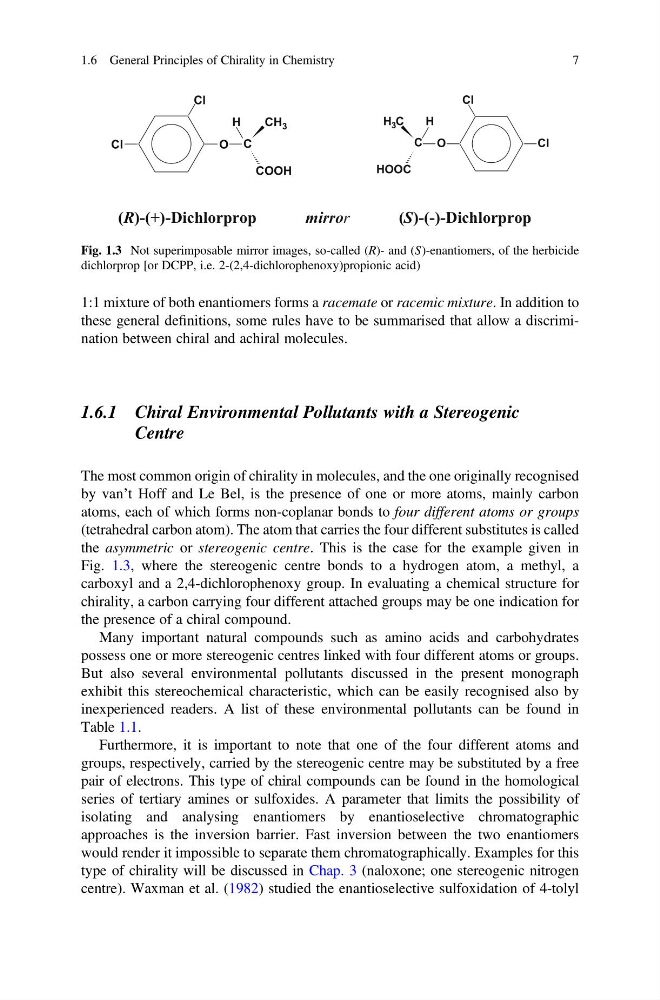
the asymmetric or stereogenic centre. This is the case for the example given in
Fig. 1.3, where the stereogenic centre bonds to a hydrogen atom, a methyl, a
carboxyl and a 2,4-dichlorophenoxy group. In evaluating a chemical structure for
chirality, a carbon carrying four different attached groups may be one indication for
the presence of a chiral compound.
Many important natural compounds such as amino acids and carbohydrates
possess one or more stereogenic centres linked with four different atoms or groups.
But also several environmental pollutants discussed in the present monograph
exhibit this stereochemical characteristic, which can be easily recognised also by
inexperienced readers. A list of these environmental pollutants can be found in
Table 1.1.
Furthermore, it is important to note that one of the four different atoms and
groups, respectively, carried by the stereogenic centre may be substituted by a free
pair of electrons. This type of chiral compounds can be found in the homological
series of tertiary amines or sulfoxides. A parameter that limits the possibility of
isolating and analysing enantiomers by enantioselective chromatographic
approaches is the inversion barrier. Fast inversion between the two enantiomers
would render it impossible to separate them chromatographically. Examples for this
type of chirality will be discussed in Chap. 3 (naloxone; one stereogenic nitrogen
centre). Waxman et al. (1982) studied the enantioselective sulfoxidation of 4-tolyl
(R)-(+)-Dichlorprop
mirror
(S)-(-)-Dichlorprop
Cl
H
COOH
O
Cl
C
CH 3
Cl
H
O
Cl
C
H 3 C
HOOC
Fig. 1.3 Not superimposable mirror images, so-called (R)- and (S)-enantiomers, of the herbicide
dichlorprop [or DCPP, i.e. 2-(2,4-dichlorophenoxy)propionic acid)
1.6 General Principles of Chirality in Chemistry
7
these general definitions, some rules have to be summarised that allow a discrimination between chiral and achiral molecules.
1.6.1 Chiral Environmental Pollutants with a Stereogenic
Centre
The most common origin of chirality in molecules, and the one originally recognised
by van’t Hoff and Le Bel, is the presence of one or more atoms, mainly carbon
atoms, each of which forms non-coplanar bonds to four different atoms or groups
(tetrahedral carbon atom). The atom that carries the four different substitutes is called
the asymmetric or stereogenic centre. This is the case for the example given in
Fig. 1.3, where the stereogenic centre bonds to a hydrogen atom, a methyl, a
carboxyl and a 2,4-dichlorophenoxy group. In evaluating a chemical structure for
chirality, a carbon carrying four different attached groups may be one indication for
the presence of a chiral compound.
Many important natural compounds such as amino acids and carbohydrates
possess one or more stereogenic centres linked with four different atoms or groups.
But also several environmental pollutants discussed in the present monograph
exhibit this stereochemical characteristic, which can be easily recognised also by
inexperienced readers. A list of these environmental pollutants can be found in
Table 1.1.
Furthermore, it is important to note that one of the four different atoms and
groups, respectively, carried by the stereogenic centre may be substituted by a free
pair of electrons. This type of chiral compounds can be found in the homological
series of tertiary amines or sulfoxides. A parameter that limits the possibility of
isolating and analysing enantiomers by enantioselective chromatographic
approaches is the inversion barrier. Fast inversion between the two enantiomers
would render it impossible to separate them chromatographically. Examples for this
type of chirality will be discussed in Chap. 3 (naloxone; one stereogenic nitrogen
centre). Waxman et al. (1982) studied the enantioselective sulfoxidation of 4-tolyl
(R)-(+)-Dichlorprop
mirror
(S)-(-)-Dichlorprop
Cl
H
COOH
O
Cl
C
CH 3
Cl
H
O
Cl
C
H 3 C
HOOC
Fig. 1.3 Not superimposable mirror images, so-called (R)- and (S)-enantiomers, of the herbicide
dichlorprop [or DCPP, i.e. 2-(2,4-dichlorophenoxy)propionic acid)
1.6 General Principles of Chirality in Chemistry
7