

kidney: ER ¼ 1.6; muscle: ER ¼ 7.0), harbour seals (Phoca vitulina; blubber: ER ¼
1.2–4.5; brain ¼ 7.9–1). Möller et al. concluded that the enrichment of the α-HCH
enantiomers in sheep fat and liver tissues is different from those found in the
respective tissues of marine biota of high trophic levels, and they assumed that the
enzymatic transformation pathways in the livers of the terrestrial (sheep) and marine
animals (harbour seals) of higher trophic levels are markedly different. However, it
is worth noting that the occurrence of β-pentachlorocyclohexene in all tissues
compared in the study by Möller et al. indicated the usual transformation mechanism, that is, trans-dehydrohalogenation of α-HCH.
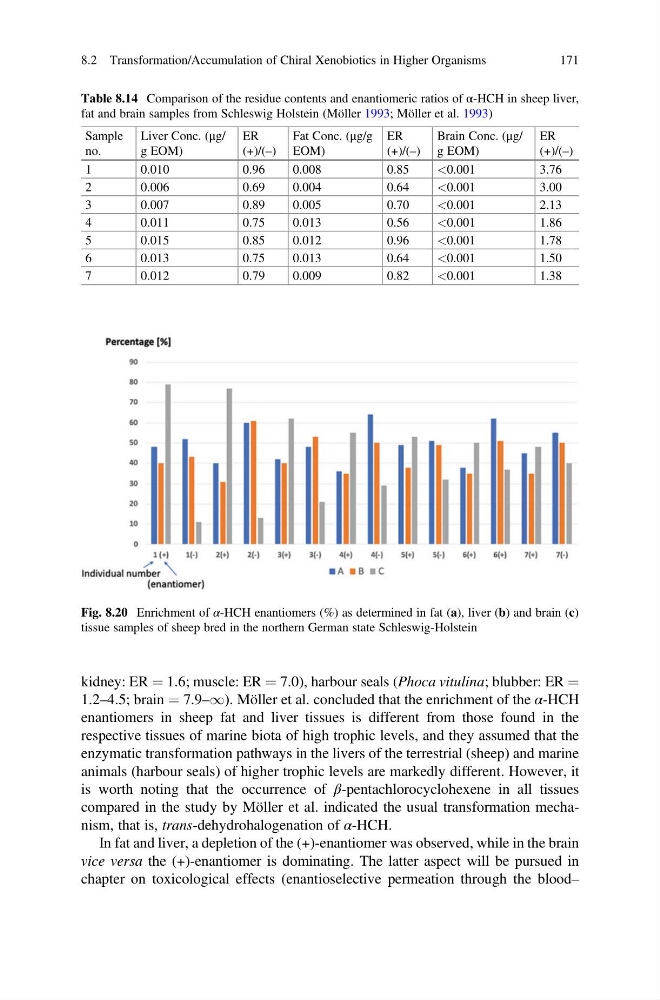
In fat and liver, a depletion of the (+)-enantiomer was observed, while in the brain
vice versa the (+)-enantiomer is dominating. The latter aspect will be pursued in
chapter on toxicological effects (enantioselective permeation through the blood–
Fig. 8.20 Enrichment of α-HCH enantiomers (%) as determined in fat (a), liver (b) and brain (c)
tissue samples of sheep bred in the northern German state Schleswig-Holstein
Table 8.14 Comparison of the residue contents and enantiomeric ratios of α-HCH in sheep liver,
fat and brain samples from Schleswig Holstein (Möller 1993; Möller et al. 1993)
Sample
no.
Liver Conc. (μg/
g EOM)
ER
(+)/(–)
Fat Conc. (μg/g
EOM)
ER
(+)/(–)
Brain Conc. (μg/
g EOM)
ER
(+)/(–)
1
0.010
0.96
0.008
0.85
<0.001
3.76
2
0.006
0.69
0.004
0.64
<0.001
3.00
3
0.007
0.89
0.005
0.70
<0.001
2.13
4
0.011
0.75
0.013
0.56
<0.001
1.86
5
0.015
0.85
0.012
0.96
<0.001
1.78
6
0.013
0.75
0.013
0.64
<0.001
1.50
7
0.012
0.79
0.009
0.82
<0.001
1.38
8.2 Transformation/Accumulation of Chiral Xenobiotics in Higher Organisms
171
1.2–4.5; brain ¼ 7.9–1). Möller et al. concluded that the enrichment of the α-HCH
enantiomers in sheep fat and liver tissues is different from those found in the
respective tissues of marine biota of high trophic levels, and they assumed that the
enzymatic transformation pathways in the livers of the terrestrial (sheep) and marine
animals (harbour seals) of higher trophic levels are markedly different. However, it
is worth noting that the occurrence of β-pentachlorocyclohexene in all tissues
compared in the study by Möller et al. indicated the usual transformation mechanism, that is, trans-dehydrohalogenation of α-HCH.
In fat and liver, a depletion of the (+)-enantiomer was observed, while in the brain
vice versa the (+)-enantiomer is dominating. The latter aspect will be pursued in
chapter on toxicological effects (enantioselective permeation through the blood–
Fig. 8.20 Enrichment of α-HCH enantiomers (%) as determined in fat (a), liver (b) and brain (c)
tissue samples of sheep bred in the northern German state Schleswig-Holstein
Table 8.14 Comparison of the residue contents and enantiomeric ratios of α-HCH in sheep liver,
fat and brain samples from Schleswig Holstein (Möller 1993; Möller et al. 1993)
Sample
no.
Liver Conc. (μg/
g EOM)
ER
(+)/(–)
Fat Conc. (μg/g
EOM)
ER
(+)/(–)
Brain Conc. (μg/
g EOM)
ER
(+)/(–)
1
0.010
0.96
0.008
0.85
<0.001
3.76
2
0.006
0.69
0.004
0.64
<0.001
3.00
3
0.007
0.89
0.005
0.70
<0.001
2.13
4
0.011
0.75
0.013
0.56
<0.001
1.86
5
0.015
0.85
0.012
0.96
<0.001
1.78
6
0.013
0.75
0.013
0.64
<0.001
1.50
7
0.012
0.79
0.009
0.82
<0.001
1.38
8.2 Transformation/Accumulation of Chiral Xenobiotics in Higher Organisms
171