

present in a non-racemic composition in technical mixtures. An explanation is
provided by the use of natural precursors (α-pinene, terpene and camphene) in the
toxaphene synthesis, which may give rise to chiral induction in the course of the
preparation pathway. Similar conclusions were drawn by a study on the Soviet
pesticide mixture Polychloropinene
® (Trukhin et al. 2007). As a consequence,
caution has to be applied when interpreting enantiomeric excesses of toxaphene
congeners determined in biota, because deviations from a racemic composition in
biological samples may not only arise from enantioselective transformation
processes.
The first to report enantiomeric excesses of two major abundant chlorobornanes
in biological samples were Kallenborn et al. (1994a, b), as well as Buser and Müller
(1994a, b). In both studies, the same sample was used, that is, blubber of a harbour
seal (Phoca vitulina L.), from which the major chlorobornanes were isolated.
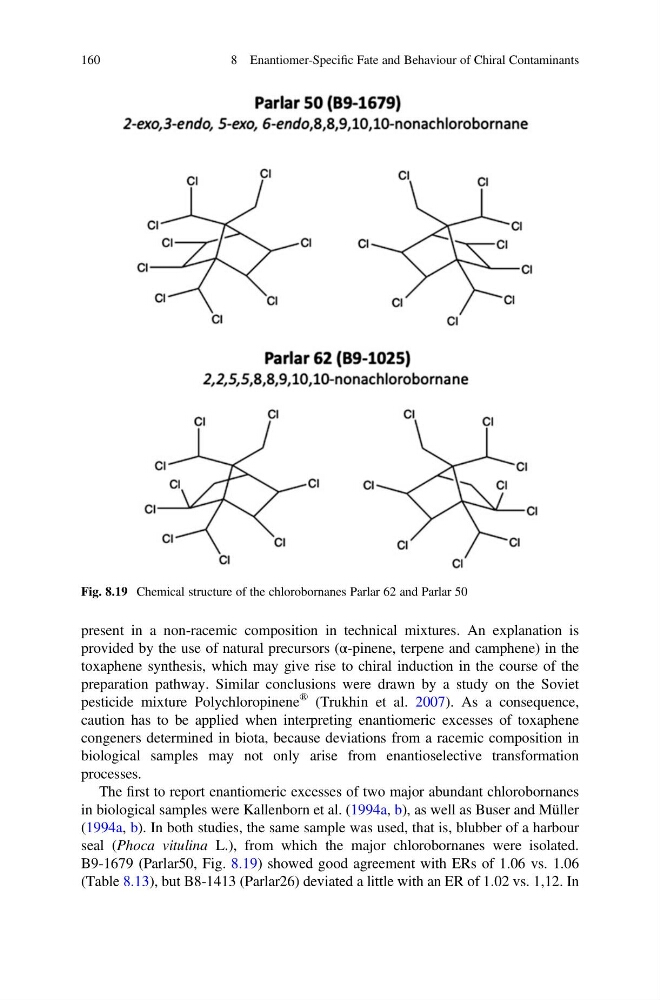
B9-1679 (Parlar50, Fig. 8.19) showed good agreement with ERs of 1.06 vs. 1.06
(Table 8.13), but B8-1413 (Parlar26) deviated a little with an ER of 1.02 vs. 1,12. In
Fig. 8.19 Chemical structure of the chlorobornanes Parlar 62 and Parlar 50
160
8 Enantiomer-Specific Fate and Behaviour of Chiral Contaminants
provided by the use of natural precursors (α-pinene, terpene and camphene) in the
toxaphene synthesis, which may give rise to chiral induction in the course of the
preparation pathway. Similar conclusions were drawn by a study on the Soviet
pesticide mixture Polychloropinene
® (Trukhin et al. 2007). As a consequence,
caution has to be applied when interpreting enantiomeric excesses of toxaphene
congeners determined in biota, because deviations from a racemic composition in
biological samples may not only arise from enantioselective transformation
processes.
The first to report enantiomeric excesses of two major abundant chlorobornanes
in biological samples were Kallenborn et al. (1994a, b), as well as Buser and Müller
(1994a, b). In both studies, the same sample was used, that is, blubber of a harbour
seal (Phoca vitulina L.), from which the major chlorobornanes were isolated.
B9-1679 (Parlar50, Fig. 8.19) showed good agreement with ERs of 1.06 vs. 1.06
(Table 8.13), but B8-1413 (Parlar26) deviated a little with an ER of 1.02 vs. 1,12. In
Fig. 8.19 Chemical structure of the chlorobornanes Parlar 62 and Parlar 50
160
8 Enantiomer-Specific Fate and Behaviour of Chiral Contaminants