

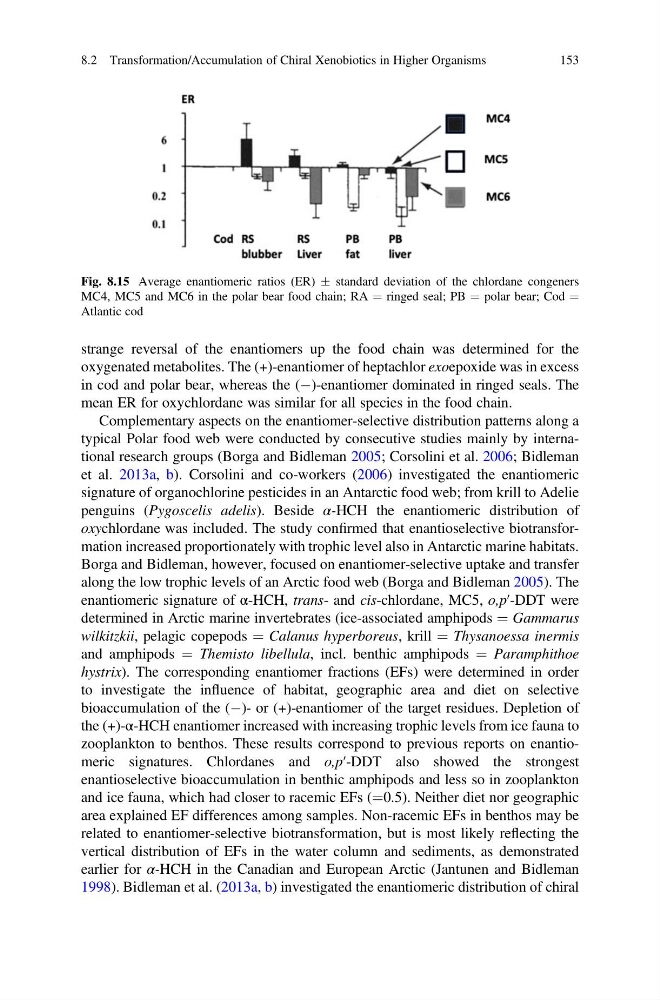
strange reversal of the enantiomers up the food chain was determined for the
oxygenated metabolites. The (+)-enantiomer of heptachlor exoepoxide was in excess
in cod and polar bear, whereas the (À)-enantiomer dominated in ringed seals. The
mean ER for oxychlordane was similar for all species in the food chain.
Complementary aspects on the enantiomer-selective distribution patterns along a
typical Polar food web were conducted by consecutive studies mainly by international research groups (Borga and Bidleman 2005; Corsolini et al. 2006; Bidleman
et al. 2013a, b). Corsolini and co-workers (2006) investigated the enantiomeric
signature of organochlorine pesticides in an Antarctic food web; from krill to Adelie
penguins (Pygoscelis adelis). Beside α-HCH the enantiomeric distribution of
oxychlordane was included. The study confirmed that enantioselective biotransformation increased proportionately with trophic level also in Antarctic marine habitats.
Borga and Bidleman, however, focused on enantiomer-selective uptake and transfer
along the low trophic levels of an Arctic food web (Borga and Bidleman 2005). The
enantiomeric signature of α-HCH, trans- and cis-chlordane, MC5, o,p'-DDT were
determined in Arctic marine invertebrates (ice-associated amphipods ¼ Gammarus
wilkitzkii, pelagic copepods ¼ Calanus hyperboreus, krill ¼ Thysanoessa inermis
and amphipods ¼ Themisto libellula, incl. benthic amphipods ¼ Paramphithoe
hystrix). The corresponding enantiomer fractions (EFs) were determined in order
to investigate the influence of habitat, geographic area and diet on selective
bioaccumulation of the (À)- or (+)-enantiomer of the target residues. Depletion of
the (+)-α-HCH enantiomer increased with increasing trophic levels from ice fauna to
zooplankton to benthos. These results correspond to previous reports on enantiomeric signatures. Chlordanes and o,p'-DDT also showed the strongest
enantioselective bioaccumulation in benthic amphipods and less so in zooplankton
and ice fauna, which had closer to racemic EFs (¼0.5). Neither diet nor geographic
area explained EF differences among samples. Non-racemic EFs in benthos may be
related to enantiomer-selective biotransformation, but is most likely reflecting the
vertical distribution of EFs in the water column and sediments, as demonstrated
earlier for α-HCH in the Canadian and European Arctic (Jantunen and Bidleman
1998). Bidleman et al. (2013a, b) investigated the enantiomeric distribution of chiral
Fig. 8.15 Average enantiomeric ratios (ER) Æ standard deviation of the chlordane congeners
MC4, MC5 and MC6 in the polar bear food chain; RA ¼ ringed seal; PB ¼ polar bear; Cod ¼
Atlantic cod
8.2 Transformation/Accumulation of Chiral Xenobiotics in Higher Organisms
153
oxygenated metabolites. The (+)-enantiomer of heptachlor exoepoxide was in excess
in cod and polar bear, whereas the (À)-enantiomer dominated in ringed seals. The
mean ER for oxychlordane was similar for all species in the food chain.
Complementary aspects on the enantiomer-selective distribution patterns along a
typical Polar food web were conducted by consecutive studies mainly by international research groups (Borga and Bidleman 2005; Corsolini et al. 2006; Bidleman
et al. 2013a, b). Corsolini and co-workers (2006) investigated the enantiomeric
signature of organochlorine pesticides in an Antarctic food web; from krill to Adelie
penguins (Pygoscelis adelis). Beside α-HCH the enantiomeric distribution of
oxychlordane was included. The study confirmed that enantioselective biotransformation increased proportionately with trophic level also in Antarctic marine habitats.
Borga and Bidleman, however, focused on enantiomer-selective uptake and transfer
along the low trophic levels of an Arctic food web (Borga and Bidleman 2005). The
enantiomeric signature of α-HCH, trans- and cis-chlordane, MC5, o,p'-DDT were
determined in Arctic marine invertebrates (ice-associated amphipods ¼ Gammarus
wilkitzkii, pelagic copepods ¼ Calanus hyperboreus, krill ¼ Thysanoessa inermis
and amphipods ¼ Themisto libellula, incl. benthic amphipods ¼ Paramphithoe
hystrix). The corresponding enantiomer fractions (EFs) were determined in order
to investigate the influence of habitat, geographic area and diet on selective
bioaccumulation of the (À)- or (+)-enantiomer of the target residues. Depletion of
the (+)-α-HCH enantiomer increased with increasing trophic levels from ice fauna to
zooplankton to benthos. These results correspond to previous reports on enantiomeric signatures. Chlordanes and o,p'-DDT also showed the strongest
enantioselective bioaccumulation in benthic amphipods and less so in zooplankton
and ice fauna, which had closer to racemic EFs (¼0.5). Neither diet nor geographic
area explained EF differences among samples. Non-racemic EFs in benthos may be
related to enantiomer-selective biotransformation, but is most likely reflecting the
vertical distribution of EFs in the water column and sediments, as demonstrated
earlier for α-HCH in the Canadian and European Arctic (Jantunen and Bidleman
1998). Bidleman et al. (2013a, b) investigated the enantiomeric distribution of chiral
Fig. 8.15 Average enantiomeric ratios (ER) Æ standard deviation of the chlordane congeners
MC4, MC5 and MC6 in the polar bear food chain; RA ¼ ringed seal; PB ¼ polar bear; Cod ¼
Atlantic cod
8.2 Transformation/Accumulation of Chiral Xenobiotics in Higher Organisms
153