

Iceland animals, that is, from the less polluted area, appear to be lower, and in the
brain samples from the eight Iceland seals almost exclusively (+)-α-HCH was found.
As the α-HCH concentrations in blubber of the German Bight seals were about five
times higher than those of the Iceland seals, it is tentatively assumed that the higher
concentrations may have induced higher enzymatic activity, which in turn is
expected to give rise to higher enantiomeric shifts in blubber. However, this postulate requires further in-depth investigations. The aspect of enantioselective permeation of α-HCH enantiomers through the blood–brain barrier, which can be also
inferred from the data set thus far available, will be discussed separately later in this
chapter.
Mössner et al. (1992; Mossner and Ballschmiter 1997) focused on the
enantioselective transformation of α-HCH in ill and healthy neonatal, as well as
adult fur seals (Callorhinus ursinus (L.)). Tissues of three dead neonatal fur seals
with different health status were collected on St. Paul Island (Pribilof Islands,
Alaska, USA) in July 1990 in co-operation with the Alaska Marine Mammal Tissue
Archival Project and the National Marine Fisheries Service. The animals were
characterised as follows: first, a neonatal fur seal (healthy): death due to massive
head trauma; body condition good; age 1–2 weeks; male. Second, a stillborn fur seal;
female; third, a neonatal fur seal (disease); white muscle syndrome; body condition
good; age 7–10 days; male. Furthermore, a milk sample, which was taken from the
stomach of a fur seal pup that died of pneumonia, was included in this study
(Mössner et al. 1992). A cod liver oil originating from the North Atlantic, reflecting
in part the sum of abiotic and biotic transformation processes of the diet, was
analysed as a reference (SRM 1588, NIST, Gaithersburg, Maryland, USA).
For blubber, liver, lung and milk tissues of the fur seals, Mössner et al. obtained
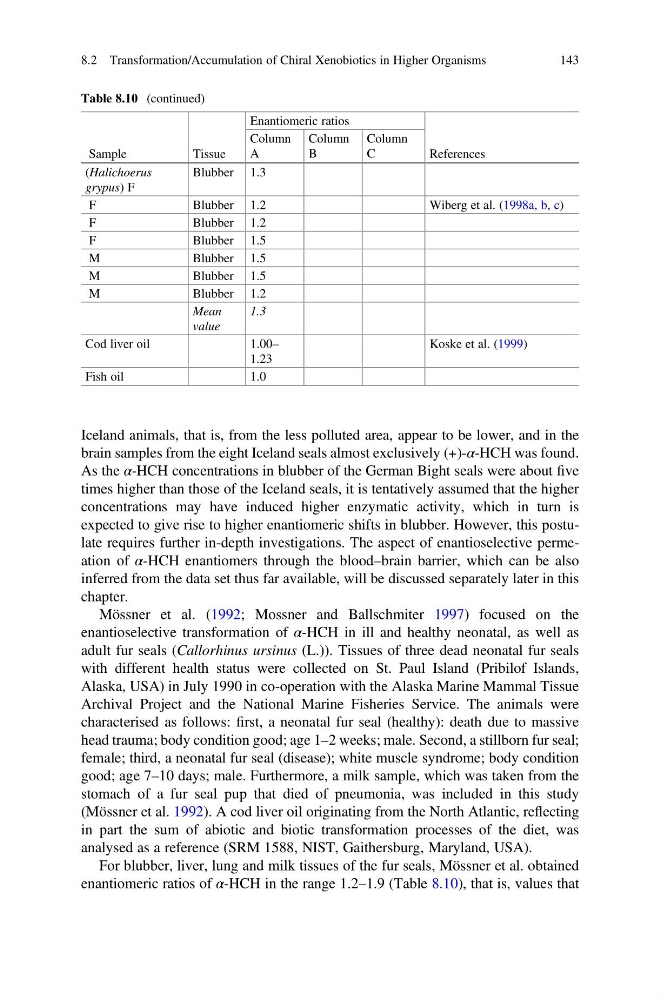
enantiomeric ratios of α-HCH in the range 1.2–1.9 (Table 8.10), that is, values that
Table 8.10 (continued)
Sample
Tissue
Enantiomeric ratios
References
Column
A
Column
B
Column
C
(Halichoerus
grypus) F
Blubber 1.3
F
Blubber 1.2
Wiberg et al. (1998a, b, c)
F
Blubber 1.2
F
Blubber 1.5
M
Blubber 1.5
M
Blubber 1.5
M
Blubber 1.2
Mean
value
1.3
Cod liver oil
1.00–
1.23
Koske et al. (1999)
Fish oil
1.0
8.2 Transformation/Accumulation of Chiral Xenobiotics in Higher Organisms
143
brain samples from the eight Iceland seals almost exclusively (+)-α-HCH was found.
As the α-HCH concentrations in blubber of the German Bight seals were about five
times higher than those of the Iceland seals, it is tentatively assumed that the higher
concentrations may have induced higher enzymatic activity, which in turn is
expected to give rise to higher enantiomeric shifts in blubber. However, this postulate requires further in-depth investigations. The aspect of enantioselective permeation of α-HCH enantiomers through the blood–brain barrier, which can be also
inferred from the data set thus far available, will be discussed separately later in this
chapter.
Mössner et al. (1992; Mossner and Ballschmiter 1997) focused on the
enantioselective transformation of α-HCH in ill and healthy neonatal, as well as
adult fur seals (Callorhinus ursinus (L.)). Tissues of three dead neonatal fur seals
with different health status were collected on St. Paul Island (Pribilof Islands,
Alaska, USA) in July 1990 in co-operation with the Alaska Marine Mammal Tissue
Archival Project and the National Marine Fisheries Service. The animals were
characterised as follows: first, a neonatal fur seal (healthy): death due to massive
head trauma; body condition good; age 1–2 weeks; male. Second, a stillborn fur seal;
female; third, a neonatal fur seal (disease); white muscle syndrome; body condition
good; age 7–10 days; male. Furthermore, a milk sample, which was taken from the
stomach of a fur seal pup that died of pneumonia, was included in this study
(Mössner et al. 1992). A cod liver oil originating from the North Atlantic, reflecting
in part the sum of abiotic and biotic transformation processes of the diet, was
analysed as a reference (SRM 1588, NIST, Gaithersburg, Maryland, USA).
For blubber, liver, lung and milk tissues of the fur seals, Mössner et al. obtained
enantiomeric ratios of α-HCH in the range 1.2–1.9 (Table 8.10), that is, values that
Table 8.10 (continued)
Sample
Tissue
Enantiomeric ratios
References
Column
A
Column
B
Column
C
(Halichoerus
grypus) F
Blubber 1.3
F
Blubber 1.2
Wiberg et al. (1998a, b, c)
F
Blubber 1.2
F
Blubber 1.5
M
Blubber 1.5
M
Blubber 1.5
M
Blubber 1.2
Mean
value
1.3
Cod liver oil
1.00–
1.23
Koske et al. (1999)
Fish oil
1.0
8.2 Transformation/Accumulation of Chiral Xenobiotics in Higher Organisms
143