

correlation between local pollutant levels and the individual concentrations in the
common Eider duck tissues has not to be expected. Moreover, in the case of the
common Eiders, the ability to transform α-HCH in the liver appears to be rather
dependent on the physical conditions of the animals, which in turn may be
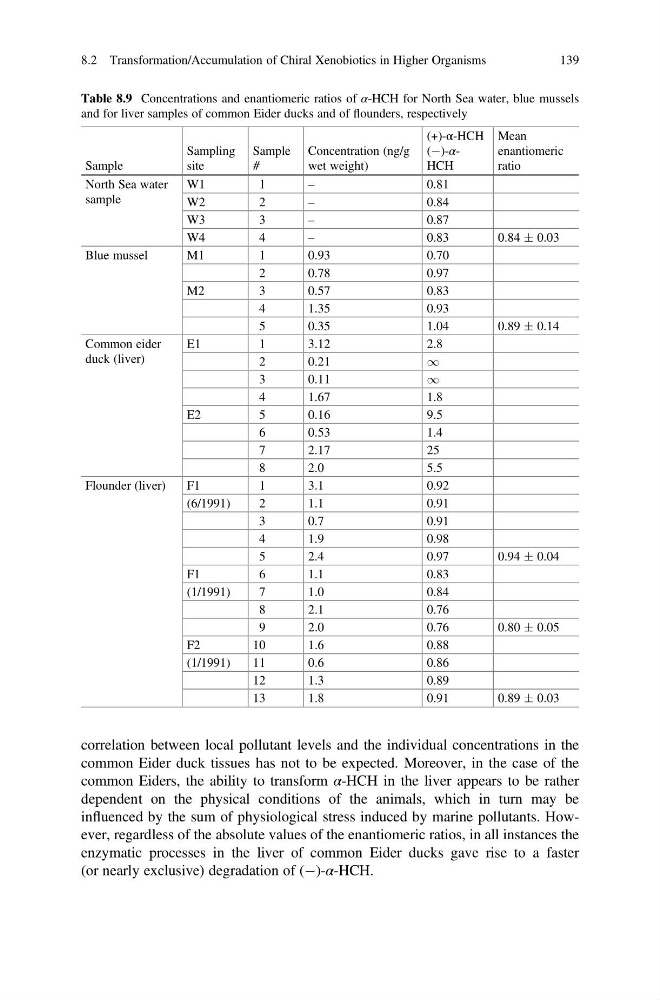
influenced by the sum of physiological stress induced by marine pollutants. However, regardless of the absolute values of the enantiomeric ratios, in all instances the
enzymatic processes in the liver of common Eider ducks gave rise to a faster
(or nearly exclusive) degradation of (À)-α-HCH.
Table 8.9 Concentrations and enantiomeric ratios of α-HCH for North Sea water, blue mussels
and for liver samples of common Eider ducks and of flounders, respectively
Sample
Sampling
site
Sample
#
Concentration (ng/g
wet weight)
(+)-α-HCH
(À)-αHCH
Mean
enantiomeric
ratio
North Sea water
sample
W1
1
–
0.81
W2
2
–
0.84
W3
3
–
0.87
W4
4
–
0.83
0.84 Æ 0.03
Blue mussel
M1
1
0.93
0.70
2
0.78
0.97
M2
3
0.57
0.83
4
1.35
0.93
5
0.35
1.04
0.89 Æ 0.14
Common eider
duck (liver)
E1
1
3.12
2.8
2
0.21
1
3
0.11
1
4
1.67
1.8
E2
5
0.16
9.5
6
0.53
1.4
7
2.17
25
8
2.0
5.5
Flounder (liver)
F1
1
3.1
0.92
(6/1991)
2
1.1
0.91
3
0.7
0.91
4
1.9
0.98
5
2.4
0.97
0.94 Æ 0.04
F1
6
1.1
0.83
(1/1991)
7
1.0
0.84
8
2.1
0.76
9
2.0
0.76
0.80 Æ 0.05
F2
10
1.6
0.88
(1/1991)
11
0.6
0.86
12
1.3
0.89
13
1.8
0.91
0.89 Æ 0.03
8.2 Transformation/Accumulation of Chiral Xenobiotics in Higher Organisms
139
common Eider duck tissues has not to be expected. Moreover, in the case of the
common Eiders, the ability to transform α-HCH in the liver appears to be rather
dependent on the physical conditions of the animals, which in turn may be
influenced by the sum of physiological stress induced by marine pollutants. However, regardless of the absolute values of the enantiomeric ratios, in all instances the
enzymatic processes in the liver of common Eider ducks gave rise to a faster
(or nearly exclusive) degradation of (À)-α-HCH.
Table 8.9 Concentrations and enantiomeric ratios of α-HCH for North Sea water, blue mussels
and for liver samples of common Eider ducks and of flounders, respectively
Sample
Sampling
site
Sample
#
Concentration (ng/g
wet weight)
(+)-α-HCH
(À)-αHCH
Mean
enantiomeric
ratio
North Sea water
sample
W1
1
–
0.81
W2
2
–
0.84
W3
3
–
0.87
W4
4
–
0.83
0.84 Æ 0.03
Blue mussel
M1
1
0.93
0.70
2
0.78
0.97
M2
3
0.57
0.83
4
1.35
0.93
5
0.35
1.04
0.89 Æ 0.14
Common eider
duck (liver)
E1
1
3.12
2.8
2
0.21
1
3
0.11
1
4
1.67
1.8
E2
5
0.16
9.5
6
0.53
1.4
7
2.17
25
8
2.0
5.5
Flounder (liver)
F1
1
3.1
0.92
(6/1991)
2
1.1
0.91
3
0.7
0.91
4
1.9
0.98
5
2.4
0.97
0.94 Æ 0.04
F1
6
1.1
0.83
(1/1991)
7
1.0
0.84
8
2.1
0.76
9
2.0
0.76
0.80 Æ 0.05
F2
10
1.6
0.88
(1/1991)
11
0.6
0.86
12
1.3
0.89
13
1.8
0.91
0.89 Æ 0.03
8.2 Transformation/Accumulation of Chiral Xenobiotics in Higher Organisms
139