

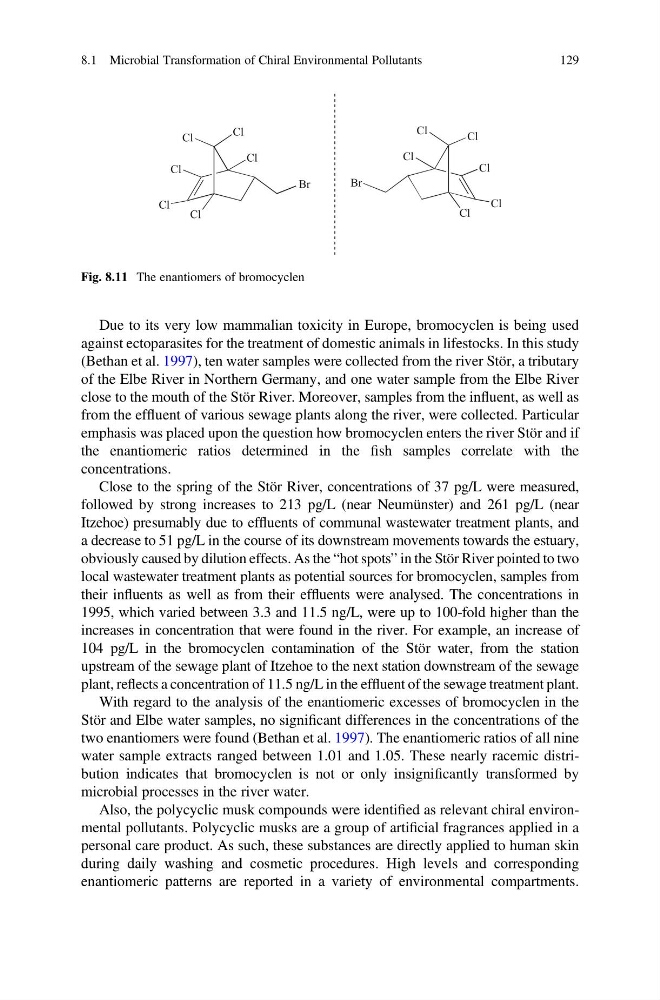
Due to its very low mammalian toxicity in Europe, bromocyclen is being used
against ectoparasites for the treatment of domestic animals in lifestocks. In this study
(Bethan et al. 1997), ten water samples were collected from the river Stör, a tributary
of the Elbe River in Northern Germany, and one water sample from the Elbe River
close to the mouth of the Stör River. Moreover, samples from the influent, as well as
from the effluent of various sewage plants along the river, were collected. Particular
emphasis was placed upon the question how bromocyclen enters the river Stör and if
the enantiomeric ratios determined in the fish samples correlate with the
concentrations.
Close to the spring of the Stör River, concentrations of 37 pg/L were measured,
followed by strong increases to 213 pg/L (near Neumünster) and 261 pg/L (near
Itzehoe) presumably due to effluents of communal wastewater treatment plants, and
a decrease to 51 pg/L in the course of its downstream movements towards the estuary,
obviously caused by dilution effects. As the “hot spots” in the Stör River pointed to two
local wastewater treatment plants as potential sources for bromocyclen, samples from
their influents as well as from their effluents were analysed. The concentrations in
1995, which varied between 3.3 and 11.5 ng/L, were up to 100-fold higher than the
increases in concentration that were found in the river. For example, an increase of
104 pg/L in the bromocyclen contamination of the Stör water, from the station
upstream of the sewage plant of Itzehoe to the next station downstream of the sewage
plant, reflects a concentration of 11.5 ng/L in the effluent of the sewage treatment plant.
With regard to the analysis of the enantiomeric excesses of bromocyclen in the
Stör and Elbe water samples, no significant differences in the concentrations of the
two enantiomers were found (Bethan et al. 1997). The enantiomeric ratios of all nine
water sample extracts ranged between 1.01 and 1.05. These nearly racemic distribution indicates that bromocyclen is not or only insignificantly transformed by
microbial processes in the river water.
Also, the polycyclic musk compounds were identified as relevant chiral environmental pollutants. Polycyclic musks are a group of artificial fragrances applied in a
personal care product. As such, these substances are directly applied to human skin
during daily washing and cosmetic procedures. High levels and corresponding
enantiomeric patterns are reported in a variety of environmental compartments.
Cl
Cl
Cl
Cl
Cl
Cl
Br
Cl
Cl
Cl
Cl
Cl
Cl
Br
Fig. 8.11 The enantiomers of bromocyclen
8.1 Microbial Transformation of Chiral Environmental Pollutants
129
against ectoparasites for the treatment of domestic animals in lifestocks. In this study
(Bethan et al. 1997), ten water samples were collected from the river Stör, a tributary
of the Elbe River in Northern Germany, and one water sample from the Elbe River
close to the mouth of the Stör River. Moreover, samples from the influent, as well as
from the effluent of various sewage plants along the river, were collected. Particular
emphasis was placed upon the question how bromocyclen enters the river Stör and if
the enantiomeric ratios determined in the fish samples correlate with the
concentrations.
Close to the spring of the Stör River, concentrations of 37 pg/L were measured,
followed by strong increases to 213 pg/L (near Neumünster) and 261 pg/L (near
Itzehoe) presumably due to effluents of communal wastewater treatment plants, and
a decrease to 51 pg/L in the course of its downstream movements towards the estuary,
obviously caused by dilution effects. As the “hot spots” in the Stör River pointed to two
local wastewater treatment plants as potential sources for bromocyclen, samples from
their influents as well as from their effluents were analysed. The concentrations in
1995, which varied between 3.3 and 11.5 ng/L, were up to 100-fold higher than the
increases in concentration that were found in the river. For example, an increase of
104 pg/L in the bromocyclen contamination of the Stör water, from the station
upstream of the sewage plant of Itzehoe to the next station downstream of the sewage
plant, reflects a concentration of 11.5 ng/L in the effluent of the sewage treatment plant.
With regard to the analysis of the enantiomeric excesses of bromocyclen in the
Stör and Elbe water samples, no significant differences in the concentrations of the
two enantiomers were found (Bethan et al. 1997). The enantiomeric ratios of all nine
water sample extracts ranged between 1.01 and 1.05. These nearly racemic distribution indicates that bromocyclen is not or only insignificantly transformed by
microbial processes in the river water.
Also, the polycyclic musk compounds were identified as relevant chiral environmental pollutants. Polycyclic musks are a group of artificial fragrances applied in a
personal care product. As such, these substances are directly applied to human skin
during daily washing and cosmetic procedures. High levels and corresponding
enantiomeric patterns are reported in a variety of environmental compartments.
Cl
Cl
Cl
Cl
Cl
Cl
Br
Cl
Cl
Cl
Cl
Cl
Cl
Br
Fig. 8.11 The enantiomers of bromocyclen
8.1 Microbial Transformation of Chiral Environmental Pollutants
129