

422
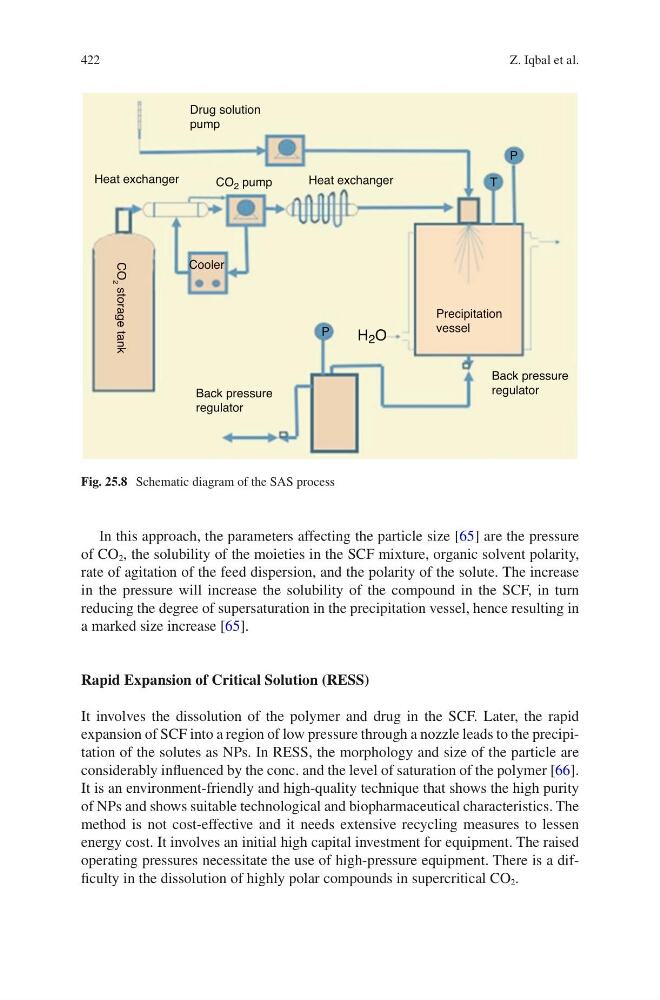
In this approach, the parameters affecting the particle size [65] are the pressure
of CO 2 , the solubility of the moieties in the SCF mixture, organic solvent polarity,
rate of agitation of the feed dispersion, and the polarity of the solute. The increase
in the pressure will increase the solubility of the compound in the SCF, in turn
reducing the degree of supersaturation in the precipitation vessel, hence resulting in
a marked size increase [65].
Rapid Expansion of Critical Solution (RESS)
It involves the dissolution of the polymer and drug in the SCF. Later, the rapid
expansion of SCF into a region of low pressure through a nozzle leads to the precipitation of the solutes as NPs. In RESS, the morphology and size of the particle are
considerably influenced by the conc. and the level of saturation of the polymer [66].
It is an environment-friendly and high-quality technique that shows the high purity
of NPs and shows suitable technological and biopharmaceutical characteristics. The
method is not cost-effective and it needs extensive recycling measures to lessen
energy cost. It involves an initial high capital investment for equipment. The raised
operating pressures necessitate the use of high-pressure equipment. There is a difficulty in the dissolution of highly polar compounds in supercritical CO 2 .
Drug solution
pump
Heat exchanger
Cooler
Heat exchanger
CO 2 pump
Precipitation
vessel
Back pressure
regulator
Back pressure
regulator
H 2 O
CO 2 storage tank
P
T
P
Fig. 25.8 Schematic diagram of the SAS process
Z. Iqbal et al.
In this approach, the parameters affecting the particle size [65] are the pressure
of CO 2 , the solubility of the moieties in the SCF mixture, organic solvent polarity,
rate of agitation of the feed dispersion, and the polarity of the solute. The increase
in the pressure will increase the solubility of the compound in the SCF, in turn
reducing the degree of supersaturation in the precipitation vessel, hence resulting in
a marked size increase [65].
Rapid Expansion of Critical Solution (RESS)
It involves the dissolution of the polymer and drug in the SCF. Later, the rapid
expansion of SCF into a region of low pressure through a nozzle leads to the precipitation of the solutes as NPs. In RESS, the morphology and size of the particle are
considerably influenced by the conc. and the level of saturation of the polymer [66].
It is an environment-friendly and high-quality technique that shows the high purity
of NPs and shows suitable technological and biopharmaceutical characteristics. The
method is not cost-effective and it needs extensive recycling measures to lessen
energy cost. It involves an initial high capital investment for equipment. The raised
operating pressures necessitate the use of high-pressure equipment. There is a difficulty in the dissolution of highly polar compounds in supercritical CO 2 .
Drug solution
pump
Heat exchanger
Cooler
Heat exchanger
CO 2 pump
Precipitation
vessel
Back pressure
regulator
Back pressure
regulator
H 2 O
CO 2 storage tank
P
T
P
Fig. 25.8 Schematic diagram of the SAS process
Z. Iqbal et al.