

369
Major Sources of Parabens
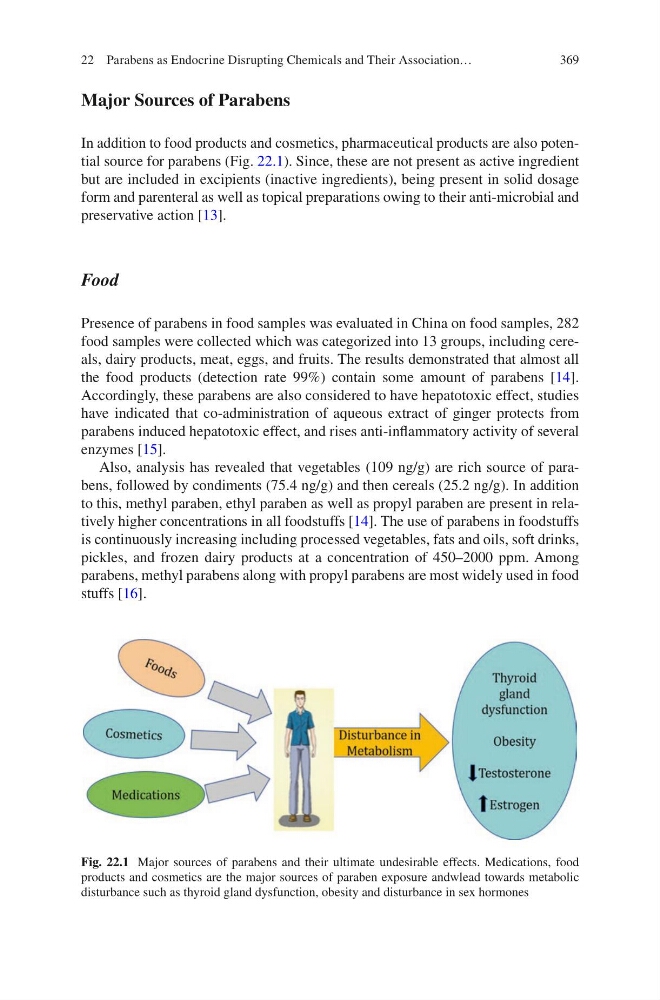
In addition to food products and cosmetics, pharmaceutical products are also potential source for parabens (Fig. 22.1). Since, these are not present as active ingredient
but are included in excipients (inactive ingredients), being present in solid dosage
form and parenteral as well as topical preparations owing to their anti-microbial and
preservative action [13].
Food
Presence of parabens in food samples was evaluated in China on food samples, 282
food samples were collected which was categorized into 13 groups, including cereals, dairy products, meat, eggs, and fruits. The results demonstrated that almost all
the food products (detection rate 99%) contain some amount of parabens [14].
Accordingly, these parabens are also considered to have hepatotoxic effect, studies
have indicated that co-administration of aqueous extract of ginger protects from
parabens induced hepatotoxic effect, and rises anti-inflammatory activity of several
enzymes [15].
Also, analysis has revealed that vegetables (109 ng/g) are rich source of parabens, followed by condiments (75.4 ng/g) and then cereals (25.2 ng/g). In addition
to this, methyl paraben, ethyl paraben as well as propyl paraben are present in relatively higher concentrations in all foodstuffs [14]. The use of parabens in foodstuffs
is continuously increasing including processed vegetables, fats and oils, soft drinks,
pickles, and frozen dairy products at a concentration of 450–2000 ppm. Among
parabens, methyl parabens along with propyl parabens are most widely used in food
stuffs [16].
Fig. 22.1 Major sources of parabens and their ultimate undesirable effects. Medications, food
products and cosmetics are the major sources of paraben exposure andwlead towards metabolic
disturbance such as thyroid gland dysfunction, obesity and disturbance in sex hormones
22 Parabens as Endocrine Disrupting Chemicals and Their Association…
Major Sources of Parabens
In addition to food products and cosmetics, pharmaceutical products are also potential source for parabens (Fig. 22.1). Since, these are not present as active ingredient
but are included in excipients (inactive ingredients), being present in solid dosage
form and parenteral as well as topical preparations owing to their anti-microbial and
preservative action [13].
Food
Presence of parabens in food samples was evaluated in China on food samples, 282
food samples were collected which was categorized into 13 groups, including cereals, dairy products, meat, eggs, and fruits. The results demonstrated that almost all
the food products (detection rate 99%) contain some amount of parabens [14].
Accordingly, these parabens are also considered to have hepatotoxic effect, studies
have indicated that co-administration of aqueous extract of ginger protects from
parabens induced hepatotoxic effect, and rises anti-inflammatory activity of several
enzymes [15].
Also, analysis has revealed that vegetables (109 ng/g) are rich source of parabens, followed by condiments (75.4 ng/g) and then cereals (25.2 ng/g). In addition
to this, methyl paraben, ethyl paraben as well as propyl paraben are present in relatively higher concentrations in all foodstuffs [14]. The use of parabens in foodstuffs
is continuously increasing including processed vegetables, fats and oils, soft drinks,
pickles, and frozen dairy products at a concentration of 450–2000 ppm. Among
parabens, methyl parabens along with propyl parabens are most widely used in food
stuffs [16].
Fig. 22.1 Major sources of parabens and their ultimate undesirable effects. Medications, food
products and cosmetics are the major sources of paraben exposure andwlead towards metabolic
disturbance such as thyroid gland dysfunction, obesity and disturbance in sex hormones
22 Parabens as Endocrine Disrupting Chemicals and Their Association…