

332
years. Around 20% of children [3–17] are obsessed and are increasing in faster rate
in western countries and in the USA. The neonatal and in utero period are the more
sensitive time period for obesogens [64].
Mechanisms of Action of Obesogenic EDCs
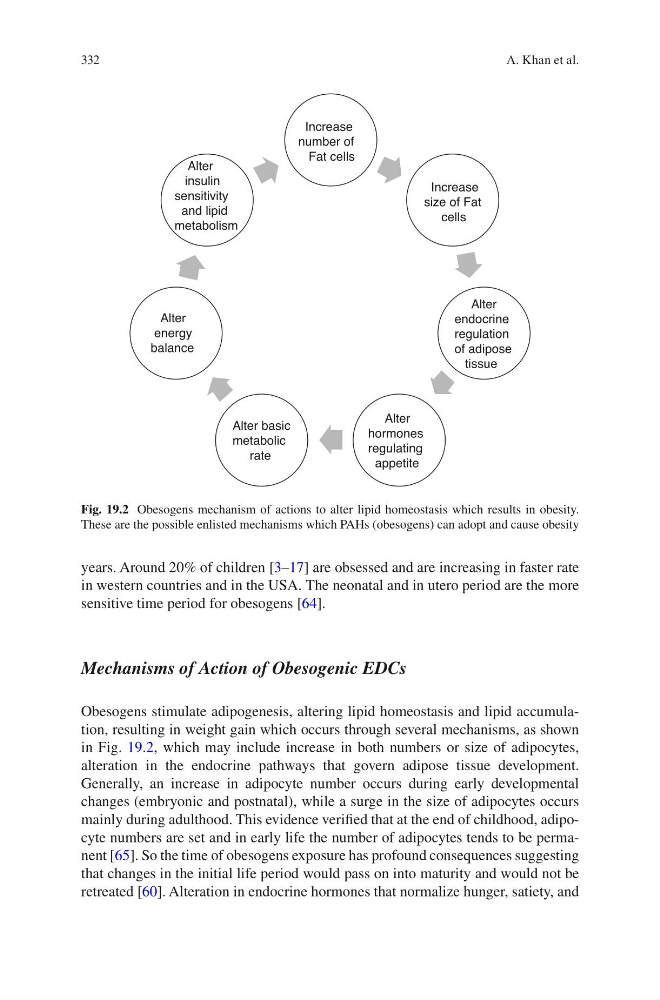
Obesogens stimulate adipogenesis, altering lipid homeostasis and lipid accumulation, resulting in weight gain which occurs through several mechanisms, as shown
in Fig. 19.2, which may include increase in both numbers or size of adipocytes,
alteration in the endocrine pathways that govern adipose tissue development.
Generally, an increase in adipocyte number occurs during early developmental
changes (embryonic and postnatal), while a surge in the size of adipocytes occurs
mainly during adulthood. This evidence verified that at the end of childhood, adipocyte numbers are set and in early life the number of adipocytes tends to be permanent [65]. So the time of obesogens exposure has profound consequences suggesting
that changes in the initial life period would pass on into maturity and would not be
retreated [60]. Alteration in endocrine hormones that normalize hunger, satiety, and
Increase
number of
Fat cells
Increase
size of Fat
cells
Alter
insulin
sensitivity
and lipid
metabolism
Alter
energy
balance
Alter
endocrine
regulation
of adipose
tissue
Alter basic
metabolic
rate
Alter
hormones
regulating
appetite
Fig. 19.2 Obesogens mechanism of actions to alter lipid homeostasis which results in obesity.
These are the possible enlisted mechanisms which PAHs (obesogens) can adopt and cause obesity
A. Khan et al.
years. Around 20% of children [3–17] are obsessed and are increasing in faster rate
in western countries and in the USA. The neonatal and in utero period are the more
sensitive time period for obesogens [64].
Mechanisms of Action of Obesogenic EDCs
Obesogens stimulate adipogenesis, altering lipid homeostasis and lipid accumulation, resulting in weight gain which occurs through several mechanisms, as shown
in Fig. 19.2, which may include increase in both numbers or size of adipocytes,
alteration in the endocrine pathways that govern adipose tissue development.
Generally, an increase in adipocyte number occurs during early developmental
changes (embryonic and postnatal), while a surge in the size of adipocytes occurs
mainly during adulthood. This evidence verified that at the end of childhood, adipocyte numbers are set and in early life the number of adipocytes tends to be permanent [65]. So the time of obesogens exposure has profound consequences suggesting
that changes in the initial life period would pass on into maturity and would not be
retreated [60]. Alteration in endocrine hormones that normalize hunger, satiety, and
Increase
number of
Fat cells
Increase
size of Fat
cells
Alter
insulin
sensitivity
and lipid
metabolism
Alter
energy
balance
Alter
endocrine
regulation
of adipose
tissue
Alter basic
metabolic
rate
Alter
hormones
regulating
appetite
Fig. 19.2 Obesogens mechanism of actions to alter lipid homeostasis which results in obesity.
These are the possible enlisted mechanisms which PAHs (obesogens) can adopt and cause obesity
A. Khan et al.