

326
Environmental Polycyclic Aromatic Hydrocarbons (ePAH)
PAHs related with environmental media such as particulate matters, water, sediment, and soil are named as environmental PAHs (ePAHs), which can be divided by
various methods including their sources or forms, natural hazardous effects, communal influences, and biological tests used to identify and quantify them [8].
Hundreds of PAHs are present in the environment which mostly occurs as a mixture
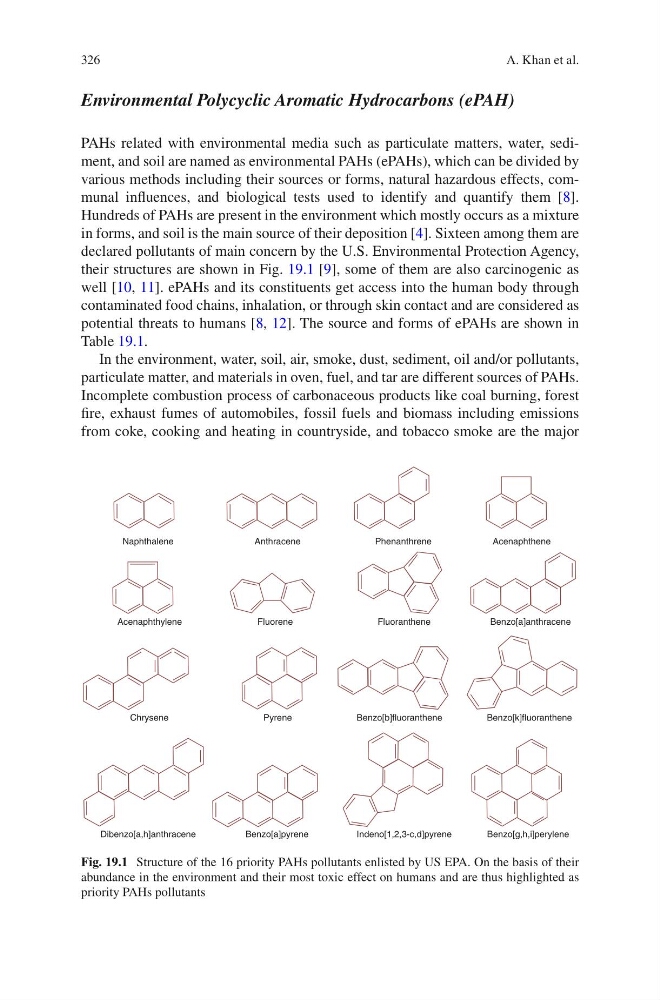
in forms, and soil is the main source of their deposition [4]. Sixteen among them are
declared pollutants of main concern by the U.S. Environmental Protection Agency,
their structures are shown in Fig. 19.1 [9], some of them are also carcinogenic as
well [10, 11]. ePAHs and its constituents get access into the human body through
contaminated food chains, inhalation, or through skin contact and are considered as
potential threats to humans [8, 12]. The source and forms of ePAHs are shown in
Table 19.1.
In the environment, water, soil, air, smoke, dust, sediment, oil and/or pollutants,
particulate matter, and materials in oven, fuel, and tar are different sources of PAHs.
Incomplete combustion process of carbonaceous products like coal burning, forest
fire, exhaust fumes of automobiles, fossil fuels and biomass including emissions
from coke, cooking and heating in countryside, and tobacco smoke are the major
Acenaphthene
Acenaphthylene
Fluorene
Fluoranthene
Benzo[a]anthracene
Chrysene
Pyrene
Benzo[b]fluoranthene
Benzo[a]pyrene
Benzo[k]fluoranthene
Dibenzo[a,h]anthracene
Indeno[1,2,3-c,d]pyrene
Benzo[g,h,i]perylene
Naphthalene
Anthracene
Phenanthrene
Fig. 19.1 Structure of the 16 priority PAHs pollutants enlisted by US EPA. On the basis of their
abundance in the environment and their most toxic effect on humans and are thus highlighted as
priority PAHs pollutants
A. Khan et al.
Environmental Polycyclic Aromatic Hydrocarbons (ePAH)
PAHs related with environmental media such as particulate matters, water, sediment, and soil are named as environmental PAHs (ePAHs), which can be divided by
various methods including their sources or forms, natural hazardous effects, communal influences, and biological tests used to identify and quantify them [8].
Hundreds of PAHs are present in the environment which mostly occurs as a mixture
in forms, and soil is the main source of their deposition [4]. Sixteen among them are
declared pollutants of main concern by the U.S. Environmental Protection Agency,
their structures are shown in Fig. 19.1 [9], some of them are also carcinogenic as
well [10, 11]. ePAHs and its constituents get access into the human body through
contaminated food chains, inhalation, or through skin contact and are considered as
potential threats to humans [8, 12]. The source and forms of ePAHs are shown in
Table 19.1.
In the environment, water, soil, air, smoke, dust, sediment, oil and/or pollutants,
particulate matter, and materials in oven, fuel, and tar are different sources of PAHs.
Incomplete combustion process of carbonaceous products like coal burning, forest
fire, exhaust fumes of automobiles, fossil fuels and biomass including emissions
from coke, cooking and heating in countryside, and tobacco smoke are the major
Acenaphthene
Acenaphthylene
Fluorene
Fluoranthene
Benzo[a]anthracene
Chrysene
Pyrene
Benzo[b]fluoranthene
Benzo[a]pyrene
Benzo[k]fluoranthene
Dibenzo[a,h]anthracene
Indeno[1,2,3-c,d]pyrene
Benzo[g,h,i]perylene
Naphthalene
Anthracene
Phenanthrene
Fig. 19.1 Structure of the 16 priority PAHs pollutants enlisted by US EPA. On the basis of their
abundance in the environment and their most toxic effect on humans and are thus highlighted as
priority PAHs pollutants
A. Khan et al.