

245
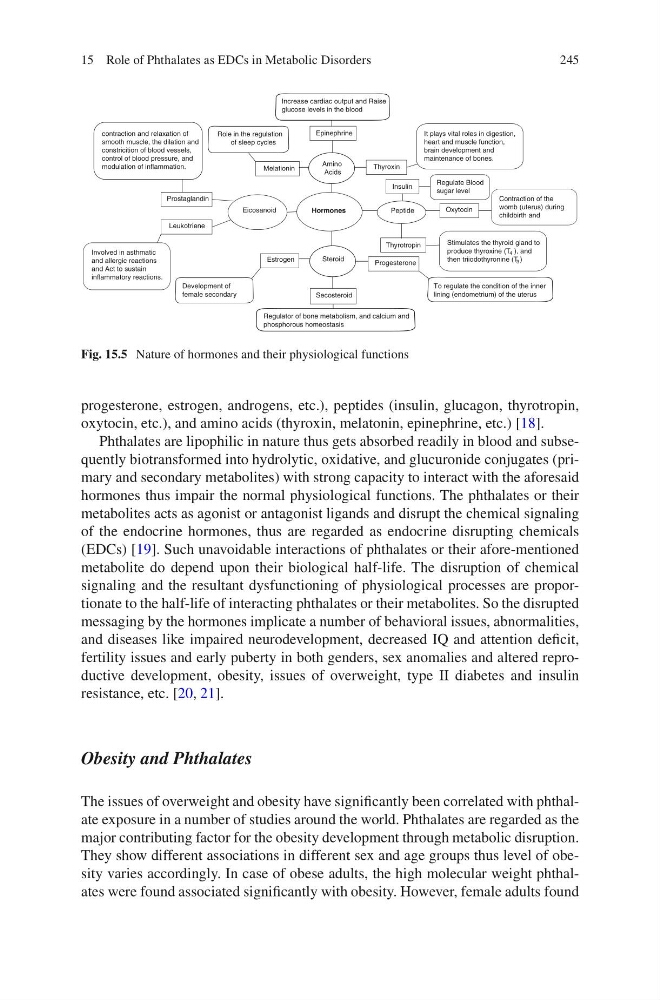
progesterone, estrogen, androgens, etc.), peptides (insulin, glucagon, thyrotropin,
oxytocin, etc.), and amino acids (thyroxin, melatonin, epinephrine, etc.) [18].
Phthalates are lipophilic in nature thus gets absorbed readily in blood and subsequently biotransformed into hydrolytic, oxidative, and glucuronide conjugates (primary and secondary metabolites) with strong capacity to interact with the aforesaid
hormones thus impair the normal physiological functions. The phthalates or their
metabolites acts as agonist or antagonist ligands and disrupt the chemical signaling
of the endocrine hormones, thus are regarded as endocrine disrupting chemicals
(EDCs) [19]. Such unavoidable interactions of phthalates or their afore-mentioned
metabolite do depend upon their biological half-life. The disruption of chemical
signaling and the resultant dysfunctioning of physiological processes are proportionate to the half-life of interacting phthalates or their metabolites. So the disrupted
messaging by the hormones implicate a number of behavioral issues, abnormalities,
and diseases like impaired neurodevelopment, decreased IQ and attention deficit,
fertility issues and early puberty in both genders, sex anomalies and altered reproductive development, obesity, issues of overweight, type II diabetes and insulin
resistance, etc. [20, 21].
Obesity and Phthalates
The issues of overweight and obesity have significantly been correlated with phthalate exposure in a number of studies around the world. Phthalates are regarded as the
major contributing factor for the obesity development through metabolic disruption.
They show different associations in different sex and age groups thus level of obesity varies accordingly. In case of obese adults, the high molecular weight phthalates were found associated significantly with obesity. However, female adults found
contraction and relaxation of
smooth muscle, the dilation and
constricition of blood vessels,
control of blood pressure, and
modulation of inflammation.
Increase cardiac output and Raise
glucose levels in the blood
Role in the regulation
of sleep cycles
Epinephrine
It plays vital roles in digestion,
heart and muscle function,
brain development and
maintenance of bones.
Melationin
Amino
Acids
Thyroxin
Prostaglandin
Leukotriene
Eicosanoid
Hormones
Insulin
Regulate Blood
sugar level
Contraction of the
womb (uterus) during
childbirth and
Peptide
Involved in asthmatic
and allergic reactions
and Act to sustain
inflammatory reactions.
Development of
female secondary
Estrogen
Steroid
Secosteroid
Thyrotropin
Progesterone
Oxytocin
Stimulates the thyroid gland to
produce thyroxine (T ), and
then triiodothyronine (T )
4
3
Regulator of bone metabolism, and calcium and
phosphorous homeostasis
To regulate the condition of the inner
lining (endometrium) of the uterus
Fig. 15.5 Nature of hormones and their physiological functions
15 Role of Phthalates as EDCs in Metabolic Disorders
progesterone, estrogen, androgens, etc.), peptides (insulin, glucagon, thyrotropin,
oxytocin, etc.), and amino acids (thyroxin, melatonin, epinephrine, etc.) [18].
Phthalates are lipophilic in nature thus gets absorbed readily in blood and subsequently biotransformed into hydrolytic, oxidative, and glucuronide conjugates (primary and secondary metabolites) with strong capacity to interact with the aforesaid
hormones thus impair the normal physiological functions. The phthalates or their
metabolites acts as agonist or antagonist ligands and disrupt the chemical signaling
of the endocrine hormones, thus are regarded as endocrine disrupting chemicals
(EDCs) [19]. Such unavoidable interactions of phthalates or their afore-mentioned
metabolite do depend upon their biological half-life. The disruption of chemical
signaling and the resultant dysfunctioning of physiological processes are proportionate to the half-life of interacting phthalates or their metabolites. So the disrupted
messaging by the hormones implicate a number of behavioral issues, abnormalities,
and diseases like impaired neurodevelopment, decreased IQ and attention deficit,
fertility issues and early puberty in both genders, sex anomalies and altered reproductive development, obesity, issues of overweight, type II diabetes and insulin
resistance, etc. [20, 21].
Obesity and Phthalates
The issues of overweight and obesity have significantly been correlated with phthalate exposure in a number of studies around the world. Phthalates are regarded as the
major contributing factor for the obesity development through metabolic disruption.
They show different associations in different sex and age groups thus level of obesity varies accordingly. In case of obese adults, the high molecular weight phthalates were found associated significantly with obesity. However, female adults found
contraction and relaxation of
smooth muscle, the dilation and
constricition of blood vessels,
control of blood pressure, and
modulation of inflammation.
Increase cardiac output and Raise
glucose levels in the blood
Role in the regulation
of sleep cycles
Epinephrine
It plays vital roles in digestion,
heart and muscle function,
brain development and
maintenance of bones.
Melationin
Amino
Acids
Thyroxin
Prostaglandin
Leukotriene
Eicosanoid
Hormones
Insulin
Regulate Blood
sugar level
Contraction of the
womb (uterus) during
childbirth and
Peptide
Involved in asthmatic
and allergic reactions
and Act to sustain
inflammatory reactions.
Development of
female secondary
Estrogen
Steroid
Secosteroid
Thyrotropin
Progesterone
Oxytocin
Stimulates the thyroid gland to
produce thyroxine (T ), and
then triiodothyronine (T )
4
3
Regulator of bone metabolism, and calcium and
phosphorous homeostasis
To regulate the condition of the inner
lining (endometrium) of the uterus
Fig. 15.5 Nature of hormones and their physiological functions
15 Role of Phthalates as EDCs in Metabolic Disorders