

242
The hand to mouth behavior of infants increases the risk of phthalates exposure
at the crucial phase of their growth and development. The fetuses and neonates are
prone to severe toxicity of phthalates as they have the potential to cross placenta [8].
Different countries allow different permissible limits of phthalates in various products; the WHO allows DEHP 8 μg/L in drinking water while it should not exceed
6 μg/L in the USA. Urine is used as main biomonitoring source for the analyses of
phthalates/metabolites as biomarker of type of phthalate exposure. However, various studies have also used other body fluids like serum, ovarian follicular fluid,
semen, breast milk, amniotic fluid, and saliva for the assessment of various phthalates in human body. The body burden of phthalates is expressed in standard units as
μg/Kg (body weight)/d (day) [9].
A recent study on fast food consumers (N = 8877) in the USA presented a vivid
picture of the frightening higher levels of DINP (39%) and DEHP (23.8%), phthalate metabolites in urine samples [10]. According to another study, adults in the USA
on average take nine phthalates in range of 0.673 for DEHP and 0.004 μg/Kg body
weight/d for DMP [11]. In one such study in China, 14 phthalate metabolites were
detected in urine samples with concentration ranging from 18.6 to 3160 ng/mL. The
monophthalates of diethylhexyl, isobutyl, and butyl phthalates were detected as the
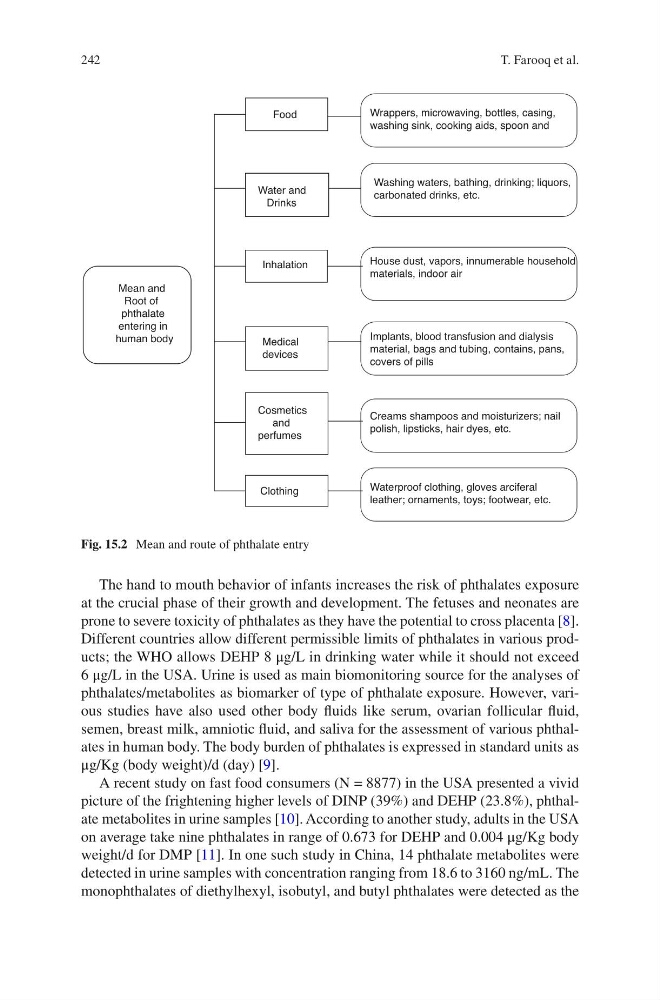
Mean and
Root of
phthalate
entering in
human body
Food
Wrappers, microwaving, bottles, casing,
washing sink, cooking aids, spoon and
Washing waters, bathing, drinking; liquors,
carbonated drinks, etc.
House dust, vapors, innumerable household
materials, indoor air
Implants, blood transfusion and dialysis
material, bags and tubing, contains, pans,
covers of pills
Creams shampoos and moisturizers; nail
polish, lipsticks, hair dyes, etc.
Waterproof clothing, gloves arciferal
leather; ornaments, toys; footwear, etc.
Water and
Drinks
Inhalation
Medical
devices
Cosmetics
and
perfumes
Clothing
Fig. 15.2 Mean and route of phthalate entry
T. Farooq et al.
The hand to mouth behavior of infants increases the risk of phthalates exposure
at the crucial phase of their growth and development. The fetuses and neonates are
prone to severe toxicity of phthalates as they have the potential to cross placenta [8].
Different countries allow different permissible limits of phthalates in various products; the WHO allows DEHP 8 μg/L in drinking water while it should not exceed
6 μg/L in the USA. Urine is used as main biomonitoring source for the analyses of
phthalates/metabolites as biomarker of type of phthalate exposure. However, various studies have also used other body fluids like serum, ovarian follicular fluid,
semen, breast milk, amniotic fluid, and saliva for the assessment of various phthalates in human body. The body burden of phthalates is expressed in standard units as
μg/Kg (body weight)/d (day) [9].
A recent study on fast food consumers (N = 8877) in the USA presented a vivid
picture of the frightening higher levels of DINP (39%) and DEHP (23.8%), phthalate metabolites in urine samples [10]. According to another study, adults in the USA
on average take nine phthalates in range of 0.673 for DEHP and 0.004 μg/Kg body
weight/d for DMP [11]. In one such study in China, 14 phthalate metabolites were
detected in urine samples with concentration ranging from 18.6 to 3160 ng/mL. The
monophthalates of diethylhexyl, isobutyl, and butyl phthalates were detected as the
Mean and
Root of
phthalate
entering in
human body
Food
Wrappers, microwaving, bottles, casing,
washing sink, cooking aids, spoon and
Washing waters, bathing, drinking; liquors,
carbonated drinks, etc.
House dust, vapors, innumerable household
materials, indoor air
Implants, blood transfusion and dialysis
material, bags and tubing, contains, pans,
covers of pills
Creams shampoos and moisturizers; nail
polish, lipsticks, hair dyes, etc.
Waterproof clothing, gloves arciferal
leather; ornaments, toys; footwear, etc.
Water and
Drinks
Inhalation
Medical
devices
Cosmetics
and
perfumes
Clothing
Fig. 15.2 Mean and route of phthalate entry
T. Farooq et al.