

231
FR in many products [80], thus there is a great possibility TBBPA may contaminate
the environment. TBBPA induces oxidative stress, as reported recently, which may
lead to apoptosis in zebrafish embryos and larvae [81], while some other studies
reported hepatotoxicity by the creation of reactive oxygen species (ROS) [82]. A
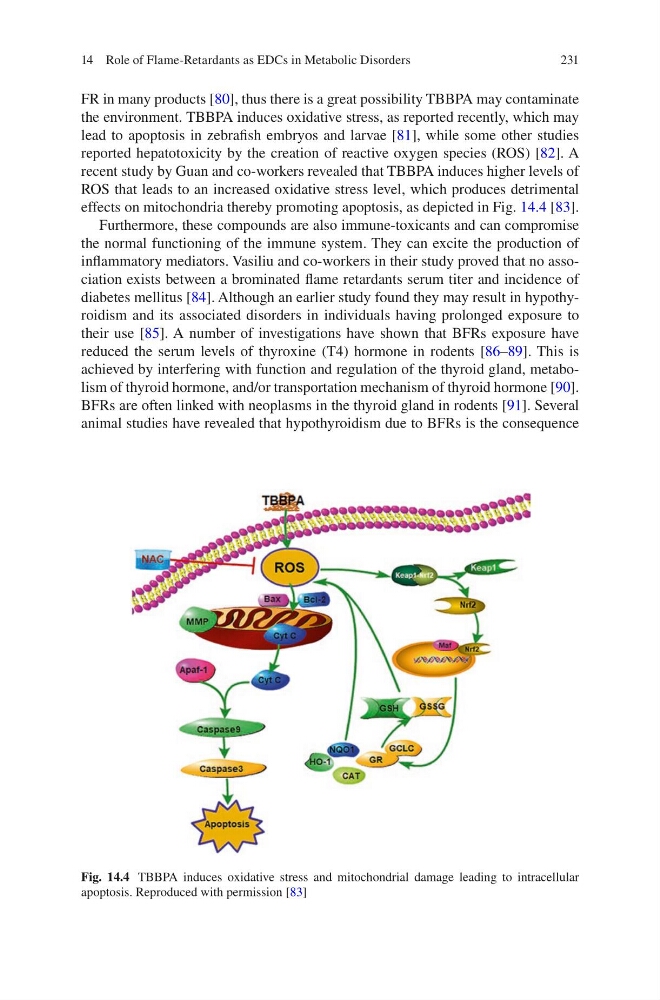
recent study by Guan and co-workers revealed that TBBPA induces higher levels of
ROS that leads to an increased oxidative stress level, which produces detrimental
effects on mitochondria thereby promoting apoptosis, as depicted in Fig. 14.4 [83].
Furthermore, these compounds are also immune-toxicants and can compromise
the normal functioning of the immune system. They can excite the production of
inflammatory mediators. Vasiliu and co-workers in their study proved that no association exists between a brominated flame retardants serum titer and incidence of
diabetes mellitus [84]. Although an earlier study found they may result in hypothyroidism and its associated disorders in individuals having prolonged exposure to
their use [85]. A number of investigations have shown that BFRs exposure have
reduced the serum levels of thyroxine (T4) hormone in rodents [86–89]. This is
achieved by interfering with function and regulation of the thyroid gland, metabolism of thyroid hormone, and/or transportation mechanism of thyroid hormone [90].
BFRs are often linked with neoplasms in the thyroid gland in rodents [91]. Several
animal studies have revealed that hypothyroidism due to BFRs is the consequence
Fig. 14.4 TBBPA induces oxidative stress and mitochondrial damage leading to intracellular
apoptosis. Reproduced with permission [83]
14 Role of Flame-Retardants as EDCs in Metabolic Disorders
FR in many products [80], thus there is a great possibility TBBPA may contaminate
the environment. TBBPA induces oxidative stress, as reported recently, which may
lead to apoptosis in zebrafish embryos and larvae [81], while some other studies
reported hepatotoxicity by the creation of reactive oxygen species (ROS) [82]. A
recent study by Guan and co-workers revealed that TBBPA induces higher levels of
ROS that leads to an increased oxidative stress level, which produces detrimental
effects on mitochondria thereby promoting apoptosis, as depicted in Fig. 14.4 [83].
Furthermore, these compounds are also immune-toxicants and can compromise
the normal functioning of the immune system. They can excite the production of
inflammatory mediators. Vasiliu and co-workers in their study proved that no association exists between a brominated flame retardants serum titer and incidence of
diabetes mellitus [84]. Although an earlier study found they may result in hypothyroidism and its associated disorders in individuals having prolonged exposure to
their use [85]. A number of investigations have shown that BFRs exposure have
reduced the serum levels of thyroxine (T4) hormone in rodents [86–89]. This is
achieved by interfering with function and regulation of the thyroid gland, metabolism of thyroid hormone, and/or transportation mechanism of thyroid hormone [90].
BFRs are often linked with neoplasms in the thyroid gland in rodents [91]. Several
animal studies have revealed that hypothyroidism due to BFRs is the consequence
Fig. 14.4 TBBPA induces oxidative stress and mitochondrial damage leading to intracellular
apoptosis. Reproduced with permission [83]
14 Role of Flame-Retardants as EDCs in Metabolic Disorders