

206
6-bisphosphate is broken down to glyceraldehyde-3-phosphate (G-3-P) and dihydroxyacetone phosphate (DHAP), which is catalyzed by an enzyme aldolase. Then
fructose 1,6-bisphosphate passes by several series of chemical reactions and
conversion of phosphoenolpyruvate into pyruvate by utilizing an enzyme pyruvate
kinase [10].
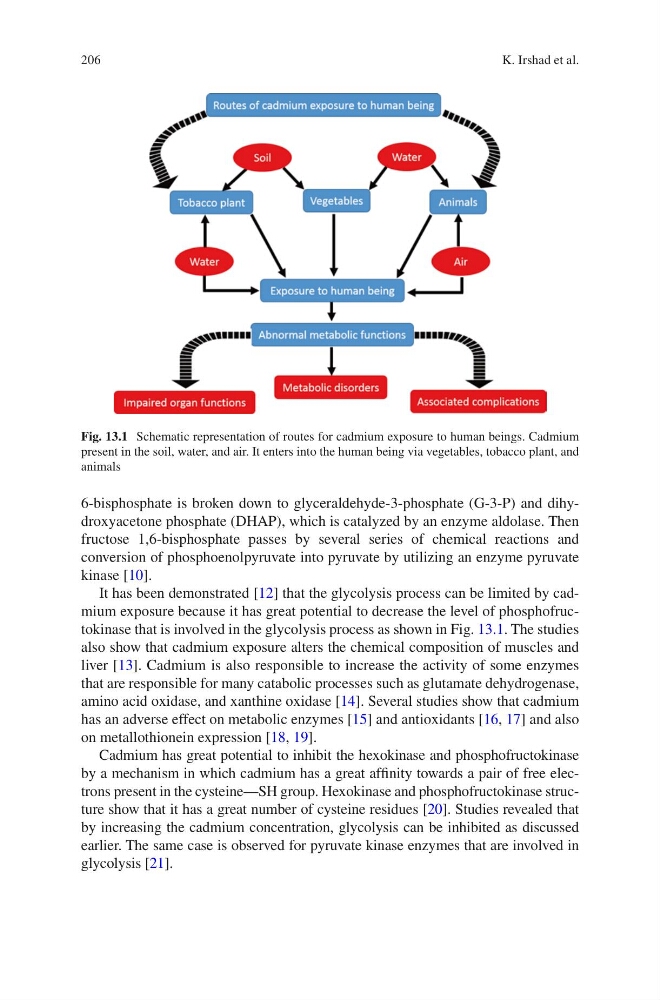
It has been demonstrated [12] that the glycolysis process can be limited by cadmium exposure because it has great potential to decrease the level of phosphofructokinase that is involved in the glycolysis process as shown in Fig. 13.1. The studies
also show that cadmium exposure alters the chemical composition of muscles and
liver [13]. Cadmium is also responsible to increase the activity of some enzymes
that are responsible for many catabolic processes such as glutamate dehydrogenase,
amino acid oxidase, and xanthine oxidase [14]. Several studies show that cadmium
has an adverse effect on metabolic enzymes [15] and antioxidants [16, 17] and also
on metallothionein expression [18, 19].
Cadmium has great potential to inhibit the hexokinase and phosphofructokinase
by a mechanism in which cadmium has a great affinity towards a pair of free electrons present in the cysteine—SH group. Hexokinase and phosphofructokinase structure show that it has a great number of cysteine residues [20]. Studies revealed that
by increasing the cadmium concentration, glycolysis can be inhibited as discussed
earlier. The same case is observed for pyruvate kinase enzymes that are involved in
glycolysis [21].
Fig. 13.1 Schematic representation of routes for cadmium exposure to human beings. Cadmium
present in the soil, water, and air. It enters into the human being via vegetables, tobacco plant, and
animals
K. Irshad et al.
6-bisphosphate is broken down to glyceraldehyde-3-phosphate (G-3-P) and dihydroxyacetone phosphate (DHAP), which is catalyzed by an enzyme aldolase. Then
fructose 1,6-bisphosphate passes by several series of chemical reactions and
conversion of phosphoenolpyruvate into pyruvate by utilizing an enzyme pyruvate
kinase [10].
It has been demonstrated [12] that the glycolysis process can be limited by cadmium exposure because it has great potential to decrease the level of phosphofructokinase that is involved in the glycolysis process as shown in Fig. 13.1. The studies
also show that cadmium exposure alters the chemical composition of muscles and
liver [13]. Cadmium is also responsible to increase the activity of some enzymes
that are responsible for many catabolic processes such as glutamate dehydrogenase,
amino acid oxidase, and xanthine oxidase [14]. Several studies show that cadmium
has an adverse effect on metabolic enzymes [15] and antioxidants [16, 17] and also
on metallothionein expression [18, 19].
Cadmium has great potential to inhibit the hexokinase and phosphofructokinase
by a mechanism in which cadmium has a great affinity towards a pair of free electrons present in the cysteine—SH group. Hexokinase and phosphofructokinase structure show that it has a great number of cysteine residues [20]. Studies revealed that
by increasing the cadmium concentration, glycolysis can be inhibited as discussed
earlier. The same case is observed for pyruvate kinase enzymes that are involved in
glycolysis [21].
Fig. 13.1 Schematic representation of routes for cadmium exposure to human beings. Cadmium
present in the soil, water, and air. It enters into the human being via vegetables, tobacco plant, and
animals
K. Irshad et al.