

189
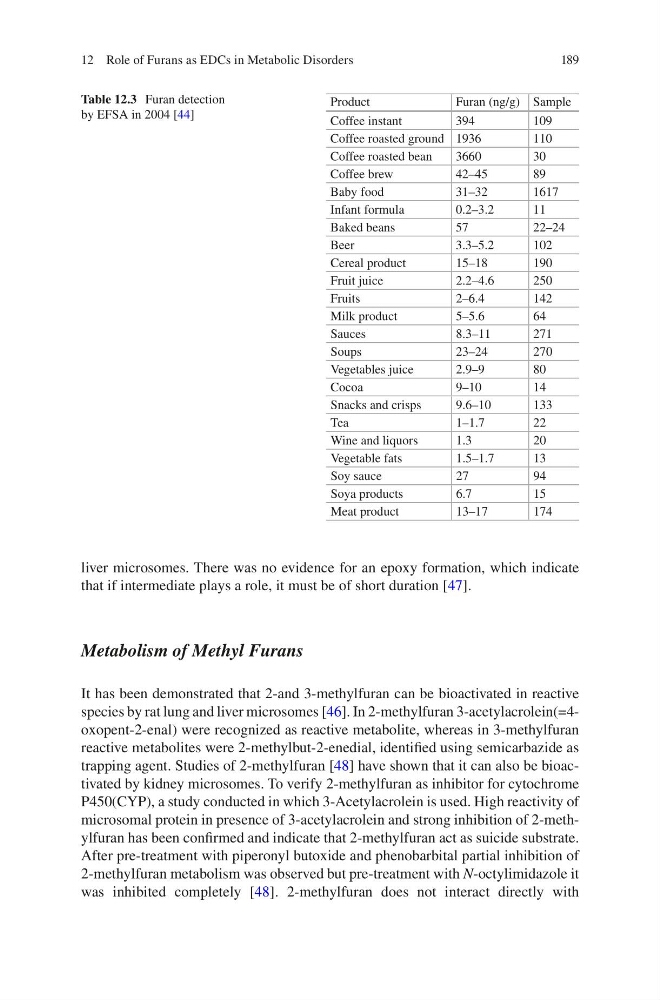
Table 12.3 Furan detection
by EFSA in 2004 [44]
Product
Furan (ng/g) Sample
Coffee instant
394
109
Coffee roasted ground 1936
110
Coffee roasted bean
3660
30
Coffee brew
42–45
89
Baby food
31–32
1617
Infant formula
0.2–3.2
11
Baked beans
57
22–24
Beer
3.3–5.2
102
Cereal product
15–18
190
Fruit juice
2.2–4.6
250
Fruits
2–6.4
142
Milk product
5–5.6
64
Sauces
8.3–11
271
Soups
23–24
270
Vegetables juice
2.9–9
80
Cocoa
9–10
14
Snacks and crisps
9.6–10
133
Tea
1–1.7
22
Wine and liquors
1.3
20
Vegetable fats
1.5–1.7
13
Soy sauce
27
94
Soya products
6.7
15
Meat product
13–17
174
liver microsomes. There was no evidence for an epoxy formation, which indicate
that if intermediate plays a role, it must be of short duration [47].
Metabolism of Methyl Furans
It has been demonstrated that 2-and 3-methylfuran can be bioactivated in reactive
species by rat lung and liver microsomes [46]. In 2-methylfuran 3-acetylacrolein(=4oxopent- 2-enal) were recognized as reactive metabolite, whereas in 3-methylfuran
reactive metabolites were 2-methylbut-2-enedial, identified using semicarbazide as
trapping agent. Studies of 2-methylfuran [48] have shown that it can also be bioactivated by kidney microsomes. To verify 2-methylfuran as inhibitor for cytochrome
P450(CYP), a study conducted in which 3-Acetylacrolein is used. High reactivity of
microsomal protein in presence of 3-acetylacrolein and strong inhibition of 2-methylfuran has been confirmed and indicate that 2-methylfuran act as suicide substrate.
After pre-treatment with piperonyl butoxide and phenobarbital partial inhibition of
2-methylfuran metabolism was observed but pre-treatment with N-octylimidazole it
was inhibited completely [48]. 2-methylfuran does not interact directly with
12 Role of Furans as EDCs in Metabolic Disorders
Table 12.3 Furan detection
by EFSA in 2004 [44]
Product
Furan (ng/g) Sample
Coffee instant
394
109
Coffee roasted ground 1936
110
Coffee roasted bean
3660
30
Coffee brew
42–45
89
Baby food
31–32
1617
Infant formula
0.2–3.2
11
Baked beans
57
22–24
Beer
3.3–5.2
102
Cereal product
15–18
190
Fruit juice
2.2–4.6
250
Fruits
2–6.4
142
Milk product
5–5.6
64
Sauces
8.3–11
271
Soups
23–24
270
Vegetables juice
2.9–9
80
Cocoa
9–10
14
Snacks and crisps
9.6–10
133
Tea
1–1.7
22
Wine and liquors
1.3
20
Vegetable fats
1.5–1.7
13
Soy sauce
27
94
Soya products
6.7
15
Meat product
13–17
174
liver microsomes. There was no evidence for an epoxy formation, which indicate
that if intermediate plays a role, it must be of short duration [47].
Metabolism of Methyl Furans
It has been demonstrated that 2-and 3-methylfuran can be bioactivated in reactive
species by rat lung and liver microsomes [46]. In 2-methylfuran 3-acetylacrolein(=4oxopent- 2-enal) were recognized as reactive metabolite, whereas in 3-methylfuran
reactive metabolites were 2-methylbut-2-enedial, identified using semicarbazide as
trapping agent. Studies of 2-methylfuran [48] have shown that it can also be bioactivated by kidney microsomes. To verify 2-methylfuran as inhibitor for cytochrome
P450(CYP), a study conducted in which 3-Acetylacrolein is used. High reactivity of
microsomal protein in presence of 3-acetylacrolein and strong inhibition of 2-methylfuran has been confirmed and indicate that 2-methylfuran act as suicide substrate.
After pre-treatment with piperonyl butoxide and phenobarbital partial inhibition of
2-methylfuran metabolism was observed but pre-treatment with N-octylimidazole it
was inhibited completely [48]. 2-methylfuran does not interact directly with
12 Role of Furans as EDCs in Metabolic Disorders