

167
Aroclor 1260 causes glucose tolerance, insulin resistance/sensitivity, adipokines,
pancreatic insulin secretion, and hepatic gluconeogenesis [61]. Intranasal exposure
encouraged insulin resistance in rats, hyperinsulinemia, and hypertriglyceridemia
together with increased oxidative stress on the islets of Langerhans [62].
Endocrine Metabolism
The underlying cause of the reproductive toxicities of PCBs is the alteration in the
hormonal levels or receptor affinities level. Decreased level of the hormone is due
to an increase in the metabolism of the steroids which are the normal substrate of
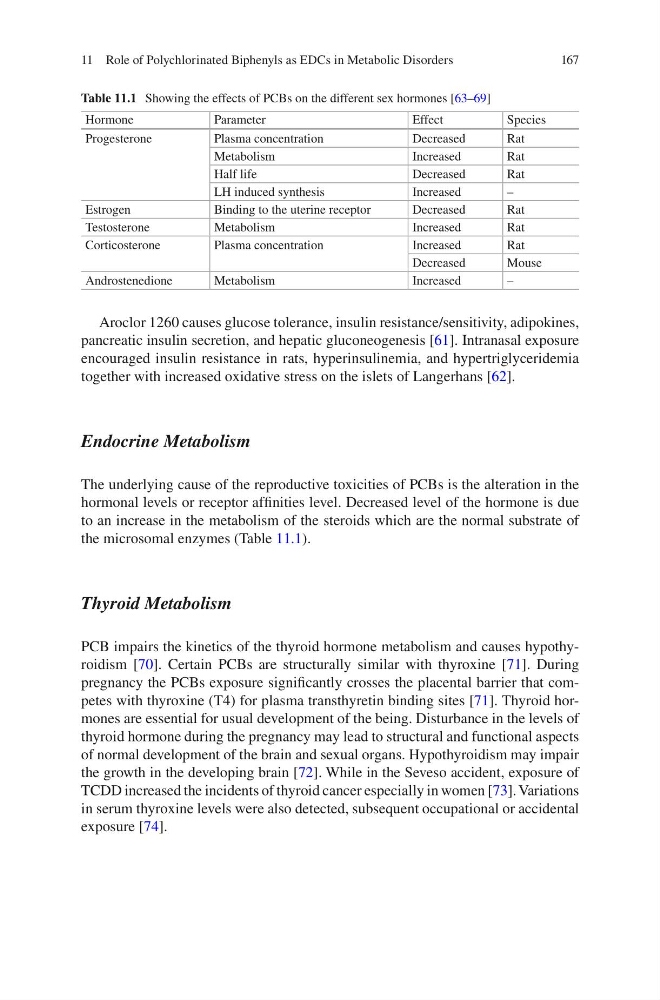
the microsomal enzymes (Table 11.1).
Thyroid Metabolism
PCB impairs the kinetics of the thyroid hormone metabolism and causes hypothyroidism [70]. Certain PCBs are structurally similar with thyroxine [71]. During
pregnancy the PCBs exposure significantly crosses the placental barrier that competes with thyroxine (T4) for plasma transthyretin binding sites [71]. Thyroid hormones are essential for usual development of the being. Disturbance in the levels of
thyroid hormone during the pregnancy may lead to structural and functional aspects
of normal development of the brain and sexual organs. Hypothyroidism may impair
the growth in the developing brain [72]. While in the Seveso accident, exposure of
TCDD increased the incidents of thyroid cancer especially in women [73]. Variations
in serum thyroxine levels were also detected, subsequent occupational or accidental
exposure [74].
Table 11.1 Showing the effects of PCBs on the different sex hormones [63–69]
Hormone
Parameter
Effect
Species
Progesterone
Plasma concentration
Decreased
Rat
Metabolism
Increased
Rat
Half life
Decreased
Rat
LH induced synthesis
Increased
–
Estrogen
Binding to the uterine receptor
Decreased
Rat
Testosterone
Metabolism
Increased
Rat
Corticosterone
Plasma concentration
Increased
Rat
Decreased
Mouse
Androstenedione
Metabolism
Increased
–
11 Role of Polychlorinated Biphenyls as EDCs in Metabolic Disorders
Aroclor 1260 causes glucose tolerance, insulin resistance/sensitivity, adipokines,
pancreatic insulin secretion, and hepatic gluconeogenesis [61]. Intranasal exposure
encouraged insulin resistance in rats, hyperinsulinemia, and hypertriglyceridemia
together with increased oxidative stress on the islets of Langerhans [62].
Endocrine Metabolism
The underlying cause of the reproductive toxicities of PCBs is the alteration in the
hormonal levels or receptor affinities level. Decreased level of the hormone is due
to an increase in the metabolism of the steroids which are the normal substrate of
the microsomal enzymes (Table 11.1).
Thyroid Metabolism
PCB impairs the kinetics of the thyroid hormone metabolism and causes hypothyroidism [70]. Certain PCBs are structurally similar with thyroxine [71]. During
pregnancy the PCBs exposure significantly crosses the placental barrier that competes with thyroxine (T4) for plasma transthyretin binding sites [71]. Thyroid hormones are essential for usual development of the being. Disturbance in the levels of
thyroid hormone during the pregnancy may lead to structural and functional aspects
of normal development of the brain and sexual organs. Hypothyroidism may impair
the growth in the developing brain [72]. While in the Seveso accident, exposure of
TCDD increased the incidents of thyroid cancer especially in women [73]. Variations
in serum thyroxine levels were also detected, subsequent occupational or accidental
exposure [74].
Table 11.1 Showing the effects of PCBs on the different sex hormones [63–69]
Hormone
Parameter
Effect
Species
Progesterone
Plasma concentration
Decreased
Rat
Metabolism
Increased
Rat
Half life
Decreased
Rat
LH induced synthesis
Increased
–
Estrogen
Binding to the uterine receptor
Decreased
Rat
Testosterone
Metabolism
Increased
Rat
Corticosterone
Plasma concentration
Increased
Rat
Decreased
Mouse
Androstenedione
Metabolism
Increased
–
11 Role of Polychlorinated Biphenyls as EDCs in Metabolic Disorders