

164
2,3,7,8-Tetrachlorodibenzo-p-dioxin (TCDD)
The most abundant PCB in the environment is TCDD. It is also composed of biphenyl aromatic rings along with four chlorine atoms attached to respective positions.
This is a by-product during organic synthesis and waste combustion. The intoxication of TCDD leads to several harmful effects, including severe skin lesions such
as chloracne, dehydration, weight loss, peripheral neuropathy, and hepatotoxicity
[8, 15]. Chronic intoxication by TCDD allegedly causes dyslipidemia, atherosclerosis, hypertension, diabetes, chronic liver disease, and various types of cancers
[16]. Moreover, TCDD is considered as a Group 1 carcinogen by IARC. A study
on the exposure of TCDD in humans showed increased plasma transaminases, steatosis, fibrosis, and inflammation, are associated with the steatohepatitis in some
individuals [8, 15].
Exposure of PCBs: Pharmacokinetics and Pharmacodynamics
Humans are exposed to PCBs by oral, inhalation, and skin routes. While PCBs are
readily absorbed, they have slow metabolism resulting in slow excretion. However,
they distribute and accumulate widely in the liver and muscle tissues. PCBs are
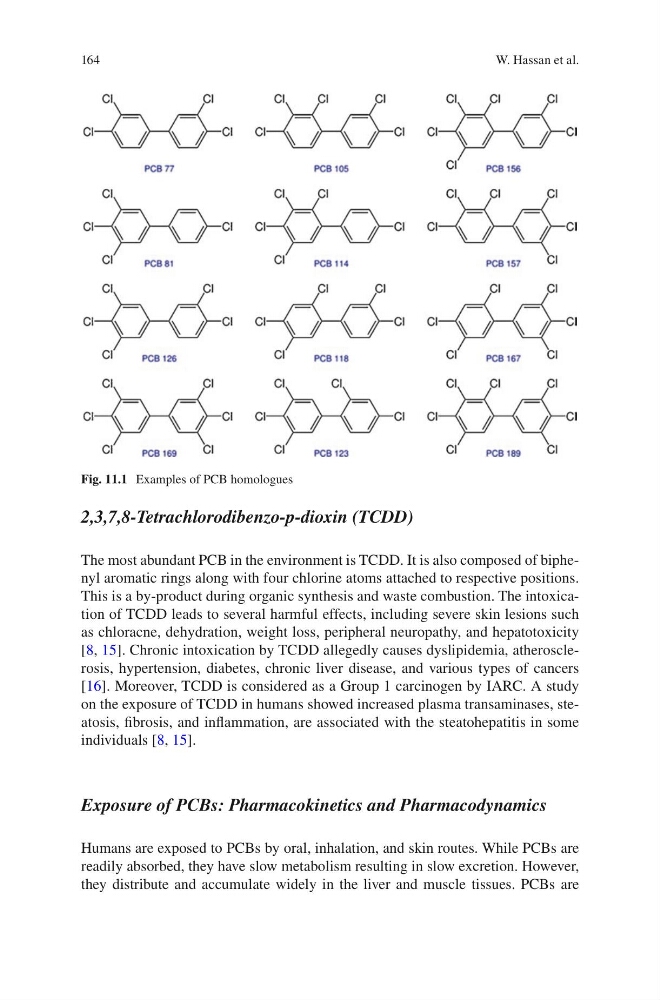
Fig. 11.1 Examples of PCB homologues
W. Hassan et al.
2,3,7,8-Tetrachlorodibenzo-p-dioxin (TCDD)
The most abundant PCB in the environment is TCDD. It is also composed of biphenyl aromatic rings along with four chlorine atoms attached to respective positions.
This is a by-product during organic synthesis and waste combustion. The intoxication of TCDD leads to several harmful effects, including severe skin lesions such
as chloracne, dehydration, weight loss, peripheral neuropathy, and hepatotoxicity
[8, 15]. Chronic intoxication by TCDD allegedly causes dyslipidemia, atherosclerosis, hypertension, diabetes, chronic liver disease, and various types of cancers
[16]. Moreover, TCDD is considered as a Group 1 carcinogen by IARC. A study
on the exposure of TCDD in humans showed increased plasma transaminases, steatosis, fibrosis, and inflammation, are associated with the steatohepatitis in some
individuals [8, 15].
Exposure of PCBs: Pharmacokinetics and Pharmacodynamics
Humans are exposed to PCBs by oral, inhalation, and skin routes. While PCBs are
readily absorbed, they have slow metabolism resulting in slow excretion. However,
they distribute and accumulate widely in the liver and muscle tissues. PCBs are
Fig. 11.1 Examples of PCB homologues
W. Hassan et al.