

154
epidemiological studies unveil the involvement of triclosan, PCBs, and perfluorooctanoic acid in rapidly growing obesity in children [45–47].
Route of Exposure of Endocrine Disrupting Chemicals
in Children
EDCs are predominately synthetic products that are extensively found in our food,
daily use products, and environment. Children are susceptible to EDCs in their early
life through breast milk consumption, placental transfer, and direct oral route [48].
Phthalates and BPA are vastly used as plasticizers to enhance durability of toys,
feeding bottles, and food containers resulting in the oral absorption of these chemicals. Whereas children are exposed to triclosan through dermal route as triclosan is
found in antimicrobial soaps and baby care products. Polychlorinated biphenyl and
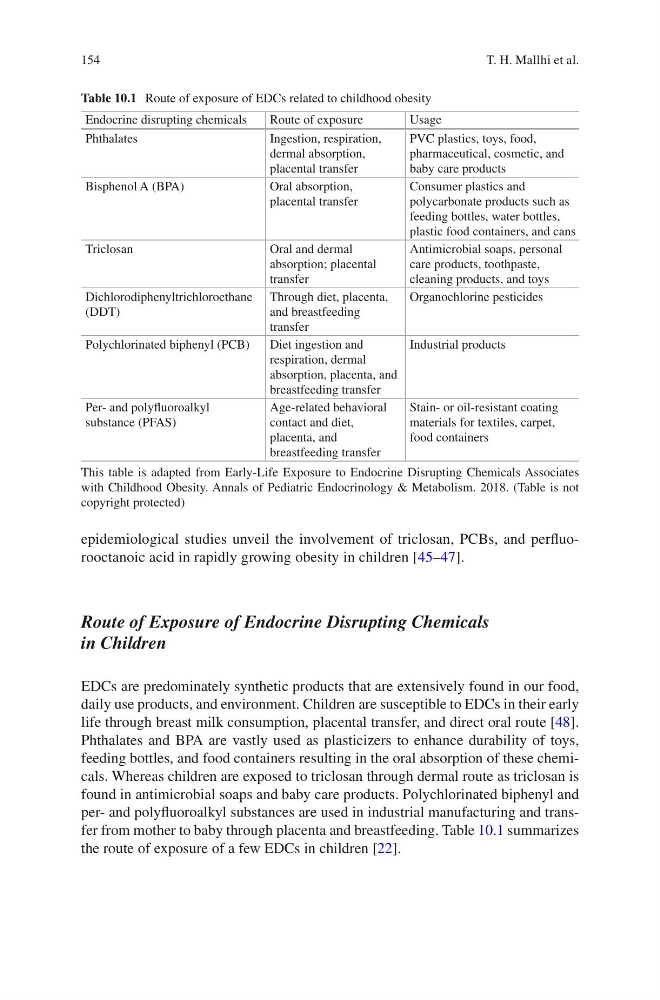
per- and polyfluoroalkyl substances are used in industrial manufacturing and transfer from mother to baby through placenta and breastfeeding. Table 10.1 summarizes
the route of exposure of a few EDCs in children [22].
Table 10.1 Route of exposure of EDCs related to childhood obesity
Endocrine disrupting chemicals
Route of exposure
Usage
Phthalates
Ingestion, respiration,
dermal absorption,
placental transfer
PVC plastics, toys, food,
pharmaceutical, cosmetic, and
baby care products
Bisphenol A (BPA)
Oral absorption,
placental transfer
Consumer plastics and
polycarbonate products such as
feeding bottles, water bottles,
plastic food containers, and cans
Triclosan
Oral and dermal
absorption; placental
transfer
Antimicrobial soaps, personal
care products, toothpaste,
cleaning products, and toys
Dichlorodiphenyltrichloroethane
(DDT)
Through diet, placenta,
and breastfeeding
transfer
Organochlorine pesticides
Polychlorinated biphenyl (PCB)
Diet ingestion and
respiration, dermal
absorption, placenta, and
breastfeeding transfer
Industrial products
Per- and polyfluoroalkyl
substance (PFAS)
Age-related behavioral
contact and diet,
placenta, and
breastfeeding transfer
Stain- or oil-resistant coating
materials for textiles, carpet,
food containers
This table is adapted from Early-Life Exposure to Endocrine Disrupting Chemicals Associates
with Childhood Obesity. Annals of Pediatric Endocrinology & Metabolism. 2018. (Table is not
copyright protected)
T. H. Mallhi et al.
epidemiological studies unveil the involvement of triclosan, PCBs, and perfluorooctanoic acid in rapidly growing obesity in children [45–47].
Route of Exposure of Endocrine Disrupting Chemicals
in Children
EDCs are predominately synthetic products that are extensively found in our food,
daily use products, and environment. Children are susceptible to EDCs in their early
life through breast milk consumption, placental transfer, and direct oral route [48].
Phthalates and BPA are vastly used as plasticizers to enhance durability of toys,
feeding bottles, and food containers resulting in the oral absorption of these chemicals. Whereas children are exposed to triclosan through dermal route as triclosan is
found in antimicrobial soaps and baby care products. Polychlorinated biphenyl and
per- and polyfluoroalkyl substances are used in industrial manufacturing and transfer from mother to baby through placenta and breastfeeding. Table 10.1 summarizes
the route of exposure of a few EDCs in children [22].
Table 10.1 Route of exposure of EDCs related to childhood obesity
Endocrine disrupting chemicals
Route of exposure
Usage
Phthalates
Ingestion, respiration,
dermal absorption,
placental transfer
PVC plastics, toys, food,
pharmaceutical, cosmetic, and
baby care products
Bisphenol A (BPA)
Oral absorption,
placental transfer
Consumer plastics and
polycarbonate products such as
feeding bottles, water bottles,
plastic food containers, and cans
Triclosan
Oral and dermal
absorption; placental
transfer
Antimicrobial soaps, personal
care products, toothpaste,
cleaning products, and toys
Dichlorodiphenyltrichloroethane
(DDT)
Through diet, placenta,
and breastfeeding
transfer
Organochlorine pesticides
Polychlorinated biphenyl (PCB)
Diet ingestion and
respiration, dermal
absorption, placenta, and
breastfeeding transfer
Industrial products
Per- and polyfluoroalkyl
substance (PFAS)
Age-related behavioral
contact and diet,
placenta, and
breastfeeding transfer
Stain- or oil-resistant coating
materials for textiles, carpet,
food containers
This table is adapted from Early-Life Exposure to Endocrine Disrupting Chemicals Associates
with Childhood Obesity. Annals of Pediatric Endocrinology & Metabolism. 2018. (Table is not
copyright protected)
T. H. Mallhi et al.