

104
carboxy kinase (PEPCK), the enzyme that catalyses the rate-limiting step of
glucose production and pyruvate carboxylase, an enzyme involved in the bioconversion of pyruvate to oxaloacetate. Thyroid hormones also decrease the
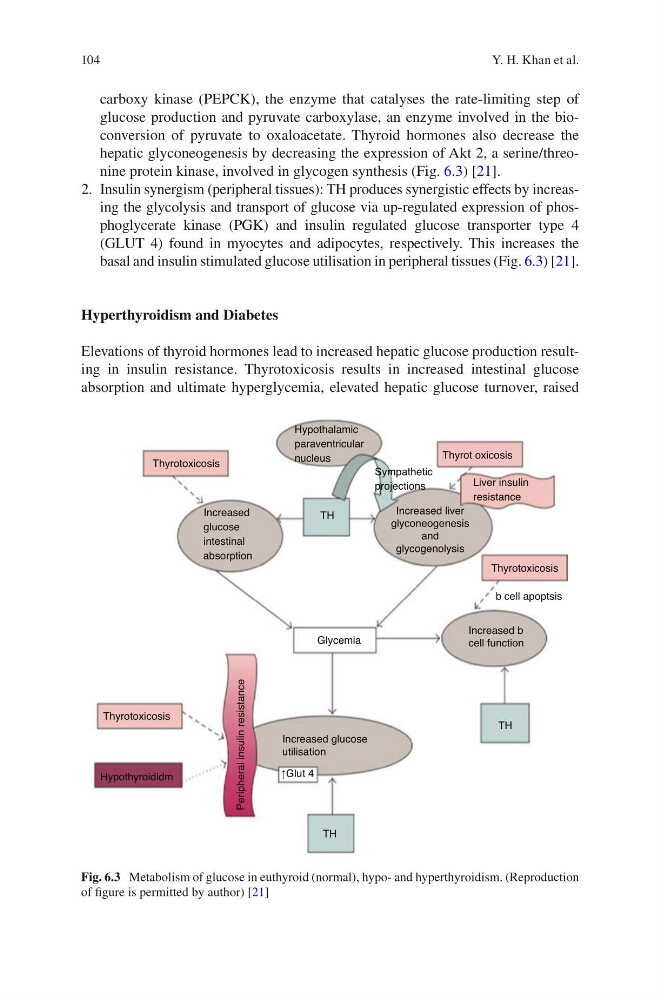
hepatic glyconeogenesis by decreasing the expression of Akt 2, a serine/threonine protein kinase, involved in glycogen synthesis (Fig. 6.3) [21].
2. Insulin synergism (peripheral tissues): TH produces synergistic effects by increasing the glycolysis and transport of glucose via up-regulated expression of phosphoglycerate kinase (PGK) and insulin regulated glucose transporter type 4
(GLUT 4) found in myocytes and adipocytes, respectively. This increases the
basal and insulin stimulated glucose utilisation in peripheral tissues (Fig. 6.3) [21].
Hyperthyroidism and Diabetes
Elevations of thyroid hormones lead to increased hepatic glucose production resulting in insulin resistance. Thyrotoxicosis results in increased intestinal glucose
absorption and ultimate hyperglycemia, elevated hepatic glucose turnover, raised
Thyrotoxicosis
Increased
glucose
intestinal
absorption
Thyrotoxicosis
Hypothyroididm
Increased glucose
utilisation
TH
TH
Glycemia
Thyrotoxicosis
TH
Hypothalamic
paraventricular
nucleus
Thyrot oxicosis
Liver insulin
resistance
Peripheral insulin resistance
Sympathetic
projections
Increased liver
glyconeogenesis
and
glycogenolysis
Increased b
cell function
b cell apoptsis
↑Glut 4
Fig. 6.3 Metabolism of glucose in euthyroid (normal), hypo- and hyperthyroidism. (Reproduction
of figure is permitted by author) [21]
Y. H. Khan et al.
carboxy kinase (PEPCK), the enzyme that catalyses the rate-limiting step of
glucose production and pyruvate carboxylase, an enzyme involved in the bioconversion of pyruvate to oxaloacetate. Thyroid hormones also decrease the
hepatic glyconeogenesis by decreasing the expression of Akt 2, a serine/threonine protein kinase, involved in glycogen synthesis (Fig. 6.3) [21].
2. Insulin synergism (peripheral tissues): TH produces synergistic effects by increasing the glycolysis and transport of glucose via up-regulated expression of phosphoglycerate kinase (PGK) and insulin regulated glucose transporter type 4
(GLUT 4) found in myocytes and adipocytes, respectively. This increases the
basal and insulin stimulated glucose utilisation in peripheral tissues (Fig. 6.3) [21].
Hyperthyroidism and Diabetes
Elevations of thyroid hormones lead to increased hepatic glucose production resulting in insulin resistance. Thyrotoxicosis results in increased intestinal glucose
absorption and ultimate hyperglycemia, elevated hepatic glucose turnover, raised
Thyrotoxicosis
Increased
glucose
intestinal
absorption
Thyrotoxicosis
Hypothyroididm
Increased glucose
utilisation
TH
TH
Glycemia
Thyrotoxicosis
TH
Hypothalamic
paraventricular
nucleus
Thyrot oxicosis
Liver insulin
resistance
Peripheral insulin resistance
Sympathetic
projections
Increased liver
glyconeogenesis
and
glycogenolysis
Increased b
cell function
b cell apoptsis
↑Glut 4
Fig. 6.3 Metabolism of glucose in euthyroid (normal), hypo- and hyperthyroidism. (Reproduction
of figure is permitted by author) [21]
Y. H. Khan et al.