

97
The plasma iodide ions are transported to the lumen of thyrocytes with the help
of two transporters: Na
+
/I
−
symporters (NIS) located at basolateral surface and an
I
−
/Cl
−
transporter located at apical membranes of thyrocytes. An enzyme named as
thyro-peroxidase catalyses the oxidation of iodide ions into elementary iodine and
incorporation of oxidised ions to thyroglobulin (a glycoprotein, synthesized in thyroid glands). Hydrogen peroxide (H 2 O 2 ) acts as an oxidising agent in this process.
The iodination of tyrosine residues of thyroglobulin results in the formation of
mono-iodotyrosine (MIT) and di-iodotyrosine (DIT). The coupling of MIT and DIT
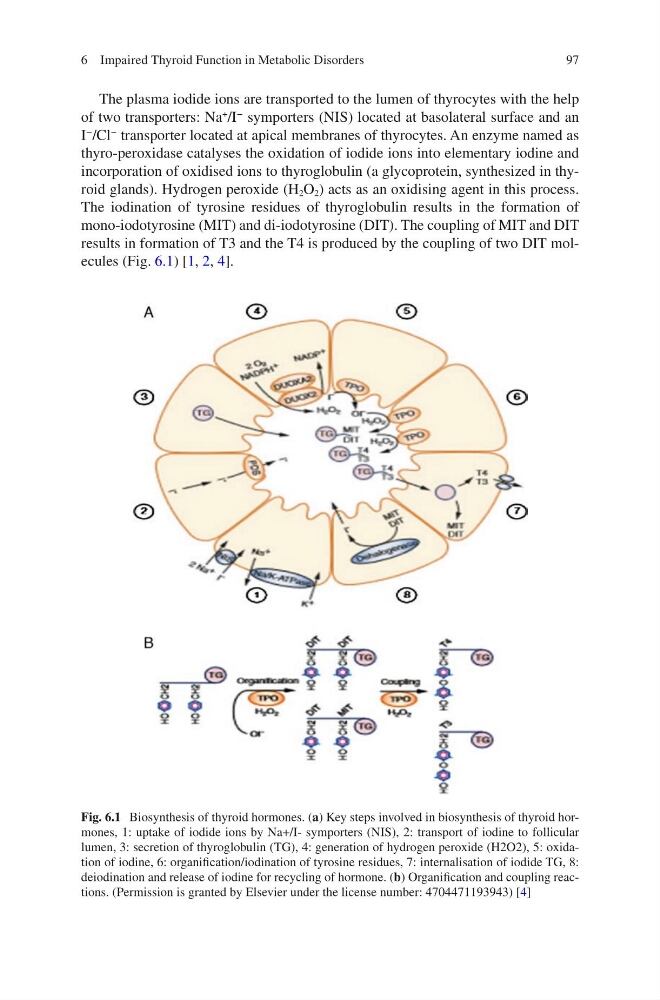
results in formation of T3 and the T4 is produced by the coupling of two DIT molecules (Fig. 6.1) [1, 2, 4].
Fig. 6.1 Biosynthesis of thyroid hormones. (a) Key steps involved in biosynthesis of thyroid hormones, 1: uptake of iodide ions by Na+/I- symporters (NIS), 2: transport of iodine to follicular
lumen, 3: secretion of thyroglobulin (TG), 4: generation of hydrogen peroxide (H2O2), 5: oxidation of iodine, 6: organification/iodination of tyrosine residues, 7: internalisation of iodide TG, 8:
deiodination and release of iodine for recycling of hormone. (b) Organification and coupling reactions. (Permission is granted by Elsevier under the license number: 4704471193943) [4]
6 Impaired Thyroid Function in Metabolic Disorders
The plasma iodide ions are transported to the lumen of thyrocytes with the help
of two transporters: Na
+
/I
−
symporters (NIS) located at basolateral surface and an
I
−
/Cl
−
transporter located at apical membranes of thyrocytes. An enzyme named as
thyro-peroxidase catalyses the oxidation of iodide ions into elementary iodine and
incorporation of oxidised ions to thyroglobulin (a glycoprotein, synthesized in thyroid glands). Hydrogen peroxide (H 2 O 2 ) acts as an oxidising agent in this process.
The iodination of tyrosine residues of thyroglobulin results in the formation of
mono-iodotyrosine (MIT) and di-iodotyrosine (DIT). The coupling of MIT and DIT
results in formation of T3 and the T4 is produced by the coupling of two DIT molecules (Fig. 6.1) [1, 2, 4].
Fig. 6.1 Biosynthesis of thyroid hormones. (a) Key steps involved in biosynthesis of thyroid hormones, 1: uptake of iodide ions by Na+/I- symporters (NIS), 2: transport of iodine to follicular
lumen, 3: secretion of thyroglobulin (TG), 4: generation of hydrogen peroxide (H2O2), 5: oxidation of iodine, 6: organification/iodination of tyrosine residues, 7: internalisation of iodide TG, 8:
deiodination and release of iodine for recycling of hormone. (b) Organification and coupling reactions. (Permission is granted by Elsevier under the license number: 4704471193943) [4]
6 Impaired Thyroid Function in Metabolic Disorders