

materials. Spodic materials are evidenced by acidic conditions (pH 5.9); organic C levels exceeding 0.6%; strong,
reddish hues, cementation by Al and organic C (optional);
10% or more cracked coatings on sand grains; an optical
density of the oxalate extract (ODOE) greater than or equal
to 0.25 (and twice that or more of an overlying eluvial
horizon); and Al + ½ Fe ratio of 0.50 or more (and twice or
more of that of an overlying eluvial horizon). Spodic horizons in Table 5.2 are highlighted in bold face. Most Spodosols have an albic (E) from which Fe, Al, and OC have
been leached; and many Spodosols in the Great Lakes region
have additional diagnostic subsurface horizons, such as a
fragipan (designated by an x), ortstein (cemented by Fe
and/or Al and OC; designed by an m), an argillic horizon
(Bt), and a glossic horizon (indicated by E/B, B/E, etc.). For
example, the Munising pedon in Table 5.2 contains five
diagnostic horizons, including an ochric horizon (A and E),
an albic horizon (E), a spodic horizon (Bhs and Bs), a
fragipan (Bx1, Ex, Bx2), and an argillic horizon (Bt).
5.4
Inceptisols
Inceptisols are the third most common soil order in the
GLCZ. They are most common on Lakes Erie, Ontario, and
Superior, but also occur around Lakes Michigan and Huron.
The majority (62%) of Inceptisols in the GLCZ are poorly
drained Aquepts, with Udepts accounting for the remaining
38%. The dominant great groups include Endoaquepts
(29%), Eutrudepts (21%), Epiaquepts (18%), Humaquepts
(14%), and Dystrudepts (13%) (Table 4.1).
The most common Endoaquepts re the Canandaigua,
Fredon, Toledo, Ensley, Lamson, Angelica, and Sanilac soil
series. The Gay (Aeric) and Minocqua (Typic) are depicted
in Fig. 5.12. The Gay soil series (Fig. 5.12a) has formed
from loamy till and contains 8 in. (20 cm) of black Oe and
Oa and dark brown A horizons, a 3 in. (7.5 cm) light gray E
horizon, and a brown Bw horizon to 22 in. (56 cm). The
Minocqua soil series (Fig. 5.12b) is derived from silt-loam
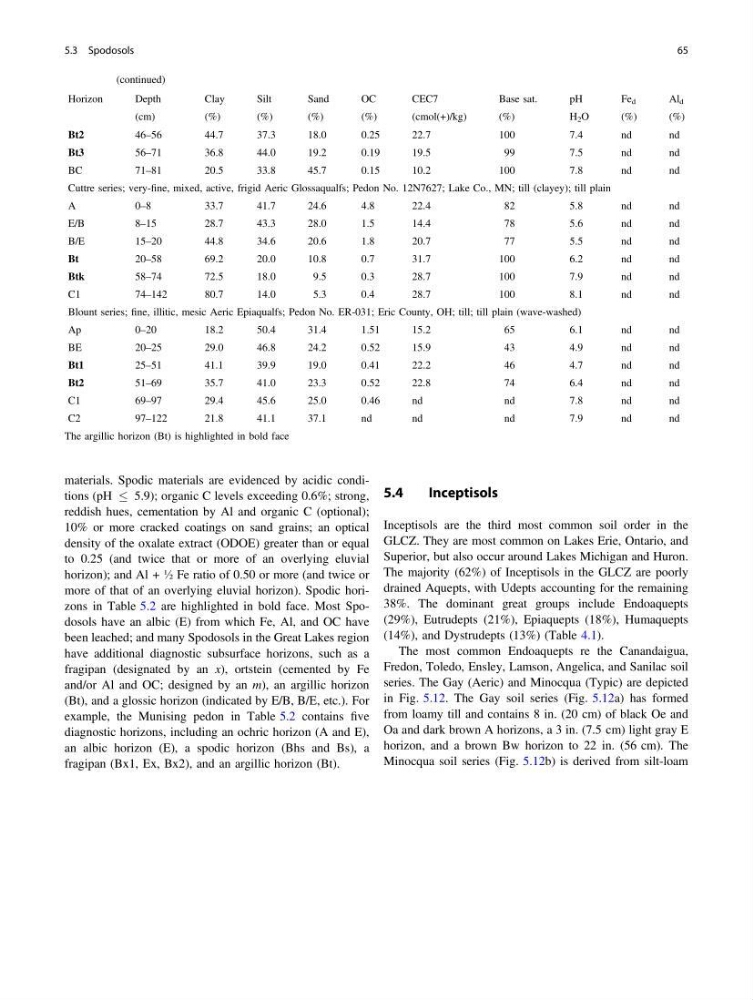
Table 5.1 (continued)
Horizon
Depth
Clay
Silt
Sand
OC
CEC7
Base sat.
pH
Fe d
Al d
(cm)
(%)
(%)
(%)
(%)
(cmol(+)/kg)
(%)
H 2 O
(%)
(%)
Bt2
46–56
44.7
37.3
18.0
0.25
22.7
100
7.4
nd
nd
Bt3
56–71
36.8
44.0
19.2
0.19
19.5
99
7.5
nd
nd
BC
71–81
20.5
33.8
45.7
0.15
10.2
100
7.8
nd
nd
Cuttre series; very-fine, mixed, active, frigid Aeric Glossaqualfs; Pedon No. 12N7627; Lake Co., MN; till (clayey); till plain
A
0 –8
33.7
41.7
24.6
4.8
22.4
82
5.8
nd
nd
E/B
8–15
28.7
43.3
28.0
1.5
14.4
78
5.6
nd
nd
B/E
15–20
44.8
34.6
20.6
1.8
20.7
77
5.5
nd
nd
Bt
20–58
69.2
20.0
10.8
0.7
31.7
100
6.2
nd
nd
Btk
58–74
72.5
18.0
9.5
0.3
28.7
100
7.9
nd
nd
C1
74–142
80.7
14.0
5.3
0.4
28.7
100
8.1
nd
nd
Blount series; fine, illitic, mesic Aeric Epiaqualfs; Pedon No. ER-031; Eric County, OH; till; till plain (wave-washed)
Ap
0–20
18.2
50.4
31.4
1.51
15.2
65
6.1
nd
nd
BE
20–25
29.0
46.8
24.2
0.52
15.9
43
4.9
nd
nd
Bt1
25–51
41.1
39.9
19.0
0.41
22.2
46
4.7
nd
nd
Bt2
51–69
35.7
41.0
23.3
0.52
22.8
74
6.4
nd
nd
C1
69–97
29.4
45.6
25.0
0.46
nd
nd
7.8
nd
nd
C2
97–122
21.8
41.1
37.1
nd
nd
nd
7.9
nd
nd
The argillic horizon (Bt) is highlighted in bold face
5.3 Spodosols
65
reddish hues, cementation by Al and organic C (optional);
10% or more cracked coatings on sand grains; an optical
density of the oxalate extract (ODOE) greater than or equal
to 0.25 (and twice that or more of an overlying eluvial
horizon); and Al + ½ Fe ratio of 0.50 or more (and twice or
more of that of an overlying eluvial horizon). Spodic horizons in Table 5.2 are highlighted in bold face. Most Spodosols have an albic (E) from which Fe, Al, and OC have
been leached; and many Spodosols in the Great Lakes region
have additional diagnostic subsurface horizons, such as a
fragipan (designated by an x), ortstein (cemented by Fe
and/or Al and OC; designed by an m), an argillic horizon
(Bt), and a glossic horizon (indicated by E/B, B/E, etc.). For
example, the Munising pedon in Table 5.2 contains five
diagnostic horizons, including an ochric horizon (A and E),
an albic horizon (E), a spodic horizon (Bhs and Bs), a
fragipan (Bx1, Ex, Bx2), and an argillic horizon (Bt).
5.4
Inceptisols
Inceptisols are the third most common soil order in the
GLCZ. They are most common on Lakes Erie, Ontario, and
Superior, but also occur around Lakes Michigan and Huron.
The majority (62%) of Inceptisols in the GLCZ are poorly
drained Aquepts, with Udepts accounting for the remaining
38%. The dominant great groups include Endoaquepts
(29%), Eutrudepts (21%), Epiaquepts (18%), Humaquepts
(14%), and Dystrudepts (13%) (Table 4.1).
The most common Endoaquepts re the Canandaigua,
Fredon, Toledo, Ensley, Lamson, Angelica, and Sanilac soil
series. The Gay (Aeric) and Minocqua (Typic) are depicted
in Fig. 5.12. The Gay soil series (Fig. 5.12a) has formed
from loamy till and contains 8 in. (20 cm) of black Oe and
Oa and dark brown A horizons, a 3 in. (7.5 cm) light gray E
horizon, and a brown Bw horizon to 22 in. (56 cm). The
Minocqua soil series (Fig. 5.12b) is derived from silt-loam
Table 5.1 (continued)
Horizon
Depth
Clay
Silt
Sand
OC
CEC7
Base sat.
pH
Fe d
Al d
(cm)
(%)
(%)
(%)
(%)
(cmol(+)/kg)
(%)
H 2 O
(%)
(%)
Bt2
46–56
44.7
37.3
18.0
0.25
22.7
100
7.4
nd
nd
Bt3
56–71
36.8
44.0
19.2
0.19
19.5
99
7.5
nd
nd
BC
71–81
20.5
33.8
45.7
0.15
10.2
100
7.8
nd
nd
Cuttre series; very-fine, mixed, active, frigid Aeric Glossaqualfs; Pedon No. 12N7627; Lake Co., MN; till (clayey); till plain
A
0 –8
33.7
41.7
24.6
4.8
22.4
82
5.8
nd
nd
E/B
8–15
28.7
43.3
28.0
1.5
14.4
78
5.6
nd
nd
B/E
15–20
44.8
34.6
20.6
1.8
20.7
77
5.5
nd
nd
Bt
20–58
69.2
20.0
10.8
0.7
31.7
100
6.2
nd
nd
Btk
58–74
72.5
18.0
9.5
0.3
28.7
100
7.9
nd
nd
C1
74–142
80.7
14.0
5.3
0.4
28.7
100
8.1
nd
nd
Blount series; fine, illitic, mesic Aeric Epiaqualfs; Pedon No. ER-031; Eric County, OH; till; till plain (wave-washed)
Ap
0–20
18.2
50.4
31.4
1.51
15.2
65
6.1
nd
nd
BE
20–25
29.0
46.8
24.2
0.52
15.9
43
4.9
nd
nd
Bt1
25–51
41.1
39.9
19.0
0.41
22.2
46
4.7
nd
nd
Bt2
51–69
35.7
41.0
23.3
0.52
22.8
74
6.4
nd
nd
C1
69–97
29.4
45.6
25.0
0.46
nd
nd
7.8
nd
nd
C2
97–122
21.8
41.1
37.1
nd
nd
nd
7.9
nd
nd
The argillic horizon (Bt) is highlighted in bold face
5.3 Spodosols
65