

grassland vegetation, base-rich parent materials (in the case
of Mollisols), and a time interval of >500 yr.
11.7 Glossification
Glossification, as defined here, refers to tonguing in soils
that results from degradation of an argillic horizon from
which clay and free iron oxides are removed (Soil Survey
Staff 2014). This process leads to the development of a
glossic horizon, which occurs in some Alfisols and Spodosols along the Great Lakes shore.
11.8 Paludization
Paludization pertains primarily to the deep (>40 cm) accumulation of organic matter (histic materials) on the landscape usually in marshy areas. This process is dominant in
most Histosols and occurs in some Aquepts in the Great
Lakes region.
11.9 Vertization
Vertization represents a collection of sub-processes occurring in soils with >60% smectitic clay, which enables soils
to undergo shrinking and swelling that leads to cracking on
the surface, tilted, wedge-shaped aggregates, and slickensides on aggregate faces. In the Great Lakes region, vertization occurs in a few soils derived from clayey till or
lacustrine deposits with a very-fine particle-size class.
11.10 Anthrosolization
In addition to these processes, anthrosolization—the effects
of humans on soil development–has affected many of the
soils directly through urbanization, industrialization, agricultural practices that have accelerated erosion and supplied
excessive N and P, and the introduction of exotic and invasive plant species. Humans affect soils indirectly in the
Great Lakes region by air and water pollution and changing
the climate.
11.11 Linkage Soil-Forming Processes
and Soil Taxa
There is a pronounced linkage among soil-forming processes, soil taxa (great-group level), and landform-parent
material (Fig. 4.13). On fine-textured lake plains and till
plains, argilluviation leads to the development of Hapludalfs
and Glossudalfs, podsolization contributes to the formation
of Haplorthods and Fragiorthods, and gleization is dominant
in Aqualfs-Aquepts-Aquolls-Aquods. On sandy lake plains
and outwash plains, argilluviation forms Hapludalfs, podsolization forms Haplorthods, and gleization forms
Aqualfs-Aquepts-Aquolls-Aquods. Beach ridges represent a
smaller-scale versions of these interactions. Podzolization is
dominant on the ridges of stabilized dunes and gleization
and paludization persist in the swales. Active dunes, evidenced by blowouts, feature dune land and Psamments, and
stabilized dunes reflect podsolization.
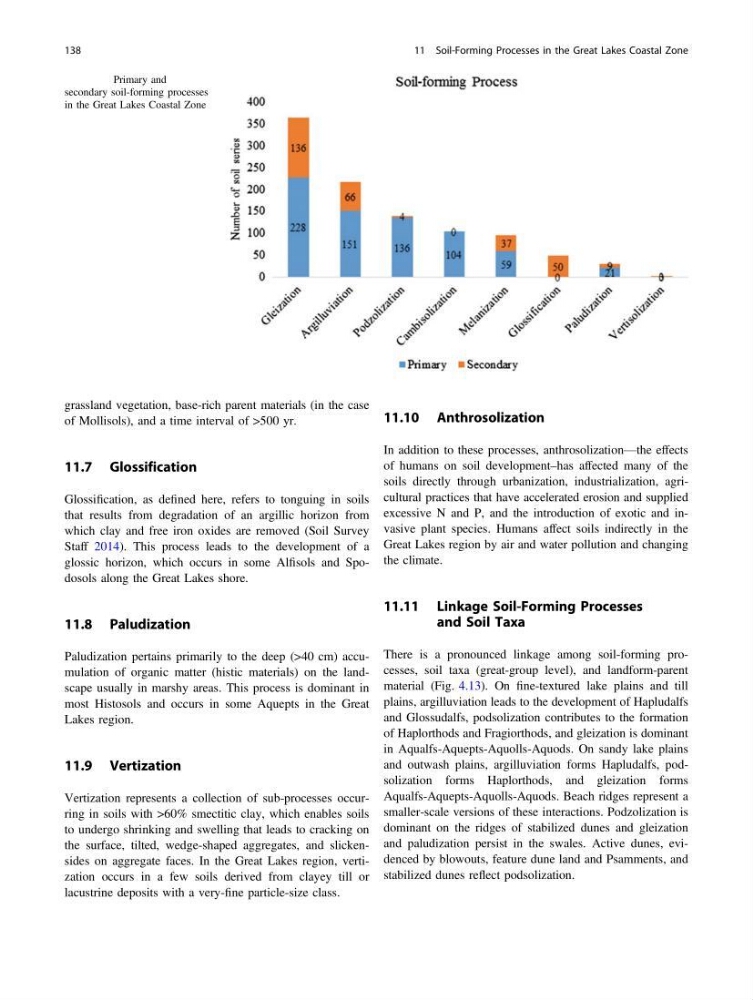
Fig. 11.1 Primary and
secondary soil-forming processes
in the Great Lakes Coastal Zone
138
11 Soil-Forming Processes in the Great Lakes Coastal Zone
of Mollisols), and a time interval of >500 yr.
11.7 Glossification
Glossification, as defined here, refers to tonguing in soils
that results from degradation of an argillic horizon from
which clay and free iron oxides are removed (Soil Survey
Staff 2014). This process leads to the development of a
glossic horizon, which occurs in some Alfisols and Spodosols along the Great Lakes shore.
11.8 Paludization
Paludization pertains primarily to the deep (>40 cm) accumulation of organic matter (histic materials) on the landscape usually in marshy areas. This process is dominant in
most Histosols and occurs in some Aquepts in the Great
Lakes region.
11.9 Vertization
Vertization represents a collection of sub-processes occurring in soils with >60% smectitic clay, which enables soils
to undergo shrinking and swelling that leads to cracking on
the surface, tilted, wedge-shaped aggregates, and slickensides on aggregate faces. In the Great Lakes region, vertization occurs in a few soils derived from clayey till or
lacustrine deposits with a very-fine particle-size class.
11.10 Anthrosolization
In addition to these processes, anthrosolization—the effects
of humans on soil development–has affected many of the
soils directly through urbanization, industrialization, agricultural practices that have accelerated erosion and supplied
excessive N and P, and the introduction of exotic and invasive plant species. Humans affect soils indirectly in the
Great Lakes region by air and water pollution and changing
the climate.
11.11 Linkage Soil-Forming Processes
and Soil Taxa
There is a pronounced linkage among soil-forming processes, soil taxa (great-group level), and landform-parent
material (Fig. 4.13). On fine-textured lake plains and till
plains, argilluviation leads to the development of Hapludalfs
and Glossudalfs, podsolization contributes to the formation
of Haplorthods and Fragiorthods, and gleization is dominant
in Aqualfs-Aquepts-Aquolls-Aquods. On sandy lake plains
and outwash plains, argilluviation forms Hapludalfs, podsolization forms Haplorthods, and gleization forms
Aqualfs-Aquepts-Aquolls-Aquods. Beach ridges represent a
smaller-scale versions of these interactions. Podzolization is
dominant on the ridges of stabilized dunes and gleization
and paludization persist in the swales. Active dunes, evidenced by blowouts, feature dune land and Psamments, and
stabilized dunes reflect podsolization.
Fig. 11.1 Primary and
secondary soil-forming processes
in the Great Lakes Coastal Zone
138
11 Soil-Forming Processes in the Great Lakes Coastal Zone