

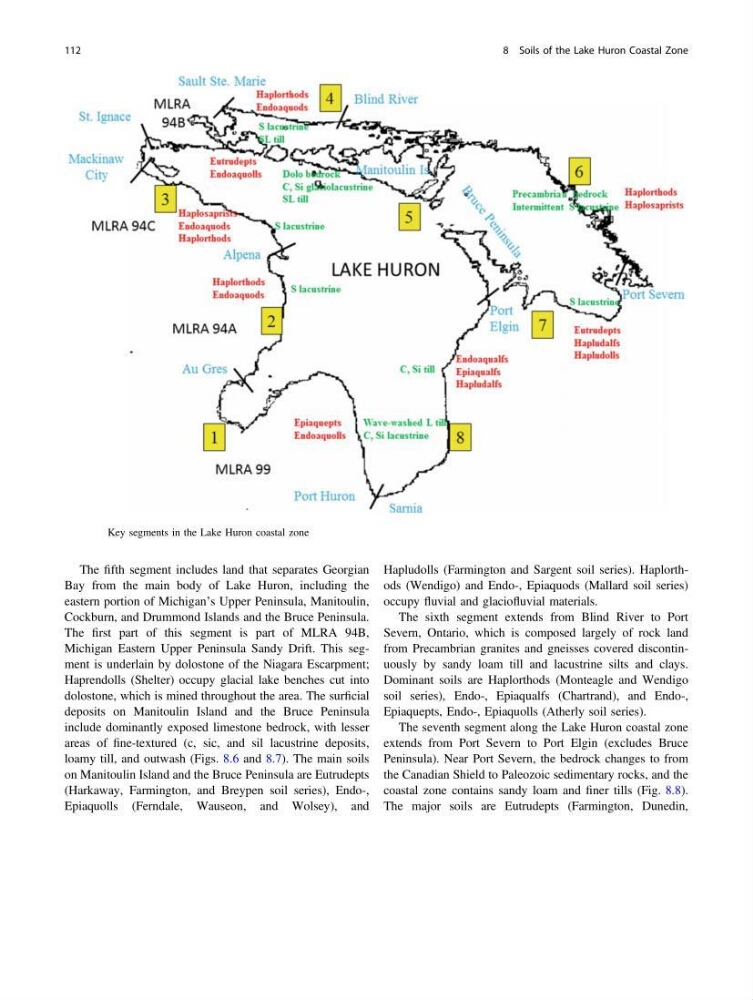
The fifth segment includes land that separates Georgian
Bay from the main body of Lake Huron, including the
eastern portion of Michigan’s Upper Peninsula, Manitoulin,
Cockburn, and Drummond Islands and the Bruce Peninsula.
The first part of this segment is part of MLRA 94B,
Michigan Eastern Upper Peninsula Sandy Drift. This segment is underlain by dolostone of the Niagara Escarpment;
Haprendolls (Shelter) occupy glacial lake benches cut into
dolostone, which is mined throughout the area. The surficial
deposits on Manitoulin Island and the Bruce Peninsula
include dominantly exposed limestone bedrock, with lesser
areas of fine-textured (c, sic, and sil lacustrine deposits,
loamy till, and outwash (Figs. 8.6 and 8.7). The main soils
on Manitoulin Island and the Bruce Peninsula are Eutrudepts
(Harkaway, Farmington, and Breypen soil series), Endo-,
Epiaquolls (Ferndale, Wauseon, and Wolsey), and
Hapludolls (Farmington and Sargent soil series). Haplorthods (Wendigo) and Endo-, Epiaquods (Mallard soil series)
occupy fluvial and glaciofluvial materials.
The sixth segment extends from Blind River to Port
Severn, Ontario, which is composed largely of rock land
from Precambrian granites and gneisses covered discontinuously by sandy loam till and lacustrine silts and clays.
Dominant soils are Haplorthods (Monteagle and Wendigo
soil series), Endo-, Epiaqualfs (Chartrand), and Endo-,
Epiaquepts, Endo-, Epiaquolls (Atherly soil series).
The seventh segment along the Lake Huron coastal zone
extends from Port Severn to Port Elgin (excludes Bruce
Peninsula). Near Port Severn, the bedrock changes to from
the Canadian Shield to Paleozoic sedimentary rocks, and the
coastal zone contains sandy loam and finer tills (Fig. 8.8).
The major soils are Eutrudepts (Farmington, Dunedin,
Fig. 8.1 Key segments in the Lake Huron coastal zone
112
8 Soils of the Lake Huron Coastal Zone
Bay from the main body of Lake Huron, including the
eastern portion of Michigan’s Upper Peninsula, Manitoulin,
Cockburn, and Drummond Islands and the Bruce Peninsula.
The first part of this segment is part of MLRA 94B,
Michigan Eastern Upper Peninsula Sandy Drift. This segment is underlain by dolostone of the Niagara Escarpment;
Haprendolls (Shelter) occupy glacial lake benches cut into
dolostone, which is mined throughout the area. The surficial
deposits on Manitoulin Island and the Bruce Peninsula
include dominantly exposed limestone bedrock, with lesser
areas of fine-textured (c, sic, and sil lacustrine deposits,
loamy till, and outwash (Figs. 8.6 and 8.7). The main soils
on Manitoulin Island and the Bruce Peninsula are Eutrudepts
(Harkaway, Farmington, and Breypen soil series), Endo-,
Epiaquolls (Ferndale, Wauseon, and Wolsey), and
Hapludolls (Farmington and Sargent soil series). Haplorthods (Wendigo) and Endo-, Epiaquods (Mallard soil series)
occupy fluvial and glaciofluvial materials.
The sixth segment extends from Blind River to Port
Severn, Ontario, which is composed largely of rock land
from Precambrian granites and gneisses covered discontinuously by sandy loam till and lacustrine silts and clays.
Dominant soils are Haplorthods (Monteagle and Wendigo
soil series), Endo-, Epiaqualfs (Chartrand), and Endo-,
Epiaquepts, Endo-, Epiaquolls (Atherly soil series).
The seventh segment along the Lake Huron coastal zone
extends from Port Severn to Port Elgin (excludes Bruce
Peninsula). Near Port Severn, the bedrock changes to from
the Canadian Shield to Paleozoic sedimentary rocks, and the
coastal zone contains sandy loam and finer tills (Fig. 8.8).
The major soils are Eutrudepts (Farmington, Dunedin,
Fig. 8.1 Key segments in the Lake Huron coastal zone
112
8 Soils of the Lake Huron Coastal Zone