

Integrated Watershed Management Vis-a-Vis Water–Energy–Food Nexus
71
2 Concept of the Water–Energy–Food (WEF) Nexus
Various global initiatives and forums of international agencies focusing on the nexus
framework, concentrated on water, energy, and food research. Many scientific gatherings were held in 2011–2012, for leading the concept of the WEF nexus, particularly
during the preparation phase for Rio + 20 in June 2012. One relevant framework was
developed on the Water, Energy, and Food Security Nexus: Solutions for the green
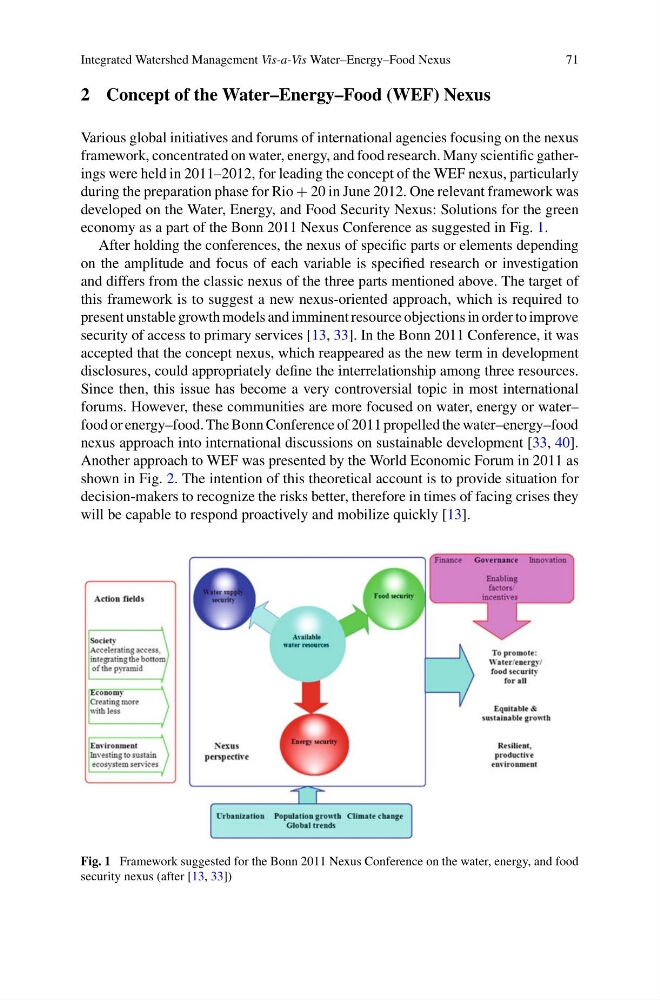
economy as a part of the Bonn 2011 Nexus Conference as suggested in Fig. 1.
After holding the conferences, the nexus of specific parts or elements depending
on the amplitude and focus of each variable is specified research or investigation
and differs from the classic nexus of the three parts mentioned above. The target of
this framework is to suggest a new nexus-oriented approach, which is required to
present unstable growth models and imminent resource objections in order to improve
security of access to primary services [13, 33]. In the Bonn 2011 Conference, it was
accepted that the concept nexus, which reappeared as the new term in development
disclosures, could appropriately define the interrelationship among three resources.
Since then, this issue has become a very controversial topic in most international
forums. However, these communities are more focused on water, energy or water–
food or energy–food. The Bonn Conference of 2011 propelled the water–energy–food
nexus approach into international discussions on sustainable development [33, 40].
Another approach to WEF was presented by the World Economic Forum in 2011 as
shown in Fig. 2. The intention of this theoretical account is to provide situation for
decision-makers to recognize the risks better, therefore in times of facing crises they
will be capable to respond proactively and mobilize quickly [13].
Fig. 1 Framework suggested for the Bonn 2011 Nexus Conference on the water, energy, and food
security nexus (after [13, 33])
71
2 Concept of the Water–Energy–Food (WEF) Nexus
Various global initiatives and forums of international agencies focusing on the nexus
framework, concentrated on water, energy, and food research. Many scientific gatherings were held in 2011–2012, for leading the concept of the WEF nexus, particularly
during the preparation phase for Rio + 20 in June 2012. One relevant framework was
developed on the Water, Energy, and Food Security Nexus: Solutions for the green
economy as a part of the Bonn 2011 Nexus Conference as suggested in Fig. 1.
After holding the conferences, the nexus of specific parts or elements depending
on the amplitude and focus of each variable is specified research or investigation
and differs from the classic nexus of the three parts mentioned above. The target of
this framework is to suggest a new nexus-oriented approach, which is required to
present unstable growth models and imminent resource objections in order to improve
security of access to primary services [13, 33]. In the Bonn 2011 Conference, it was
accepted that the concept nexus, which reappeared as the new term in development
disclosures, could appropriately define the interrelationship among three resources.
Since then, this issue has become a very controversial topic in most international
forums. However, these communities are more focused on water, energy or water–
food or energy–food. The Bonn Conference of 2011 propelled the water–energy–food
nexus approach into international discussions on sustainable development [33, 40].
Another approach to WEF was presented by the World Economic Forum in 2011 as
shown in Fig. 2. The intention of this theoretical account is to provide situation for
decision-makers to recognize the risks better, therefore in times of facing crises they
will be capable to respond proactively and mobilize quickly [13].
Fig. 1 Framework suggested for the Bonn 2011 Nexus Conference on the water, energy, and food
security nexus (after [13, 33])