

The Evolution of the Water–Energy–Food Nexus …
61
The rationale is based on establishing a quantitative relationship among the intricately connected and multiple interactions within the agricultural systems. This
facilitates an understanding of how socio-economic, environmental, and ecological interactions are influencing change and unsustainability. This is fundamental
for evaluating the major societal outcomes that are affected by these interactions
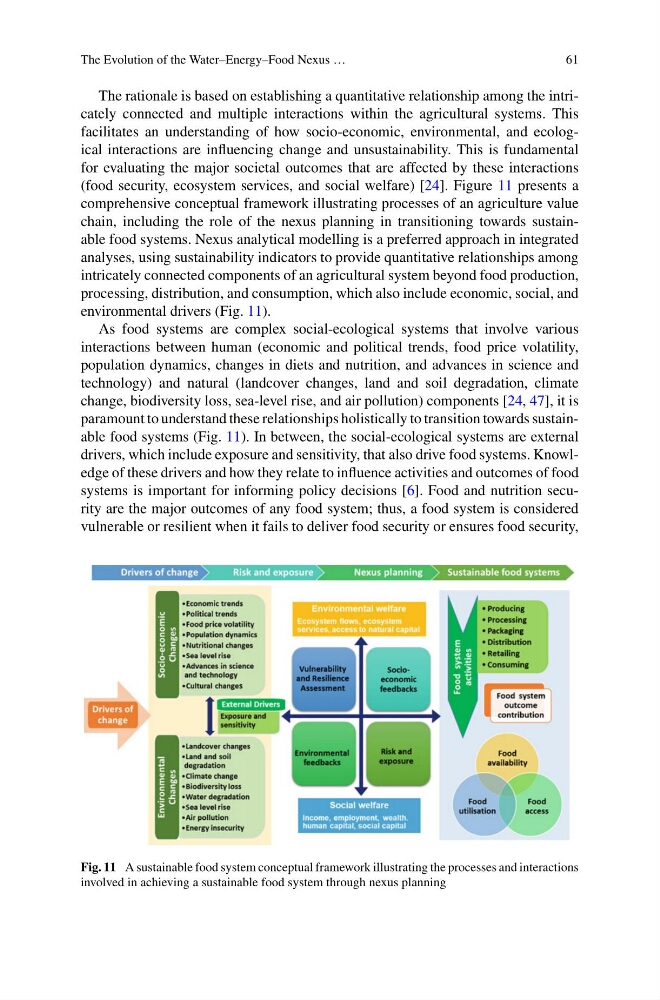
(food security, ecosystem services, and social welfare) [24]. Figure 11 presents a
comprehensive conceptual framework illustrating processes of an agriculture value
chain, including the role of the nexus planning in transitioning towards sustainable food systems. Nexus analytical modelling is a preferred approach in integrated
analyses, using sustainability indicators to provide quantitative relationships among
intricately connected components of an agricultural system beyond food production,
processing, distribution, and consumption, which also include economic, social, and
environmental drivers (Fig. 11).
As food systems are complex social-ecological systems that involve various
interactions between human (economic and political trends, food price volatility,
population dynamics, changes in diets and nutrition, and advances in science and
technology) and natural (landcover changes, land and soil degradation, climate
change, biodiversity loss, sea-level rise, and air pollution) components [24, 47], it is
paramount to understand these relationships holistically to transition towards sustainable food systems (Fig. 11). In between, the social-ecological systems are external
drivers, which include exposure and sensitivity, that also drive food systems. Knowledge of these drivers and how they relate to influence activities and outcomes of food
systems is important for informing policy decisions [6]. Food and nutrition security are the major outcomes of any food system; thus, a food system is considered
vulnerable or resilient when it fails to deliver food security or ensures food security,
Fig. 11 A sustainable food system conceptual framework illustrating the processes and interactions
involved in achieving a sustainable food system through nexus planning
61
The rationale is based on establishing a quantitative relationship among the intricately connected and multiple interactions within the agricultural systems. This
facilitates an understanding of how socio-economic, environmental, and ecological interactions are influencing change and unsustainability. This is fundamental
for evaluating the major societal outcomes that are affected by these interactions
(food security, ecosystem services, and social welfare) [24]. Figure 11 presents a
comprehensive conceptual framework illustrating processes of an agriculture value
chain, including the role of the nexus planning in transitioning towards sustainable food systems. Nexus analytical modelling is a preferred approach in integrated
analyses, using sustainability indicators to provide quantitative relationships among
intricately connected components of an agricultural system beyond food production,
processing, distribution, and consumption, which also include economic, social, and
environmental drivers (Fig. 11).
As food systems are complex social-ecological systems that involve various
interactions between human (economic and political trends, food price volatility,
population dynamics, changes in diets and nutrition, and advances in science and
technology) and natural (landcover changes, land and soil degradation, climate
change, biodiversity loss, sea-level rise, and air pollution) components [24, 47], it is
paramount to understand these relationships holistically to transition towards sustainable food systems (Fig. 11). In between, the social-ecological systems are external
drivers, which include exposure and sensitivity, that also drive food systems. Knowledge of these drivers and how they relate to influence activities and outcomes of food
systems is important for informing policy decisions [6]. Food and nutrition security are the major outcomes of any food system; thus, a food system is considered
vulnerable or resilient when it fails to deliver food security or ensures food security,
Fig. 11 A sustainable food system conceptual framework illustrating the processes and interactions
involved in achieving a sustainable food system through nexus planning