

50
S. Liphadzi et al.
An important feature of the WEF nexus is its capability to assess the performance
of SDGs and act as a decision support tool to achieve sustainability in resource
planning, utilisation, and development, particularly SDGs 2, 6, and 7. The nexus
framework given in Fig. 4 explains and clarifies the connectedness of the three WEF
sectors. The direct and indirect drivers of change, affecting these intricate linkages,
are also demonstrated in Fig. 7. The essence of the WEF nexus consists of the
drivers that are critical to the WEF sectors, and the cross-sector feedbacks in South
Africa, the reason why they are placed in the centre of the nexus. The framework
forms the research agenda for the WEF nexus in South Africa. The innovations
expected from the research agenda are in direct response to the WRC Knowledge
Tree components like knowledge and innovation, capacity building through the application of the integrative analytical model, and the formulation of integrative policy
and legal frameworks to drive the political will. The whole process would culminate in improved livelihoods, resilient communities, environmental sustainability,
and inclusive development.
3.3 The WEF Nexus Integrative Model
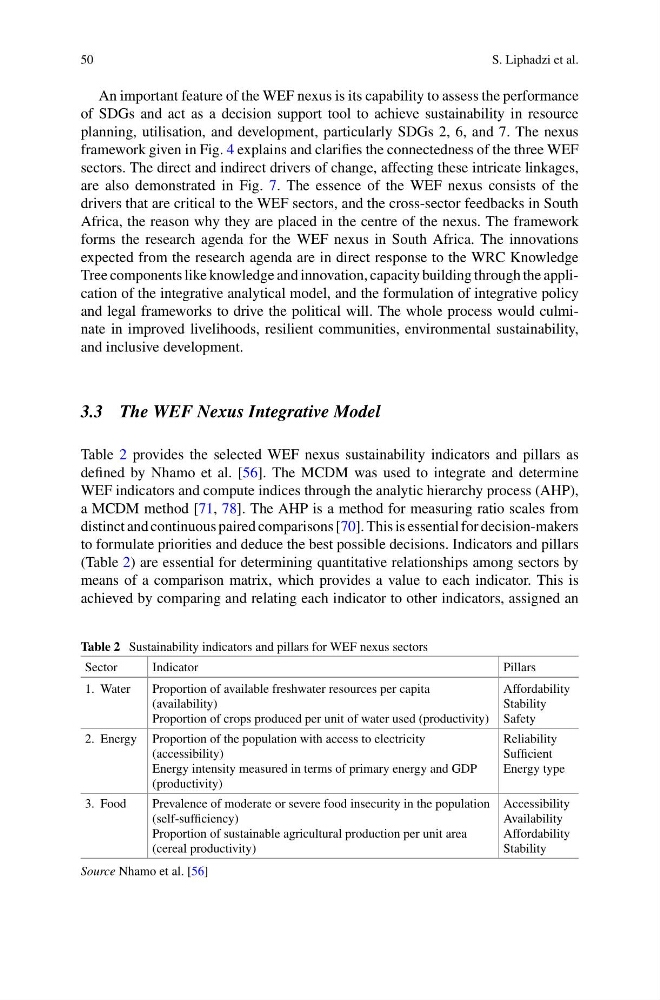
Table 2 provides the selected WEF nexus sustainability indicators and pillars as
defined by Nhamo et al. [56]. The MCDM was used to integrate and determine
WEF indicators and compute indices through the analytic hierarchy process (AHP),
a MCDM method [71, 78]. The AHP is a method for measuring ratio scales from
distinct and continuous paired comparisons [70]. This is essential for decision-makers
to formulate priorities and deduce the best possible decisions. Indicators and pillars
(Table 2) are essential for determining quantitative relationships among sectors by
means of a comparison matrix, which provides a value to each indicator. This is
achieved by comparing and relating each indicator to other indicators, assigned an
Table 2 Sustainability indicators and pillars for WEF nexus sectors
Sector
Indicator
Pillars
1. Water
Proportion of available freshwater resources per capita
(availability)
Proportion of crops produced per unit of water used (productivity)
Affordability
Stability
Safety
2. Energy Proportion of the population with access to electricity
(accessibility)
Energy intensity measured in terms of primary energy and GDP
(productivity)
Reliability
Sufficient
Energy type
3. Food
Prevalence of moderate or severe food insecurity in the population
(self-sufficiency)
Proportion of sustainable agricultural production per unit area
(cereal productivity)
Accessibility
Availability
Affordability
Stability
Source Nhamo et al. [56]
S. Liphadzi et al.
An important feature of the WEF nexus is its capability to assess the performance
of SDGs and act as a decision support tool to achieve sustainability in resource
planning, utilisation, and development, particularly SDGs 2, 6, and 7. The nexus
framework given in Fig. 4 explains and clarifies the connectedness of the three WEF
sectors. The direct and indirect drivers of change, affecting these intricate linkages,
are also demonstrated in Fig. 7. The essence of the WEF nexus consists of the
drivers that are critical to the WEF sectors, and the cross-sector feedbacks in South
Africa, the reason why they are placed in the centre of the nexus. The framework
forms the research agenda for the WEF nexus in South Africa. The innovations
expected from the research agenda are in direct response to the WRC Knowledge
Tree components like knowledge and innovation, capacity building through the application of the integrative analytical model, and the formulation of integrative policy
and legal frameworks to drive the political will. The whole process would culminate in improved livelihoods, resilient communities, environmental sustainability,
and inclusive development.
3.3 The WEF Nexus Integrative Model
Table 2 provides the selected WEF nexus sustainability indicators and pillars as
defined by Nhamo et al. [56]. The MCDM was used to integrate and determine
WEF indicators and compute indices through the analytic hierarchy process (AHP),
a MCDM method [71, 78]. The AHP is a method for measuring ratio scales from
distinct and continuous paired comparisons [70]. This is essential for decision-makers
to formulate priorities and deduce the best possible decisions. Indicators and pillars
(Table 2) are essential for determining quantitative relationships among sectors by
means of a comparison matrix, which provides a value to each indicator. This is
achieved by comparing and relating each indicator to other indicators, assigned an
Table 2 Sustainability indicators and pillars for WEF nexus sectors
Sector
Indicator
Pillars
1. Water
Proportion of available freshwater resources per capita
(availability)
Proportion of crops produced per unit of water used (productivity)
Affordability
Stability
Safety
2. Energy Proportion of the population with access to electricity
(accessibility)
Energy intensity measured in terms of primary energy and GDP
(productivity)
Reliability
Sufficient
Energy type
3. Food
Prevalence of moderate or severe food insecurity in the population
(self-sufficiency)
Proportion of sustainable agricultural production per unit area
(cereal productivity)
Accessibility
Availability
Affordability
Stability
Source Nhamo et al. [56]