

44
S. Liphadzi et al.
contract number of the project, the field of application, journal paper, as well as
the stakeholders/beneficiaries of the reported innovation. The identified WEF nexusrelated innovations were compiled in an excel spreadsheet, recording information
such as innovation title, objective, application area, beneficiaries, and key strategic
research area. Keywords used to pick WEF nexus projects and innovations include
nexus, WEF, operationalisation, and cross-sectoral.
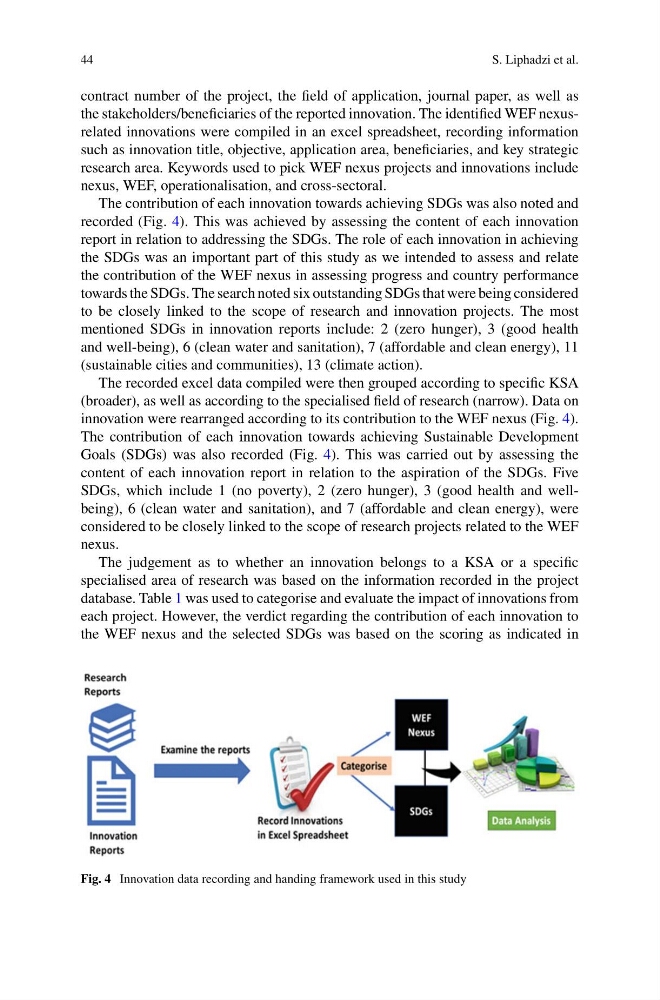
The contribution of each innovation towards achieving SDGs was also noted and
recorded (Fig. 4). This was achieved by assessing the content of each innovation
report in relation to addressing the SDGs. The role of each innovation in achieving
the SDGs was an important part of this study as we intended to assess and relate
the contribution of the WEF nexus in assessing progress and country performance
towards the SDGs. The search noted six outstanding SDGs that were being considered
to be closely linked to the scope of research and innovation projects. The most
mentioned SDGs in innovation reports include: 2 (zero hunger), 3 (good health
and well-being), 6 (clean water and sanitation), 7 (affordable and clean energy), 11
(sustainable cities and communities), 13 (climate action).
The recorded excel data compiled were then grouped according to specific KSA
(broader), as well as according to the specialised field of research (narrow). Data on
innovation were rearranged according to its contribution to the WEF nexus (Fig. 4).
The contribution of each innovation towards achieving Sustainable Development
Goals (SDGs) was also recorded (Fig. 4). This was carried out by assessing the
content of each innovation report in relation to the aspiration of the SDGs. Five
SDGs, which include 1 (no poverty), 2 (zero hunger), 3 (good health and wellbeing), 6 (clean water and sanitation), and 7 (affordable and clean energy), were
considered to be closely linked to the scope of research projects related to the WEF
nexus.
The judgement as to whether an innovation belongs to a KSA or a specific
specialised area of research was based on the information recorded in the project
database. Table 1 was used to categorise and evaluate the impact of innovations from
each project. However, the verdict regarding the contribution of each innovation to
the WEF nexus and the selected SDGs was based on the scoring as indicated in
Fig. 4 Innovation data recording and handing framework used in this study
S. Liphadzi et al.
contract number of the project, the field of application, journal paper, as well as
the stakeholders/beneficiaries of the reported innovation. The identified WEF nexusrelated innovations were compiled in an excel spreadsheet, recording information
such as innovation title, objective, application area, beneficiaries, and key strategic
research area. Keywords used to pick WEF nexus projects and innovations include
nexus, WEF, operationalisation, and cross-sectoral.
The contribution of each innovation towards achieving SDGs was also noted and
recorded (Fig. 4). This was achieved by assessing the content of each innovation
report in relation to addressing the SDGs. The role of each innovation in achieving
the SDGs was an important part of this study as we intended to assess and relate
the contribution of the WEF nexus in assessing progress and country performance
towards the SDGs. The search noted six outstanding SDGs that were being considered
to be closely linked to the scope of research and innovation projects. The most
mentioned SDGs in innovation reports include: 2 (zero hunger), 3 (good health
and well-being), 6 (clean water and sanitation), 7 (affordable and clean energy), 11
(sustainable cities and communities), 13 (climate action).
The recorded excel data compiled were then grouped according to specific KSA
(broader), as well as according to the specialised field of research (narrow). Data on
innovation were rearranged according to its contribution to the WEF nexus (Fig. 4).
The contribution of each innovation towards achieving Sustainable Development
Goals (SDGs) was also recorded (Fig. 4). This was carried out by assessing the
content of each innovation report in relation to the aspiration of the SDGs. Five
SDGs, which include 1 (no poverty), 2 (zero hunger), 3 (good health and wellbeing), 6 (clean water and sanitation), and 7 (affordable and clean energy), were
considered to be closely linked to the scope of research projects related to the WEF
nexus.
The judgement as to whether an innovation belongs to a KSA or a specific
specialised area of research was based on the information recorded in the project
database. Table 1 was used to categorise and evaluate the impact of innovations from
each project. However, the verdict regarding the contribution of each innovation to
the WEF nexus and the selected SDGs was based on the scoring as indicated in
Fig. 4 Innovation data recording and handing framework used in this study