

12
H. Schlör et al.
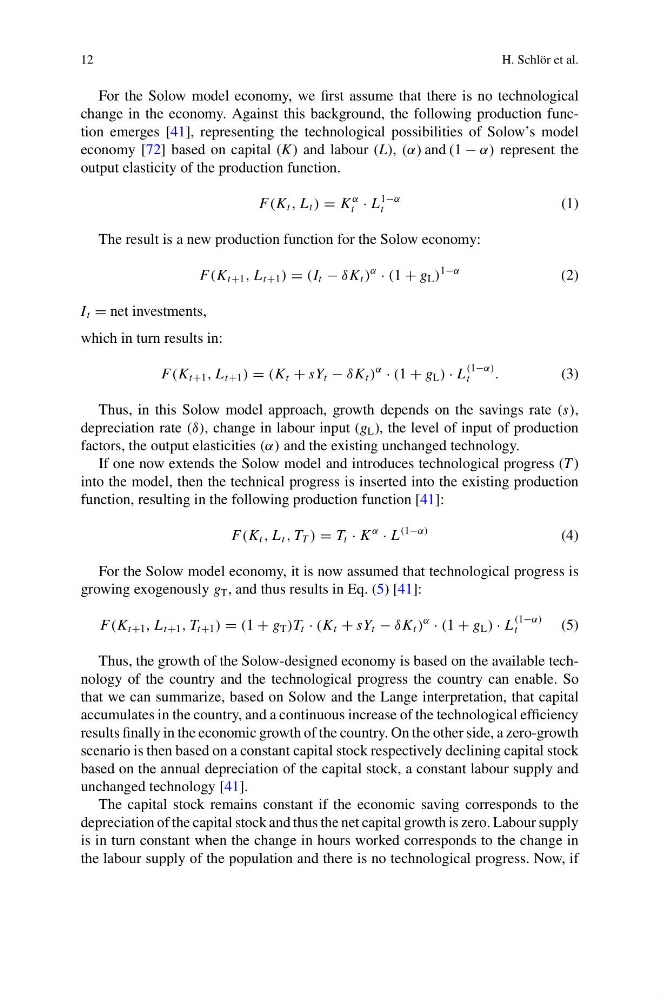
For the Solow model economy, we first assume that there is no technological
change in the economy. Against this background, the following production function emerges [41], representing the technological possibilities of Solow’s model
economy [72] based on capital (K) and labour (L), (α) and (1 − α) represent the
output elasticity of the production function.
F(K t , L t ) = K
α
t · L
1−α
t
(1)
The result is a new production function for the Solow economy:
F(K t+1 , L t+1 ) = (I t − δ K t )
α
· (1 + g L )
1−α
(2)
I t = net investments,
which in turn results in:
F(K t+1 , L t+1 ) = (K t + sY t − δ K t )
α
· (1 + g L ) · L
(1−α)
t
.
(3)
Thus, in this Solow model approach, growth depends on the savings rate (s),
depreciation rate (δ), change in labour input (g L ), the level of input of production
factors, the output elasticities (α) and the existing unchanged technology.
If one now extends the Solow model and introduces technological progress (T )
into the model, then the technical progress is inserted into the existing production
function, resulting in the following production function [41]:
F(K t , L t , T T ) = T t · K
α
· L
(1−α)
(4)
For the Solow model economy, it is now assumed that technological progress is
growing exogenously g T , and thus results in Eq. (5) [41]:
F(K t+1 , L t+1 , T t+1 ) = (1 + g T )T t · (K t + sY t − δ K t )
α
· (1 + g L ) · L
(1−α)
t
(5)
Thus, the growth of the Solow-designed economy is based on the available technology of the country and the technological progress the country can enable. So
that we can summarize, based on Solow and the Lange interpretation, that capital
accumulates in the country, and a continuous increase of the technological efficiency
results finally in the economic growth of the country. On the other side, a zero-growth
scenario is then based on a constant capital stock respectively declining capital stock
based on the annual depreciation of the capital stock, a constant labour supply and
unchanged technology [41].
The capital stock remains constant if the economic saving corresponds to the
depreciation of the capital stock and thus the net capital growth is zero. Labour supply
is in turn constant when the change in hours worked corresponds to the change in
the labour supply of the population and there is no technological progress. Now, if
H. Schlör et al.
For the Solow model economy, we first assume that there is no technological
change in the economy. Against this background, the following production function emerges [41], representing the technological possibilities of Solow’s model
economy [72] based on capital (K) and labour (L), (α) and (1 − α) represent the
output elasticity of the production function.
F(K t , L t ) = K
α
t · L
1−α
t
(1)
The result is a new production function for the Solow economy:
F(K t+1 , L t+1 ) = (I t − δ K t )
α
· (1 + g L )
1−α
(2)
I t = net investments,
which in turn results in:
F(K t+1 , L t+1 ) = (K t + sY t − δ K t )
α
· (1 + g L ) · L
(1−α)
t
.
(3)
Thus, in this Solow model approach, growth depends on the savings rate (s),
depreciation rate (δ), change in labour input (g L ), the level of input of production
factors, the output elasticities (α) and the existing unchanged technology.
If one now extends the Solow model and introduces technological progress (T )
into the model, then the technical progress is inserted into the existing production
function, resulting in the following production function [41]:
F(K t , L t , T T ) = T t · K
α
· L
(1−α)
(4)
For the Solow model economy, it is now assumed that technological progress is
growing exogenously g T , and thus results in Eq. (5) [41]:
F(K t+1 , L t+1 , T t+1 ) = (1 + g T )T t · (K t + sY t − δ K t )
α
· (1 + g L ) · L
(1−α)
t
(5)
Thus, the growth of the Solow-designed economy is based on the available technology of the country and the technological progress the country can enable. So
that we can summarize, based on Solow and the Lange interpretation, that capital
accumulates in the country, and a continuous increase of the technological efficiency
results finally in the economic growth of the country. On the other side, a zero-growth
scenario is then based on a constant capital stock respectively declining capital stock
based on the annual depreciation of the capital stock, a constant labour supply and
unchanged technology [41].
The capital stock remains constant if the economic saving corresponds to the
depreciation of the capital stock and thus the net capital growth is zero. Labour supply
is in turn constant when the change in hours worked corresponds to the change in
the labour supply of the population and there is no technological progress. Now, if