

73
Downward links:
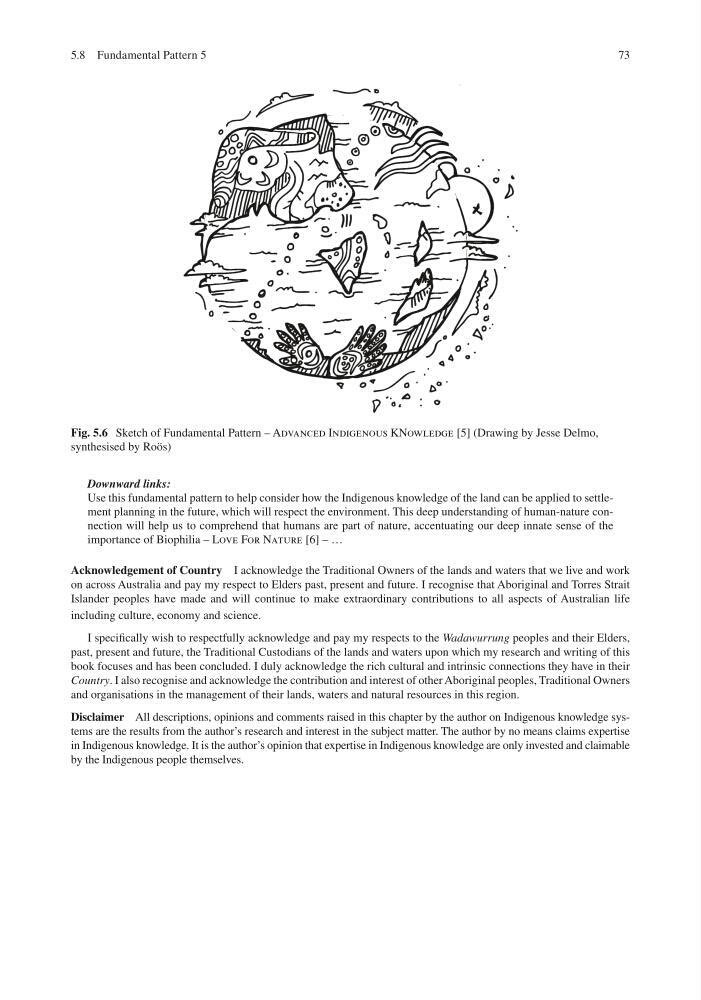
Use this fundamental pattern to help consider how the Indigenous knowledge of the land can be applied to settlement planning in the future, which will respect the environment. This deep understanding of human-nature connection will help us to comprehend that humans are part of nature, accentuating our deep innate sense of the
importance of Biophilia – Love For Nature [6] – …
Acknowledgement of Country I acknowledge the Traditional Owners of the lands and waters that we live and work
on across Australia and pay my respect to Elders past, present and future. I recognise that Aboriginal and Torres Strait
Islander peoples have made and will continue to make extraordinary contributions to all aspects of Australian life
including culture, economy and science.
I specifically wish to respectfully acknowledge and pay my respects to the Wadawurrung peoples and their Elders,
past, present and future, the Traditional Custodians of the lands and waters upon which my research and writing of this
book focuses and has been concluded. I duly acknowledge the rich cultural and intrinsic connections they have in their
Country. I also recognise and acknowledge the contribution and interest of other Aboriginal peoples, Traditional Owners
and organisations in the management of their lands, waters and natural resources in this region.
Disclaimer All descriptions, opinions and comments raised in this chapter by the author on Indigenous knowledge systems are the results from the author’s research and interest in the subject matter. The author by no means claims expertise
in Indigenous knowledge. It is the author’s opinion that expertise in Indigenous knowledge are only invested and claimable
by the Indigenous people themselves.
Fig. 5.6 Sketch of Fundamental Pattern – Advanced Indigenous KNowledge [5] (Drawing by Jesse Delmo,
synthesised by Roös)
5.8 Fundamental Pattern 5
Downward links:
Use this fundamental pattern to help consider how the Indigenous knowledge of the land can be applied to settlement planning in the future, which will respect the environment. This deep understanding of human-nature connection will help us to comprehend that humans are part of nature, accentuating our deep innate sense of the
importance of Biophilia – Love For Nature [6] – …
Acknowledgement of Country I acknowledge the Traditional Owners of the lands and waters that we live and work
on across Australia and pay my respect to Elders past, present and future. I recognise that Aboriginal and Torres Strait
Islander peoples have made and will continue to make extraordinary contributions to all aspects of Australian life
including culture, economy and science.
I specifically wish to respectfully acknowledge and pay my respects to the Wadawurrung peoples and their Elders,
past, present and future, the Traditional Custodians of the lands and waters upon which my research and writing of this
book focuses and has been concluded. I duly acknowledge the rich cultural and intrinsic connections they have in their
Country. I also recognise and acknowledge the contribution and interest of other Aboriginal peoples, Traditional Owners
and organisations in the management of their lands, waters and natural resources in this region.
Disclaimer All descriptions, opinions and comments raised in this chapter by the author on Indigenous knowledge systems are the results from the author’s research and interest in the subject matter. The author by no means claims expertise
in Indigenous knowledge. It is the author’s opinion that expertise in Indigenous knowledge are only invested and claimable
by the Indigenous people themselves.
Fig. 5.6 Sketch of Fundamental Pattern – Advanced Indigenous KNowledge [5] (Drawing by Jesse Delmo,
synthesised by Roös)
5.8 Fundamental Pattern 5