

53
not dictate outcomes and is vague about what is expected in the treatment of coastal issues (Macintosh, 2012,
p. 6).
Part of this problem is that the autonomy of local councils in the planning system is tightly constrained. This is due to the multiplicity of powers of other governmental bodies, such as the State
Planning Minister, the Referral Authorities, the Victorian Coastal Council (including Regional Coastal
Boards), and the Victorian Civil and Administrative Tribunal (VCAT). Another constraint to the
implementation of a sustainability- focused policy is that an urban/growth boundary is not set, and the
continued movement towards and across this notional boundary into the natural landscape of coastal
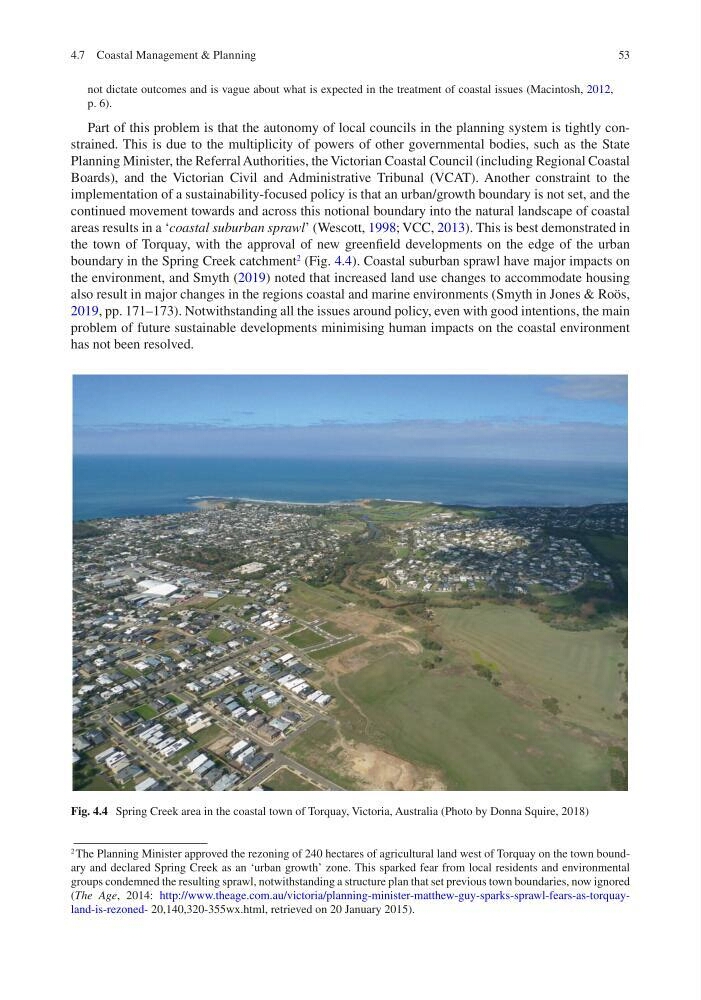
areas results in a ‘coastal suburban sprawl’ (Wescott, 1998; VCC, 2013). This is best demonstrated in
the town of Torquay, with the approval of new greenfield developments on the edge of the urban
boundary in the Spring Creek catchment
2
(Fig. 4.4). Coastal suburban sprawl have major impacts on
the environment, and Smyth (2019) noted that increased land use changes to accommodate housing
also result in major changes in the regions coastal and marine environments (Smyth in Jones & Roös,
2019, pp. 171–173). Notwithstanding all the issues around policy, even with good intentions, the main
problem of future sustainable developments minimising human impacts on the coastal environment
has not been resolved.
2 The Planning Minister approved the rezoning of 240 hectares of agricultural land west of Torquay on the town boundary and declared Spring Creek as an ‘urban growth’ zone. This sparked fear from local residents and environmental
groups condemned the resulting sprawl, notwithstanding a structure plan that set previous town boundaries, now ignored
(The Age, 2014: http://www.theage.com.au/victoria/planning-minister-matthew-guy-sparks-sprawl-fears-as-torquayland-is-rezoned- 20,140,320-355wx.html, retrieved on 20 January 2015).
Fig. 4.4 Spring Creek area in the coastal town of Torquay, Victoria, Australia (Photo by Donna Squire, 2018)
4.7 Coastal Management & Planning
not dictate outcomes and is vague about what is expected in the treatment of coastal issues (Macintosh, 2012,
p. 6).
Part of this problem is that the autonomy of local councils in the planning system is tightly constrained. This is due to the multiplicity of powers of other governmental bodies, such as the State
Planning Minister, the Referral Authorities, the Victorian Coastal Council (including Regional Coastal
Boards), and the Victorian Civil and Administrative Tribunal (VCAT). Another constraint to the
implementation of a sustainability- focused policy is that an urban/growth boundary is not set, and the
continued movement towards and across this notional boundary into the natural landscape of coastal
areas results in a ‘coastal suburban sprawl’ (Wescott, 1998; VCC, 2013). This is best demonstrated in
the town of Torquay, with the approval of new greenfield developments on the edge of the urban
boundary in the Spring Creek catchment
2
(Fig. 4.4). Coastal suburban sprawl have major impacts on
the environment, and Smyth (2019) noted that increased land use changes to accommodate housing
also result in major changes in the regions coastal and marine environments (Smyth in Jones & Roös,
2019, pp. 171–173). Notwithstanding all the issues around policy, even with good intentions, the main
problem of future sustainable developments minimising human impacts on the coastal environment
has not been resolved.
2 The Planning Minister approved the rezoning of 240 hectares of agricultural land west of Torquay on the town boundary and declared Spring Creek as an ‘urban growth’ zone. This sparked fear from local residents and environmental
groups condemned the resulting sprawl, notwithstanding a structure plan that set previous town boundaries, now ignored
(The Age, 2014: http://www.theage.com.au/victoria/planning-minister-matthew-guy-sparks-sprawl-fears-as-torquayland-is-rezoned- 20,140,320-355wx.html, retrieved on 20 January 2015).
Fig. 4.4 Spring Creek area in the coastal town of Torquay, Victoria, Australia (Photo by Donna Squire, 2018)
4.7 Coastal Management & Planning