

51
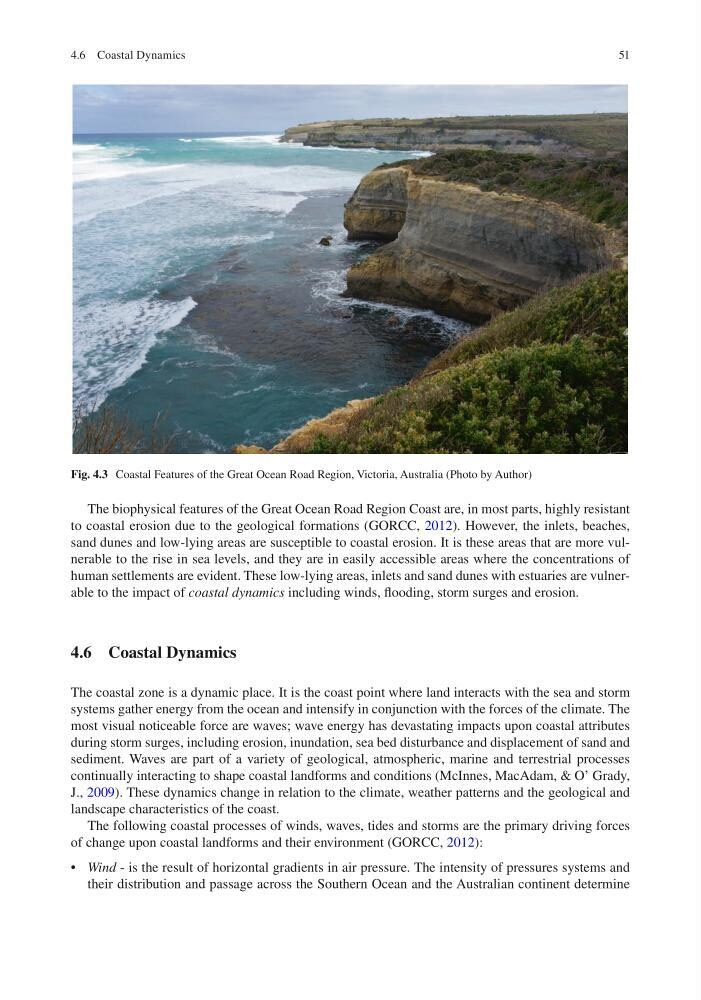
The biophysical features of the Great Ocean Road Region Coast are, in most parts, highly resistant
to coastal erosion due to the geological formations (GORCC, 2012). However, the inlets, beaches,
sand dunes and low-lying areas are susceptible to coastal erosion. It is these areas that are more vulnerable to the rise in sea levels, and they are in easily accessible areas where the concentrations of
human settlements are evident. These low-lying areas, inlets and sand dunes with estuaries are vulnerable to the impact of coastal dynamics including winds, flooding, storm surges and erosion.
4.6 Coastal Dynamics
The coastal zone is a dynamic place. It is the coast point where land interacts with the sea and storm
systems gather energy from the ocean and intensify in conjunction with the forces of the climate. The
most visual noticeable force are waves; wave energy has devastating impacts upon coastal attributes
during storm surges, including erosion, inundation, sea bed disturbance and displacement of sand and
sediment. Waves are part of a variety of geological, atmospheric, marine and terrestrial processes
continually interacting to shape coastal landforms and conditions (McInnes, MacAdam, & O’ Grady,
J., 2009). These dynamics change in relation to the climate, weather patterns and the geological and
landscape characteristics of the coast.
The following coastal processes of winds, waves, tides and storms are the primary driving forces
of change upon coastal landforms and their environment (GORCC, 2012):
• Wind - is the result of horizontal gradients in air pressure. The intensity of pressures systems and
their distribution and passage across the Southern Ocean and the Australian continent determine
Fig. 4.3 Coastal Features of the Great Ocean Road Region, Victoria, Australia (Photo by Author)
4.6 Coastal Dynamics
The biophysical features of the Great Ocean Road Region Coast are, in most parts, highly resistant
to coastal erosion due to the geological formations (GORCC, 2012). However, the inlets, beaches,
sand dunes and low-lying areas are susceptible to coastal erosion. It is these areas that are more vulnerable to the rise in sea levels, and they are in easily accessible areas where the concentrations of
human settlements are evident. These low-lying areas, inlets and sand dunes with estuaries are vulnerable to the impact of coastal dynamics including winds, flooding, storm surges and erosion.
4.6 Coastal Dynamics
The coastal zone is a dynamic place. It is the coast point where land interacts with the sea and storm
systems gather energy from the ocean and intensify in conjunction with the forces of the climate. The
most visual noticeable force are waves; wave energy has devastating impacts upon coastal attributes
during storm surges, including erosion, inundation, sea bed disturbance and displacement of sand and
sediment. Waves are part of a variety of geological, atmospheric, marine and terrestrial processes
continually interacting to shape coastal landforms and conditions (McInnes, MacAdam, & O’ Grady,
J., 2009). These dynamics change in relation to the climate, weather patterns and the geological and
landscape characteristics of the coast.
The following coastal processes of winds, waves, tides and storms are the primary driving forces
of change upon coastal landforms and their environment (GORCC, 2012):
• Wind - is the result of horizontal gradients in air pressure. The intensity of pressures systems and
their distribution and passage across the Southern Ocean and the Australian continent determine
Fig. 4.3 Coastal Features of the Great Ocean Road Region, Victoria, Australia (Photo by Author)
4.6 Coastal Dynamics