

46
Humans have an affinity with water, especially with the coast and the sea. This is not surprising
because the coastal zone
1
provides many resources for human use, including economic benefits that
accrue from access to ocean navigation, coastal ports at river mouths, fisheries, tourism and recreation. Historically settlements have been established around these resources, and are scattered along
coastlines worldwide. In the context of landscape, it is the beauty and visual attributes of coastal areas
that attract humans, resulting in more and more people settling on the coast. As population density and
economic activity in the coastal zone increases, so does pressure on coastal ecosystems. This humancoastal interface sounds simplistic, but in fact it is an interface that is a complex social-ecological
system characterized by natural ecological processes and human-induced changes (Kittinger & Ayers,
2010). The cumulative impacts from human activities have made coastal ecosystems among the most
transformed and degraded environments in the world (Halpern et al., 2008; Lotze, 2006). From a
human built environment perspective, environmental degradation increases the vulnerability of coastal
community settlements and threatens the supporting ecosystems and goods, services and values
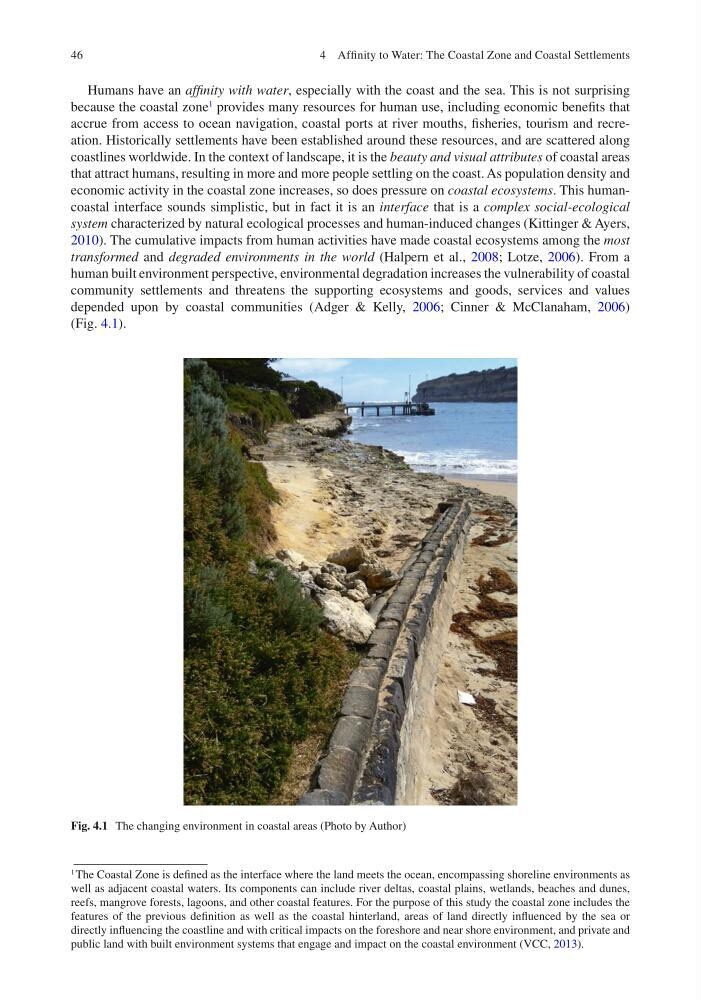
depended upon by coastal communities (Adger & Kelly, 2006; Cinner & McClanaham, 2006)
(Fig. 4.1).
1 The Coastal Zone is defined as the interface where the land meets the ocean, encompassing shoreline environments as
well as adjacent coastal waters. Its components can include river deltas, coastal plains, wetlands, beaches and dunes,
reefs, mangrove forests, lagoons, and other coastal features. For the purpose of this study the coastal zone includes the
features of the previous definition as well as the coastal hinterland, areas of land directly influenced by the sea or
directly influencing the coastline and with critical impacts on the foreshore and near shore environment, and private and
public land with built environment systems that engage and impact on the coastal environment (VCC, 2013).
Fig. 4.1 The changing environment in coastal areas (Photo by Author)
4 Affinity to Water: The Coastal Zone and Coastal Settlements
Humans have an affinity with water, especially with the coast and the sea. This is not surprising
because the coastal zone
1
provides many resources for human use, including economic benefits that
accrue from access to ocean navigation, coastal ports at river mouths, fisheries, tourism and recreation. Historically settlements have been established around these resources, and are scattered along
coastlines worldwide. In the context of landscape, it is the beauty and visual attributes of coastal areas
that attract humans, resulting in more and more people settling on the coast. As population density and
economic activity in the coastal zone increases, so does pressure on coastal ecosystems. This humancoastal interface sounds simplistic, but in fact it is an interface that is a complex social-ecological
system characterized by natural ecological processes and human-induced changes (Kittinger & Ayers,
2010). The cumulative impacts from human activities have made coastal ecosystems among the most
transformed and degraded environments in the world (Halpern et al., 2008; Lotze, 2006). From a
human built environment perspective, environmental degradation increases the vulnerability of coastal
community settlements and threatens the supporting ecosystems and goods, services and values
depended upon by coastal communities (Adger & Kelly, 2006; Cinner & McClanaham, 2006)
(Fig. 4.1).
1 The Coastal Zone is defined as the interface where the land meets the ocean, encompassing shoreline environments as
well as adjacent coastal waters. Its components can include river deltas, coastal plains, wetlands, beaches and dunes,
reefs, mangrove forests, lagoons, and other coastal features. For the purpose of this study the coastal zone includes the
features of the previous definition as well as the coastal hinterland, areas of land directly influenced by the sea or
directly influencing the coastline and with critical impacts on the foreshore and near shore environment, and private and
public land with built environment systems that engage and impact on the coastal environment (VCC, 2013).
Fig. 4.1 The changing environment in coastal areas (Photo by Author)
4 Affinity to Water: The Coastal Zone and Coastal Settlements