

40
3.10 Fundamental Pattern 3
Climate Change Co-Adaptation [3].
Changes on Earth operate at multiple levels of intricacy and takes place in dynamic social,
economic, technological, biophysical, and political contexts. Due to anthropogenic influences,
the climate and ecological systems are changing rapidly. Therefore, implement practices that
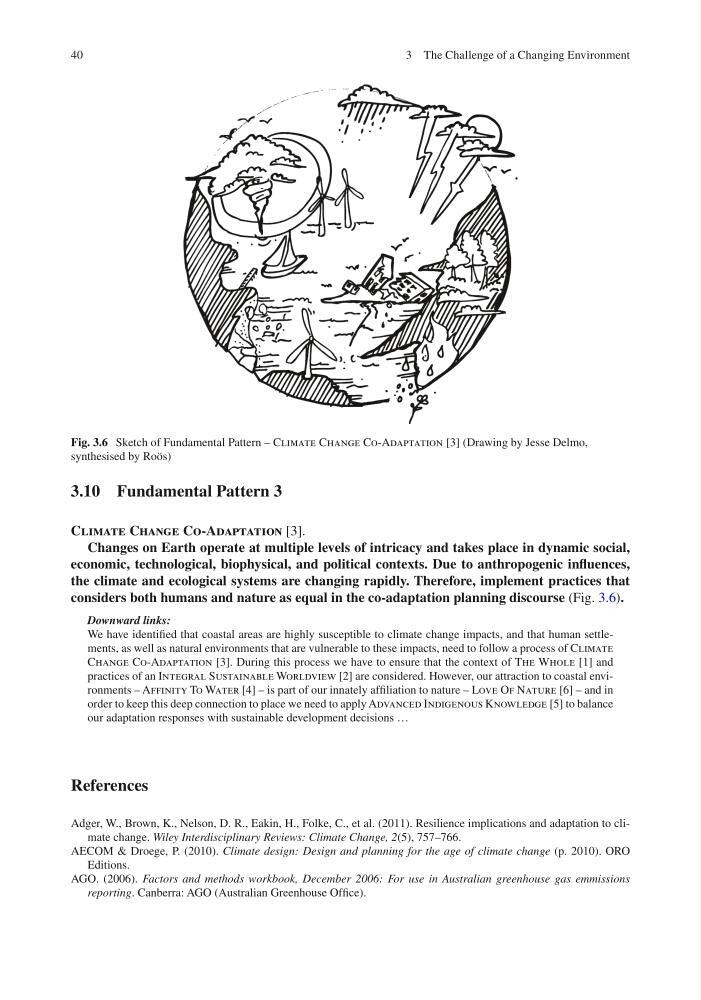
considers both humans and nature as equal in the co-adaptation planning discourse (Fig. 3.6).
Downward links:
We have identified that coastal areas are highly susceptible to climate change impacts, and that human settlements, as well as natural environments that are vulnerable to these impacts, need to follow a process of Climate
Change Co- Adaptation [3]. During this process we have to ensure that the context of The Whole [1] and
practices of an Integral Sustainable Worldview [2] are considered. However, our attraction to coastal environments – Affinity To Water [4] – is part of our innately affiliation to nature – Love Of Nature [6] – and in
order to keep this deep connection to place we need to apply Advanced Indigenous Knowledge [5] to balance
our adaptation responses with sustainable development decisions …
References
Adger, W., Brown, K., Nelson, D. R., Eakin, H., Folke, C., et al. (2011). Resilience implications and adaptation to climate change. Wiley Interdisciplinary Reviews: Climate Change, 2(5), 757–766.
AECOM & Droege, P. (2010). Climate design: Design and planning for the age of climate change (p. 2010). ORO
Editions.
AGO. (2006). Factors and methods workbook, December 2006: For use in Australian greenhouse gas emmissions
reporting. Canberra: AGO (Australian Greenhouse Office).
Fig. 3.6 Sketch of Fundamental Pattern – Climate Change Co-Adaptation [3] (Drawing by Jesse Delmo,
synthesised by Roös)
3 The Challenge of a Changing Environment
3.10 Fundamental Pattern 3
Climate Change Co-Adaptation [3].
Changes on Earth operate at multiple levels of intricacy and takes place in dynamic social,
economic, technological, biophysical, and political contexts. Due to anthropogenic influences,
the climate and ecological systems are changing rapidly. Therefore, implement practices that
considers both humans and nature as equal in the co-adaptation planning discourse (Fig. 3.6).
Downward links:
We have identified that coastal areas are highly susceptible to climate change impacts, and that human settlements, as well as natural environments that are vulnerable to these impacts, need to follow a process of Climate
Change Co- Adaptation [3]. During this process we have to ensure that the context of The Whole [1] and
practices of an Integral Sustainable Worldview [2] are considered. However, our attraction to coastal environments – Affinity To Water [4] – is part of our innately affiliation to nature – Love Of Nature [6] – and in
order to keep this deep connection to place we need to apply Advanced Indigenous Knowledge [5] to balance
our adaptation responses with sustainable development decisions …
References
Adger, W., Brown, K., Nelson, D. R., Eakin, H., Folke, C., et al. (2011). Resilience implications and adaptation to climate change. Wiley Interdisciplinary Reviews: Climate Change, 2(5), 757–766.
AECOM & Droege, P. (2010). Climate design: Design and planning for the age of climate change (p. 2010). ORO
Editions.
AGO. (2006). Factors and methods workbook, December 2006: For use in Australian greenhouse gas emmissions
reporting. Canberra: AGO (Australian Greenhouse Office).
Fig. 3.6 Sketch of Fundamental Pattern – Climate Change Co-Adaptation [3] (Drawing by Jesse Delmo,
synthesised by Roös)
3 The Challenge of a Changing Environment