

24
to acknowledge that in the face of a changing climate, unprecedented environmental degradation, and
the declining of available resources we need to shift our thinking from mitigation to adaptation.
Therefore:
If we want to achieve a more sustainable and resilient future for both human-built environments
and the natural environment, we need to apply the principles of integral sustainable design to our
sustainable development practices. Further, new behaviours must be underpinned by the fundamentals
of a regenerative-adaptive paradigm, enabling a new integral sustainable worldview.
2.8 Fundamental Pattern 2
Integral Sustainable Worldview [2]
Achieve a resilient and sustainable future by adopting integral sustainable design practices
at multiple levels of complexity, including technological, ecological, experiential and cultural
sustainability perspectives (Fig. 2.4).
Downward links:
However, we face an unprecedented change in the climate due to Anthropogenic causes and this will require a
Climate Change Co-Adaptation [3] approach, where both humans and nature will be able to co-adapt to the
effects and impacts of a new world …
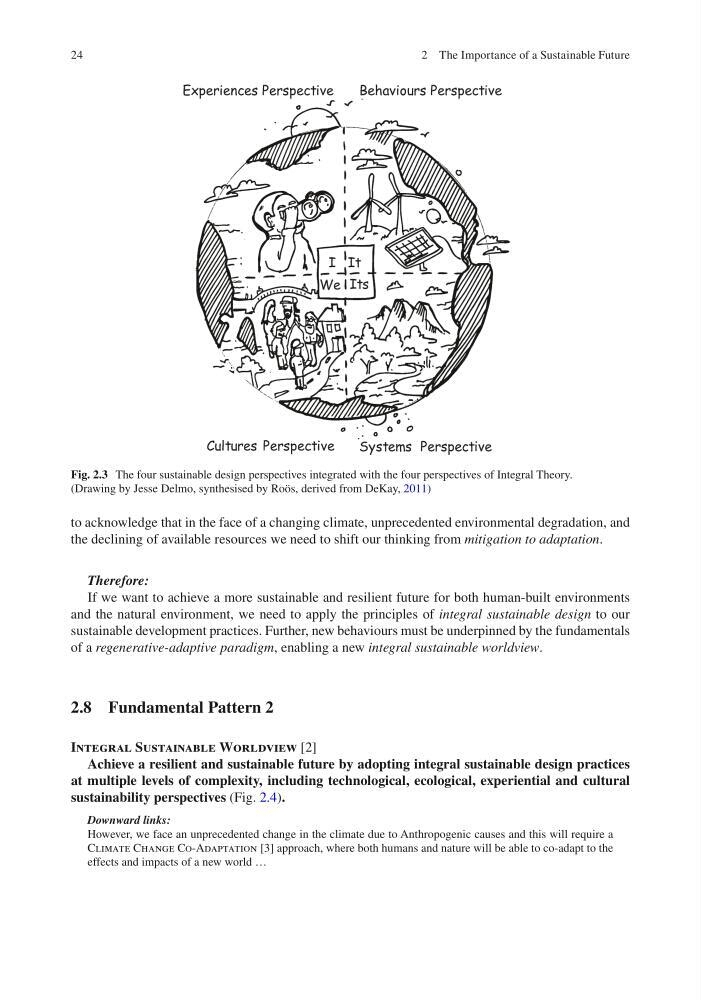
Fig. 2.3 The four sustainable design perspectives integrated with the four perspectives of Integral Theory.
(Drawing by Jesse Delmo, synthesised by Roös, derived from DeKay, 2011)
2 The Importance of a Sustainable Future
to acknowledge that in the face of a changing climate, unprecedented environmental degradation, and
the declining of available resources we need to shift our thinking from mitigation to adaptation.
Therefore:
If we want to achieve a more sustainable and resilient future for both human-built environments
and the natural environment, we need to apply the principles of integral sustainable design to our
sustainable development practices. Further, new behaviours must be underpinned by the fundamentals
of a regenerative-adaptive paradigm, enabling a new integral sustainable worldview.
2.8 Fundamental Pattern 2
Integral Sustainable Worldview [2]
Achieve a resilient and sustainable future by adopting integral sustainable design practices
at multiple levels of complexity, including technological, ecological, experiential and cultural
sustainability perspectives (Fig. 2.4).
Downward links:
However, we face an unprecedented change in the climate due to Anthropogenic causes and this will require a
Climate Change Co-Adaptation [3] approach, where both humans and nature will be able to co-adapt to the
effects and impacts of a new world …
Fig. 2.3 The four sustainable design perspectives integrated with the four perspectives of Integral Theory.
(Drawing by Jesse Delmo, synthesised by Roös, derived from DeKay, 2011)
2 The Importance of a Sustainable Future