

182
It is recommended to use the concept of a regenerative-adaptive pattern language in settlement
planning and design, rather than a typical standard master planning and risk management process. The
results and the outcomes are dynamic in nature, with the ability to deal with forces of change. This
allow residents of a town to regenerate, adapt and apply lasting, deep sustainable practices for the
ongoing function of that place for it to exist within the larger whole, and to create a living structure of
resilience continuing into the future, adapting with circumstances as they are changing over time, following an evolutionary process.
11.14 Fundamental Pattern
Evolutionary Adaptation [11].
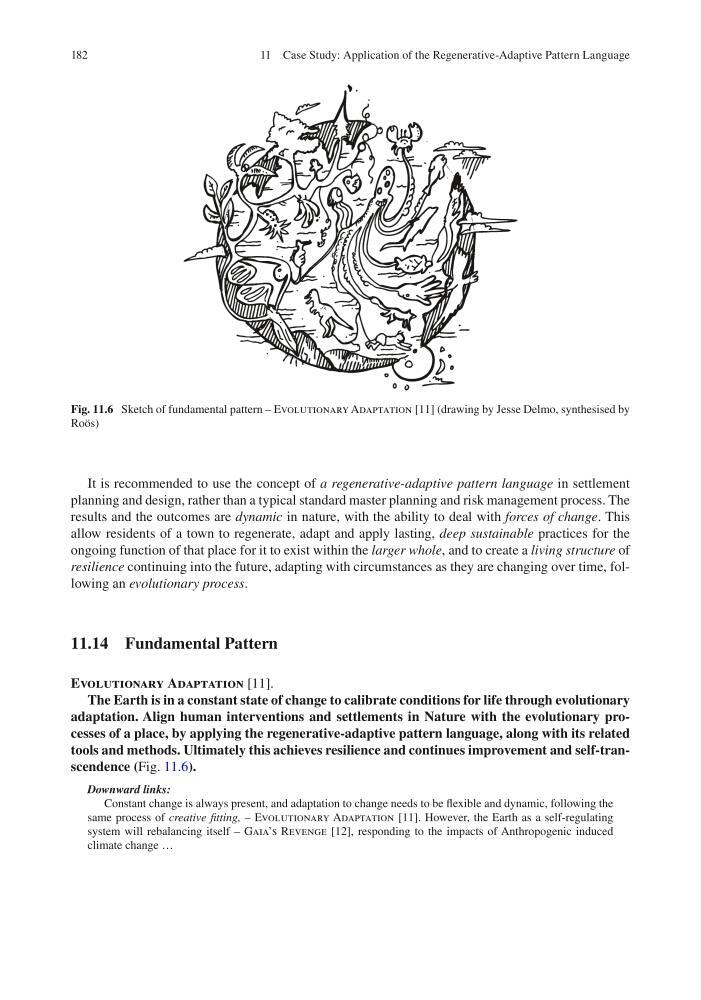
The Earth is in a constant state of change to calibrate conditions for life through evolutionary
adaptation. Align human interventions and settlements in Nature with the evolutionary processes of a place, by applying the regenerative-adaptive pattern language, along with its related
tools and methods. Ultimately this achieves resilience and continues improvement and self-transcendence (Fig. 11.6).
Downward links:
Constant change is always present, and adaptation to change needs to be flexible and dynamic, following the
same process of creative fitting, – Evolutionary Adaptation [11]. However, the Earth as a self-regulating
system will rebalancing itself – Gaia’s Revenge [12], responding to the impacts of Anthropogenic induced
climate change …
Fig. 11.6 Sketch of fundamental pattern – Evolutionary Adaptation [11] (drawing by Jesse Delmo, synthesised by
Roös)
11 Case Study: Application of the Regenerative-Adaptive Pattern Language
It is recommended to use the concept of a regenerative-adaptive pattern language in settlement
planning and design, rather than a typical standard master planning and risk management process. The
results and the outcomes are dynamic in nature, with the ability to deal with forces of change. This
allow residents of a town to regenerate, adapt and apply lasting, deep sustainable practices for the
ongoing function of that place for it to exist within the larger whole, and to create a living structure of
resilience continuing into the future, adapting with circumstances as they are changing over time, following an evolutionary process.
11.14 Fundamental Pattern
Evolutionary Adaptation [11].
The Earth is in a constant state of change to calibrate conditions for life through evolutionary
adaptation. Align human interventions and settlements in Nature with the evolutionary processes of a place, by applying the regenerative-adaptive pattern language, along with its related
tools and methods. Ultimately this achieves resilience and continues improvement and self-transcendence (Fig. 11.6).
Downward links:
Constant change is always present, and adaptation to change needs to be flexible and dynamic, following the
same process of creative fitting, – Evolutionary Adaptation [11]. However, the Earth as a self-regulating
system will rebalancing itself – Gaia’s Revenge [12], responding to the impacts of Anthropogenic induced
climate change …
Fig. 11.6 Sketch of fundamental pattern – Evolutionary Adaptation [11] (drawing by Jesse Delmo, synthesised by
Roös)
11 Case Study: Application of the Regenerative-Adaptive Pattern Language