

179
The potential is there for Anglesea to be celebrated and to thrive long term, rather than just surviving in a less diverse and inhospitable world due to Gaia’s Revenge [12]. Therefore, acknowledge that
the Earth is regulating itself and providing conditions for life. Thus we need to consciously make
decisions for human habitation that is supportive, embedded and part of The Whole [1].
11.12 Adaptive Planning and Design of Place
Making use of the regenerative-adaptive design model results in an integrated process of adaptation
planning, regenerative design, and the application of the regenerative-adaptive patterns. However,
the impacts of climate change to Anglesea need to be identified, and vulnerabilities established first,
then integrated with the regenerative-adaptive design model. The first step for climate change risk
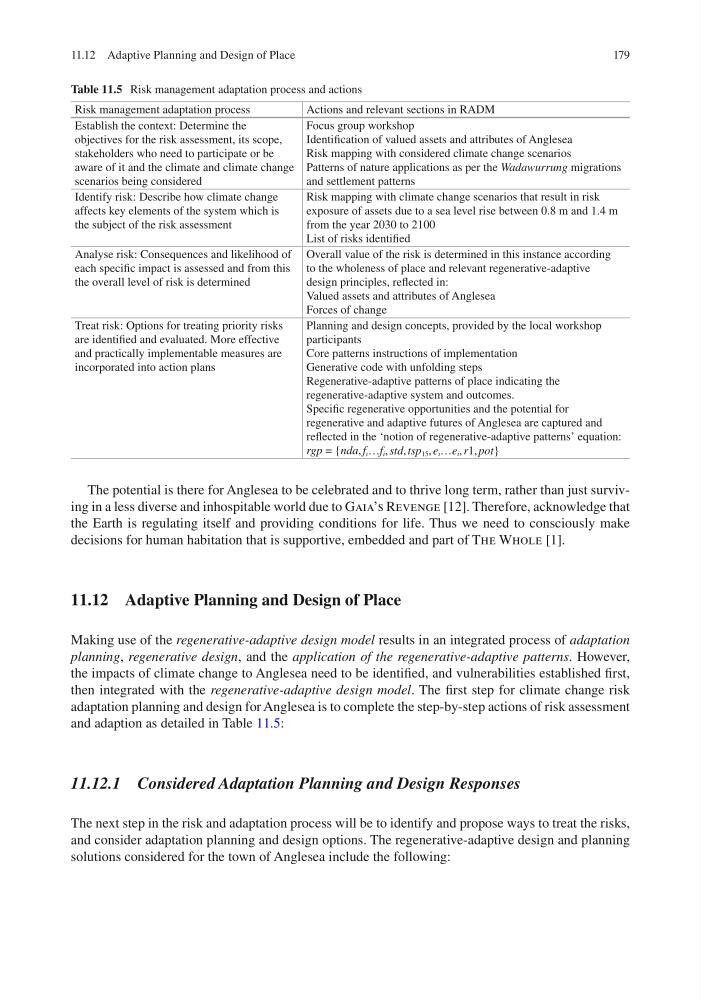
adaptation planning and design for Anglesea is to complete the step- by- step actions of risk assessment
and adaption as detailed in Table 11.5:
11.12.1 Considered Adaptation Planning and Design Responses
The next step in the risk and adaptation process will be to identify and propose ways to treat the risks,
and consider adaptation planning and design options. The regenerative-adaptive design and planning
solutions considered for the town of Anglesea include the following:
Table 11.5 Risk management adaptation process and actions
Risk management adaptation process
Actions and relevant sections in RADM
Establish the context: Determine the
objectives for the risk assessment, its scope,
stakeholders who need to participate or be
aware of it and the climate and climate change
scenarios being considered
Focus group workshop
Identification of valued assets and attributes of Anglesea
Risk mapping with considered climate change scenarios
Patterns of nature applications as per the Wadawurrung migrations
and settlement patterns
Identify risk: Describe how climate change
affects key elements of the system which is
the subject of the risk assessment
Risk mapping with climate change scenarios that result in risk
exposure of assets due to a sea level rise between 0.8 m and 1.4 m
from the year 2030 to 2100
List of risks identified
Analyse risk: Consequences and likelihood of
each specific impact is assessed and from this
the overall level of risk is determined
Overall value of the risk is determined in this instance according
to the wholeness of place and relevant regenerative-adaptive
design principles, reflected in:
Valued assets and attributes of Anglesea
Forces of change
Treat risk: Options for treating priority risks
are identified and evaluated. More effective
and practically implementable measures are
incorporated into action plans
Planning and design concepts, provided by the local workshop
participants
Core patterns instructions of implementation
Generative code with unfolding steps
Regenerative-adaptive patterns of place indicating the
regenerative-adaptive system and outcomes.
Specific regenerative opportunities and the potential for
regenerative and adaptive futures of Anglesea are captured and
reflected in the ‘notion of regenerative-adaptive patterns’ equation:
rgp = {nda, f ı …f i , std, tsp 15 , e ı …e i , r1, pot}
11.12 Adaptive Planning and Design of Place
The potential is there for Anglesea to be celebrated and to thrive long term, rather than just surviving in a less diverse and inhospitable world due to Gaia’s Revenge [12]. Therefore, acknowledge that
the Earth is regulating itself and providing conditions for life. Thus we need to consciously make
decisions for human habitation that is supportive, embedded and part of The Whole [1].
11.12 Adaptive Planning and Design of Place
Making use of the regenerative-adaptive design model results in an integrated process of adaptation
planning, regenerative design, and the application of the regenerative-adaptive patterns. However,
the impacts of climate change to Anglesea need to be identified, and vulnerabilities established first,
then integrated with the regenerative-adaptive design model. The first step for climate change risk
adaptation planning and design for Anglesea is to complete the step- by- step actions of risk assessment
and adaption as detailed in Table 11.5:
11.12.1 Considered Adaptation Planning and Design Responses
The next step in the risk and adaptation process will be to identify and propose ways to treat the risks,
and consider adaptation planning and design options. The regenerative-adaptive design and planning
solutions considered for the town of Anglesea include the following:
Table 11.5 Risk management adaptation process and actions
Risk management adaptation process
Actions and relevant sections in RADM
Establish the context: Determine the
objectives for the risk assessment, its scope,
stakeholders who need to participate or be
aware of it and the climate and climate change
scenarios being considered
Focus group workshop
Identification of valued assets and attributes of Anglesea
Risk mapping with considered climate change scenarios
Patterns of nature applications as per the Wadawurrung migrations
and settlement patterns
Identify risk: Describe how climate change
affects key elements of the system which is
the subject of the risk assessment
Risk mapping with climate change scenarios that result in risk
exposure of assets due to a sea level rise between 0.8 m and 1.4 m
from the year 2030 to 2100
List of risks identified
Analyse risk: Consequences and likelihood of
each specific impact is assessed and from this
the overall level of risk is determined
Overall value of the risk is determined in this instance according
to the wholeness of place and relevant regenerative-adaptive
design principles, reflected in:
Valued assets and attributes of Anglesea
Forces of change
Treat risk: Options for treating priority risks
are identified and evaluated. More effective
and practically implementable measures are
incorporated into action plans
Planning and design concepts, provided by the local workshop
participants
Core patterns instructions of implementation
Generative code with unfolding steps
Regenerative-adaptive patterns of place indicating the
regenerative-adaptive system and outcomes.
Specific regenerative opportunities and the potential for
regenerative and adaptive futures of Anglesea are captured and
reflected in the ‘notion of regenerative-adaptive patterns’ equation:
rgp = {nda, f ı …f i , std, tsp 15 , e ı …e i , r1, pot}
11.12 Adaptive Planning and Design of Place