

162
11.1 Introduction
In every walk with nature one receives far more than one seeks (John Muir, 1877)
Reading through all the chapters of this book starting from Chap. 1 will help form a narrative on
how the overall regenerative-adaptive pattern language fits together. However, up to this point it is
possible for the reader to raise the question of how all of this can be applied to a real place, and conclude that it is complex. Further, the enormous complexity of the topic can cause confusion, and
indeed it is not uncommon that the understanding of a pattern language theory causes this puzzlement
in many instances (Neis, Brown, Gurr, & Schmidt, 2012). Knowledge of patterns and the pattern
language theory are useful when applied to a real problem, and further reading is recommended to
grasp this understanding. Recommended readings include A Pattern Language (Alexander et al.,
1977); The Timeless Way of Building (Alexander, 1979); Chaps. 1 and 5 in The Nature of Order, Book
One, The Phenomenon of Life (Alexander, 2001–2005a); Chap. 2 in The Nature of Order, Book Two,
The Process of Creating Life (Alexander, 2001–2005b); and Chap. 7 – Form Languages and Their
Vocabulary in Unified Architectural Theory: Form, Language, Complexity (Salingaros, 2013)
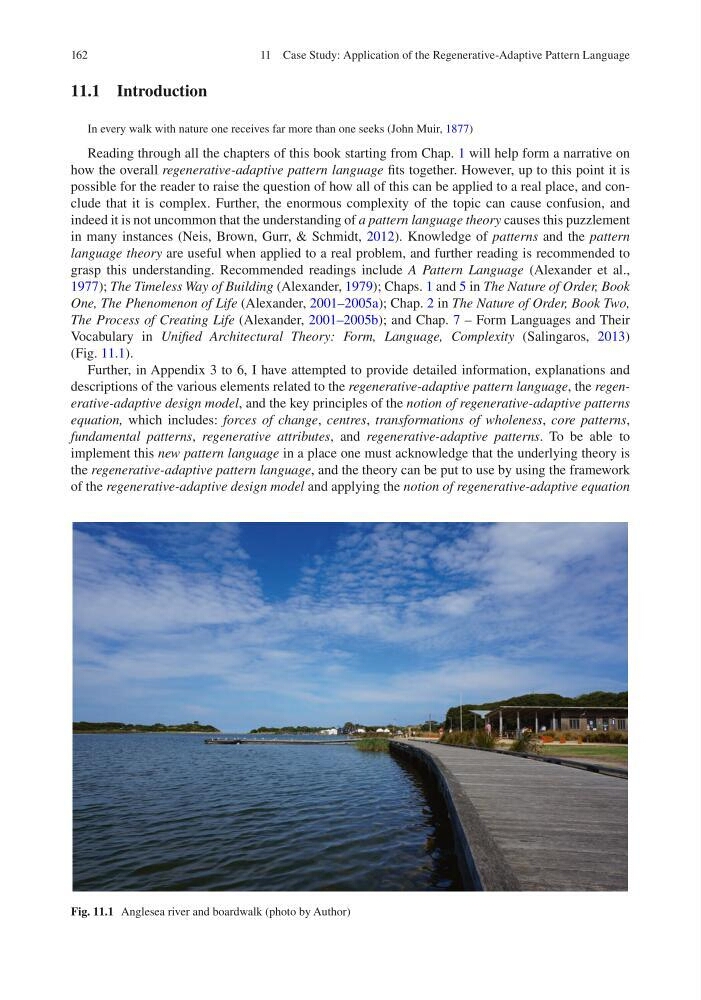
(Fig. 11.1).
Further, in Appendix 3 to 6, I have attempted to provide detailed information, explanations and
descriptions of the various elements related to the regenerative-adaptive pattern language, the regenerative-adaptive design model, and the key principles of the notion of regenerative-adaptive patterns
equation, which includes: forces of change, centres, transformations of wholeness, core patterns,
fundamental patterns, regenerative attributes, and regenerative-adaptive patterns. To be able to
implement this new pattern language in a place one must acknowledge that the underlying theory is
the regenerative-adaptive pattern language, and the theory can be put to use by using the framework
of the regenerative- adaptive design model and applying the notion of regenerative-adaptive equation
Fig. 11.1 Anglesea river and boardwalk (photo by Author)
11 Case Study: Application of the Regenerative-Adaptive Pattern Language
11.1 Introduction
In every walk with nature one receives far more than one seeks (John Muir, 1877)
Reading through all the chapters of this book starting from Chap. 1 will help form a narrative on
how the overall regenerative-adaptive pattern language fits together. However, up to this point it is
possible for the reader to raise the question of how all of this can be applied to a real place, and conclude that it is complex. Further, the enormous complexity of the topic can cause confusion, and
indeed it is not uncommon that the understanding of a pattern language theory causes this puzzlement
in many instances (Neis, Brown, Gurr, & Schmidt, 2012). Knowledge of patterns and the pattern
language theory are useful when applied to a real problem, and further reading is recommended to
grasp this understanding. Recommended readings include A Pattern Language (Alexander et al.,
1977); The Timeless Way of Building (Alexander, 1979); Chaps. 1 and 5 in The Nature of Order, Book
One, The Phenomenon of Life (Alexander, 2001–2005a); Chap. 2 in The Nature of Order, Book Two,
The Process of Creating Life (Alexander, 2001–2005b); and Chap. 7 – Form Languages and Their
Vocabulary in Unified Architectural Theory: Form, Language, Complexity (Salingaros, 2013)
(Fig. 11.1).
Further, in Appendix 3 to 6, I have attempted to provide detailed information, explanations and
descriptions of the various elements related to the regenerative-adaptive pattern language, the regenerative-adaptive design model, and the key principles of the notion of regenerative-adaptive patterns
equation, which includes: forces of change, centres, transformations of wholeness, core patterns,
fundamental patterns, regenerative attributes, and regenerative-adaptive patterns. To be able to
implement this new pattern language in a place one must acknowledge that the underlying theory is
the regenerative-adaptive pattern language, and the theory can be put to use by using the framework
of the regenerative- adaptive design model and applying the notion of regenerative-adaptive equation
Fig. 11.1 Anglesea river and boardwalk (photo by Author)
11 Case Study: Application of the Regenerative-Adaptive Pattern Language