

156
• Forces of change: Identify forces of change that can impact the sustainable future of the place,
including risk to social, economic, and environmental, cultural-heritage, and built and natural
attributes;
• Potential of place: What is the vocation of the place, what is unique to it that has the potential to
contribute to the wholeness of the larger system of which it forms part;
• Regenerative patterns: The combination of the various processes of the place, accumulating to support its morphological growth and regeneration, give it characteristics for resilience and allow it to
adapt to changes;
• Regenerative-adaptive pattern language: The overall pattern language for the place connecting all
attributes and the ‘notion of regenerative- adaptive patterns’ with the fundamental patterns; and
• Adaptation planning and design: Use of the regenerative-adaptive pattern language and the regenerative-adaptive processes, principles and qualities of place as an input for an adaptation framework that can inform adaptation responses, contributing to the overall implementation of the
Regenerative-adaptive design model.
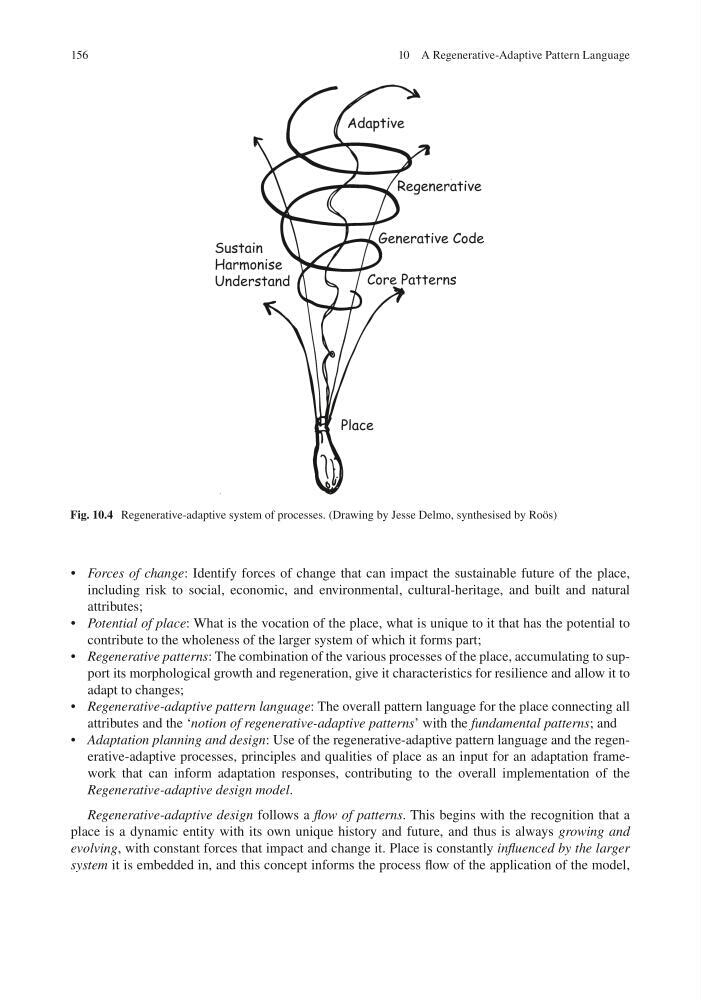
Regenerative-adaptive design follows a flow of patterns. This begins with the recognition that a
place is a dynamic entity with its own unique history and future, and thus is always growing and
evolving, with constant forces that impact and change it. Place is constantly influenced by the larger
system it is embedded in, and this concept informs the process flow of the application of the model,
Fig. 10.4 Regenerative-adaptive system of processes. (Drawing by Jesse Delmo, synthesised by Roös)
10 A Regenerative-Adaptive Pattern Language
• Forces of change: Identify forces of change that can impact the sustainable future of the place,
including risk to social, economic, and environmental, cultural-heritage, and built and natural
attributes;
• Potential of place: What is the vocation of the place, what is unique to it that has the potential to
contribute to the wholeness of the larger system of which it forms part;
• Regenerative patterns: The combination of the various processes of the place, accumulating to support its morphological growth and regeneration, give it characteristics for resilience and allow it to
adapt to changes;
• Regenerative-adaptive pattern language: The overall pattern language for the place connecting all
attributes and the ‘notion of regenerative- adaptive patterns’ with the fundamental patterns; and
• Adaptation planning and design: Use of the regenerative-adaptive pattern language and the regenerative-adaptive processes, principles and qualities of place as an input for an adaptation framework that can inform adaptation responses, contributing to the overall implementation of the
Regenerative-adaptive design model.
Regenerative-adaptive design follows a flow of patterns. This begins with the recognition that a
place is a dynamic entity with its own unique history and future, and thus is always growing and
evolving, with constant forces that impact and change it. Place is constantly influenced by the larger
system it is embedded in, and this concept informs the process flow of the application of the model,
Fig. 10.4 Regenerative-adaptive system of processes. (Drawing by Jesse Delmo, synthesised by Roös)
10 A Regenerative-Adaptive Pattern Language