

151
of both? Borchers’ equation (Borchers, 2008), as identified in Chap. 9, has been used and adapted to
provide a new approach for adaptation to climate change through a generative process. The fundamental philosophy behind this approach is to include the human, built and natural environments as a
whole interconnected system. This consideration of the whole interconnected system is represented
within the new regenerative-adaptive pattern language, and analysed for application through the
development of a ‘notion of regenerative- adaptive patterns’ equation.
10.5 The Notion of Regenerative- Adaptive Patterns Equation
During my research and investigations for more than 9 years to develop the theory of a RegenerativeAdaptive Pattern Language, I have tested Borchers’ equation of the notion of patterns through further
research of the work of Weick (1979), Dell (2002) and Stark (2012). Stark explored the innovative and
creative actions of communities and organisations. While some social systems manage to adapt to
today’s complex world and are able to re-design their structure and environment using the potential
available, other social systems are not be able to do this. Exploring these phenomena, Stark used a
methodological approach, which aims to identify the patterns of innovative cultures in communities
and organisations, by using improvisation (Dell, 2002; Stark, 2012; Weick, 1979). His analyses were
based on Alexander’s A Pattern Language (Alexander et al., 1977), and for application to social structures and organisations, Stark adapted Borcher’s notion of patterns and developed an equation that
can be applied to the complex phenomena of social and organisational interactions (Stark, 2012,
p. 92). Upon further investigation of Stark’s equation, I found that this was more dynamic and adaptable than Borchers’ ‘notion of patterns’ one, which tends to be static. This is similar to what has been
criticized about Alexander’s Pattern Language,
1
focusing on the functional aspects of space and not
on the geometry of unfolding sequences of patterns in it (Pontikis, 2012). A comparison of Borchers’
‘notion of patterns’ equation and Stark’s equation are described in Appendix 2.
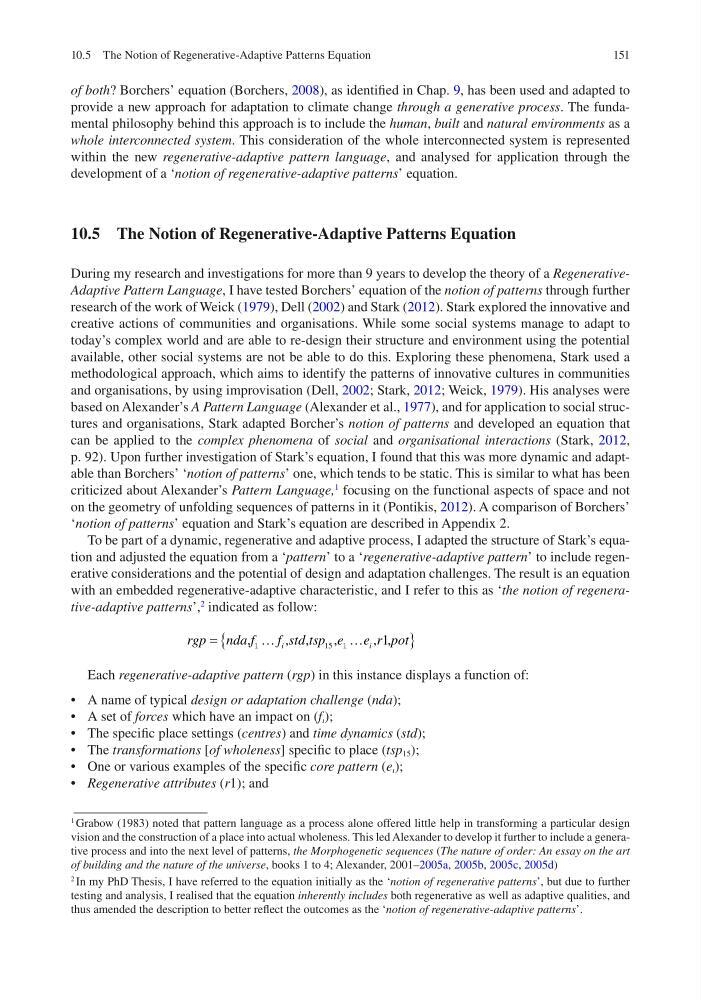
To be part of a dynamic, regenerative and adaptive process, I adapted the structure of Stark’s equation and adjusted the equation from a ‘pattern’ to a ‘regenerative-adaptive pattern’ to include regenerative considerations and the potential of design and adaptation challenges. The result is an equation
with an embedded regenerative-adaptive characteristic, and I refer to this as ‘the notion of regenerative-adaptive patterns’,
2
indicated as follow:
rgp nda f
f std tsp e e r pot
i
i
=
…
…
{
}
,
, ,
,
, ,
1
1
15
1
Each regenerative-adaptive pattern (rgp) in this instance displays a function of:
• A name of typical design or adaptation challenge (nda);
• A set of forces which have an impact on (f ı );
• The specific place settings (centres) and time dynamics (std);
• The transformations [of wholeness] specific to place (tsp 15 );
• One or various examples of the specific core pattern (e ı );
• Regenerative attributes (r1); and
1 Grabow (1983) noted that pattern language as a process alone offered little help in transforming a particular design
vision and the construction of a place into actual wholeness. This led Alexander to develop it further to include a generative process and into the next level of patterns, the Morphogenetic sequences (The nature of order: An essay on the art
of building and the nature of the universe, books 1 to 4; Alexander, 2001–2005a, 2005b, 2005c, 2005d)
2 In my PhD Thesis, I have referred to the equation initially as the ‘notion of regenerative patterns’, but due to further
testing and analysis, I realised that the equation inherently includes both regenerative as well as adaptive qualities, and
thus amended the description to better reflect the outcomes as the ‘notion of regenerative-adaptive patterns’.
10.5 The Notion of Regenerative-Adaptive Patterns Equation
of both? Borchers’ equation (Borchers, 2008), as identified in Chap. 9, has been used and adapted to
provide a new approach for adaptation to climate change through a generative process. The fundamental philosophy behind this approach is to include the human, built and natural environments as a
whole interconnected system. This consideration of the whole interconnected system is represented
within the new regenerative-adaptive pattern language, and analysed for application through the
development of a ‘notion of regenerative- adaptive patterns’ equation.
10.5 The Notion of Regenerative- Adaptive Patterns Equation
During my research and investigations for more than 9 years to develop the theory of a RegenerativeAdaptive Pattern Language, I have tested Borchers’ equation of the notion of patterns through further
research of the work of Weick (1979), Dell (2002) and Stark (2012). Stark explored the innovative and
creative actions of communities and organisations. While some social systems manage to adapt to
today’s complex world and are able to re-design their structure and environment using the potential
available, other social systems are not be able to do this. Exploring these phenomena, Stark used a
methodological approach, which aims to identify the patterns of innovative cultures in communities
and organisations, by using improvisation (Dell, 2002; Stark, 2012; Weick, 1979). His analyses were
based on Alexander’s A Pattern Language (Alexander et al., 1977), and for application to social structures and organisations, Stark adapted Borcher’s notion of patterns and developed an equation that
can be applied to the complex phenomena of social and organisational interactions (Stark, 2012,
p. 92). Upon further investigation of Stark’s equation, I found that this was more dynamic and adaptable than Borchers’ ‘notion of patterns’ one, which tends to be static. This is similar to what has been
criticized about Alexander’s Pattern Language,
1
focusing on the functional aspects of space and not
on the geometry of unfolding sequences of patterns in it (Pontikis, 2012). A comparison of Borchers’
‘notion of patterns’ equation and Stark’s equation are described in Appendix 2.
To be part of a dynamic, regenerative and adaptive process, I adapted the structure of Stark’s equation and adjusted the equation from a ‘pattern’ to a ‘regenerative-adaptive pattern’ to include regenerative considerations and the potential of design and adaptation challenges. The result is an equation
with an embedded regenerative-adaptive characteristic, and I refer to this as ‘the notion of regenerative-adaptive patterns’,
2
indicated as follow:
rgp nda f
f std tsp e e r pot
i
i
=
…
…
{
}
,
, ,
,
, ,
1
1
15
1
Each regenerative-adaptive pattern (rgp) in this instance displays a function of:
• A name of typical design or adaptation challenge (nda);
• A set of forces which have an impact on (f ı );
• The specific place settings (centres) and time dynamics (std);
• The transformations [of wholeness] specific to place (tsp 15 );
• One or various examples of the specific core pattern (e ı );
• Regenerative attributes (r1); and
1 Grabow (1983) noted that pattern language as a process alone offered little help in transforming a particular design
vision and the construction of a place into actual wholeness. This led Alexander to develop it further to include a generative process and into the next level of patterns, the Morphogenetic sequences (The nature of order: An essay on the art
of building and the nature of the universe, books 1 to 4; Alexander, 2001–2005a, 2005b, 2005c, 2005d)
2 In my PhD Thesis, I have referred to the equation initially as the ‘notion of regenerative patterns’, but due to further
testing and analysis, I realised that the equation inherently includes both regenerative as well as adaptive qualities, and
thus amended the description to better reflect the outcomes as the ‘notion of regenerative-adaptive patterns’.
10.5 The Notion of Regenerative-Adaptive Patterns Equation