

121
Each place has a unique character, and the visible (and non-visible) patterns of that place form a
pattern language. When people of a community shape buildings and a town, these patterns grow
through the process of unfolding. Alexander calls this ‘genetic code’ a ‘pattern language’ (Alexander,
1979). According to Borchers (2008), the notion of patterns in a pattern language, used in the fields
of architecture, software design or sustainable innovation, will follow the following formal principles:
Each pattern is a set p = {n, f ı …f i , s, e ı …e i } of a name n, forces f ı …f i , the solution s, and examples e ı …e i . It
describes a commonly encountered design problem and suggests a solution that has been proven useful in this
situation. A pattern language is a directed acyclic graph with each mode represents a pattern. There is a directed
edge from pattern p1 to p2 if p1 recruits p2 to complete its solution. Edges pointing away from a pattern are its
consequences, showing what lower levels of pattern need to be applied next. Edges pointing to a pattern are its
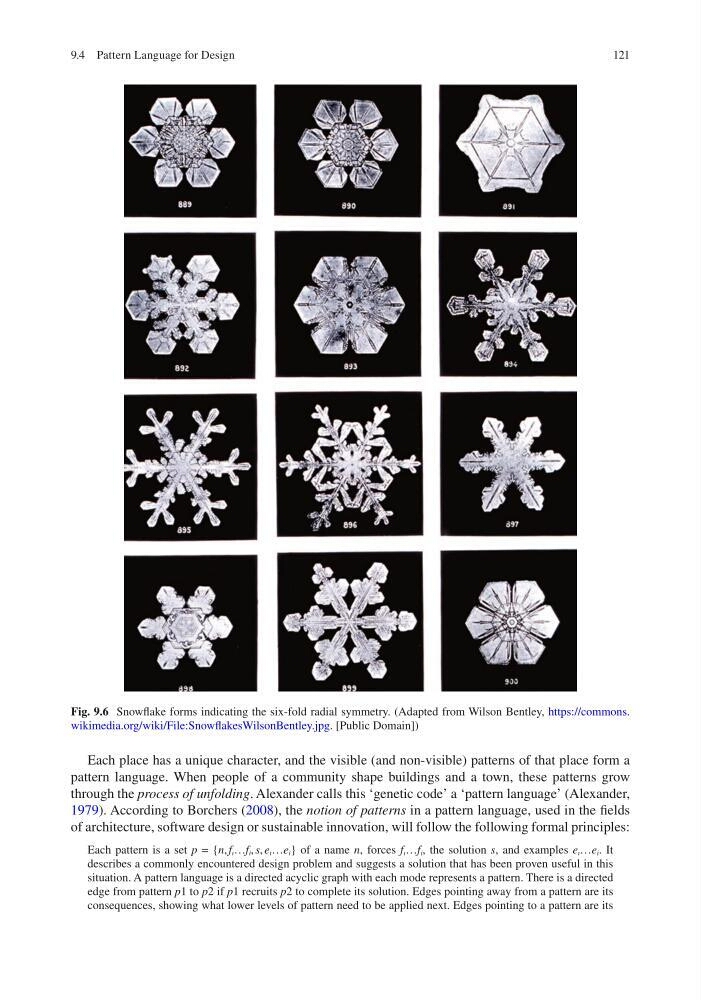
Fig. 9.6 Snowflake forms indicating the six-fold radial symmetry. (Adapted from Wilson Bentley, https://commons.
wikimedia.org/wiki/File:SnowflakesWilsonBentley.jpg. [Public Domain])
9.4 Pattern Language for Design
Each place has a unique character, and the visible (and non-visible) patterns of that place form a
pattern language. When people of a community shape buildings and a town, these patterns grow
through the process of unfolding. Alexander calls this ‘genetic code’ a ‘pattern language’ (Alexander,
1979). According to Borchers (2008), the notion of patterns in a pattern language, used in the fields
of architecture, software design or sustainable innovation, will follow the following formal principles:
Each pattern is a set p = {n, f ı …f i , s, e ı …e i } of a name n, forces f ı …f i , the solution s, and examples e ı …e i . It
describes a commonly encountered design problem and suggests a solution that has been proven useful in this
situation. A pattern language is a directed acyclic graph with each mode represents a pattern. There is a directed
edge from pattern p1 to p2 if p1 recruits p2 to complete its solution. Edges pointing away from a pattern are its
consequences, showing what lower levels of pattern need to be applied next. Edges pointing to a pattern are its
Fig. 9.6 Snowflake forms indicating the six-fold radial symmetry. (Adapted from Wilson Bentley, https://commons.
wikimedia.org/wiki/File:SnowflakesWilsonBentley.jpg. [Public Domain])
9.4 Pattern Language for Design