

114
language once again, we must first learn how to discover patterns which are deep, and capable of generating life
(Alexander et al., 1977, pp. 245–246).
In my quest to find an Architecture for Life, I often asked the question: what are the fundamental
requirements for design and building to create objects that are inherently living structures? Nature is
full of living structures that create wholeness. In this chapter I further investigate in detail Alexander’s
(2001–2005a, 2001–2005b) explanation of his hypothesis that morphogenesis is the fundamental process of wholeness in nature. Alexander argues that the process in nature does not use a ‘plan’ in the
development of organisms, but rather it acts to transform an existing whole into a new whole through
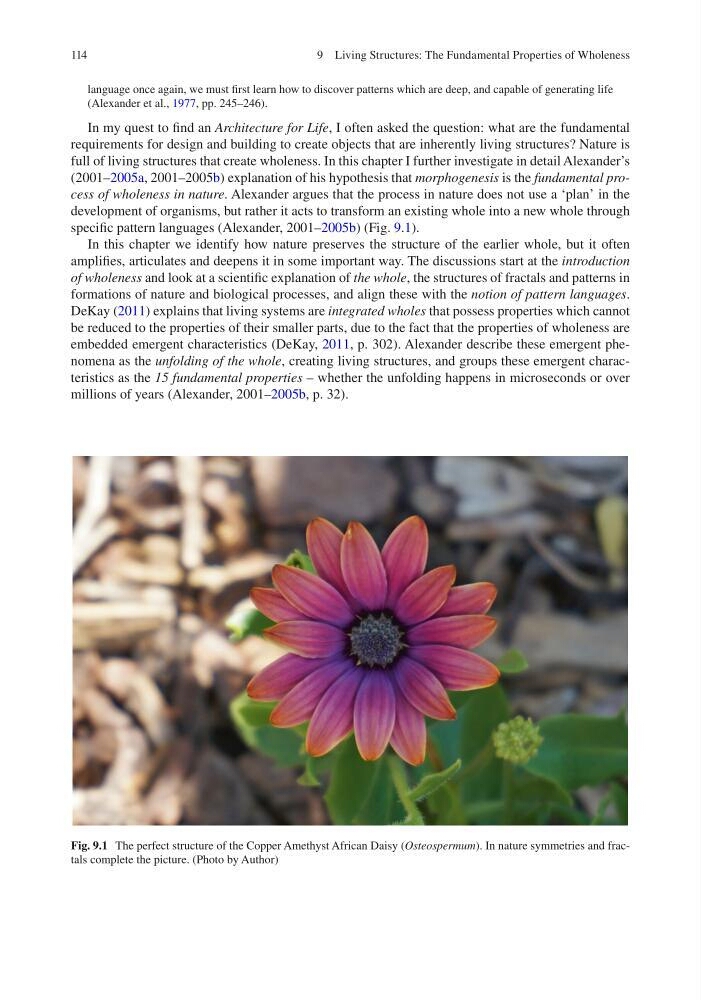
specific pattern languages (Alexander, 2001–2005b) (Fig. 9.1).
In this chapter we identify how nature preserves the structure of the earlier whole, but it often
amplifies, articulates and deepens it in some important way. The discussions start at the introduction
of wholeness and look at a scientific explanation of the whole, the structures of fractals and patterns in
formations of nature and biological processes, and align these with the notion of pattern languages.
DeKay (2011) explains that living systems are integrated wholes that possess properties which cannot
be reduced to the properties of their smaller parts, due to the fact that the properties of wholeness are
embedded emergent characteristics (DeKay, 2011, p. 302). Alexander describe these emergent phenomena as the unfolding of the whole, creating living structures, and groups these emergent characteristics as the 15 fundamental properties – whether the unfolding happens in microseconds or over
millions of years (Alexander, 2001–2005b, p. 32).
Fig. 9.1 The perfect structure of the Copper Amethyst African Daisy (Osteospermum). In nature symmetries and fractals complete the picture. (Photo by Author)
9 Living Structures: The Fundamental Properties of Wholeness
language once again, we must first learn how to discover patterns which are deep, and capable of generating life
(Alexander et al., 1977, pp. 245–246).
In my quest to find an Architecture for Life, I often asked the question: what are the fundamental
requirements for design and building to create objects that are inherently living structures? Nature is
full of living structures that create wholeness. In this chapter I further investigate in detail Alexander’s
(2001–2005a, 2001–2005b) explanation of his hypothesis that morphogenesis is the fundamental process of wholeness in nature. Alexander argues that the process in nature does not use a ‘plan’ in the
development of organisms, but rather it acts to transform an existing whole into a new whole through
specific pattern languages (Alexander, 2001–2005b) (Fig. 9.1).
In this chapter we identify how nature preserves the structure of the earlier whole, but it often
amplifies, articulates and deepens it in some important way. The discussions start at the introduction
of wholeness and look at a scientific explanation of the whole, the structures of fractals and patterns in
formations of nature and biological processes, and align these with the notion of pattern languages.
DeKay (2011) explains that living systems are integrated wholes that possess properties which cannot
be reduced to the properties of their smaller parts, due to the fact that the properties of wholeness are
embedded emergent characteristics (DeKay, 2011, p. 302). Alexander describe these emergent phenomena as the unfolding of the whole, creating living structures, and groups these emergent characteristics as the 15 fundamental properties – whether the unfolding happens in microseconds or over
millions of years (Alexander, 2001–2005b, p. 32).
Fig. 9.1 The perfect structure of the Copper Amethyst African Daisy (Osteospermum). In nature symmetries and fractals complete the picture. (Photo by Author)
9 Living Structures: The Fundamental Properties of Wholeness