

111
To achieve regenerative outcomes that include the adaptive capacity, the need is there to identify
the patterns of relationships between systems as clues to how systems and processes are sustained and
self-organized, and how emerging adaptive outcomes are produced by these systems. The patterns
have the potential to reveal the directionality, emergence and nature of the processes within the overall
regenerative cycle (Gauthier, 2013; Michael & Meacham, 1998; Marvick & Murphy, 1998). Patterns
should also reveal adaptability. These patterns collectively will result in a language that can be continuing, adaptive and resilient. Reed (2007) argues that the regenerative methodology should begin by
‘attempting to understand how the systems of life work in each unique place’ (Reed, 2007, p. 1). What
this indicates is that it is about the understanding of the patterns that are unique to a place. In order to
maximize the potential of regenerative development processes, patterns form the clues to the rationale
behind the place-based process (Capra, 1996).
Therefore:
To understand the regenerative process of a whole system that is part of The Whole [1] is to
understand the patterns and the generation of the system in the first place. Patterns provide a placebased understanding of the integrated human and ecological systems, which can only be appreciated
through exploring the nature of generation processes and their relationship to patterns and pattern
languages. It is thus important to apply to the practice of regenerative design the stipulations of generative processes from both human and ecological systems as part of the sustainable development
discourse.
8.5 Fundamental Pattern 8
Regenerative Ecosystems [8]
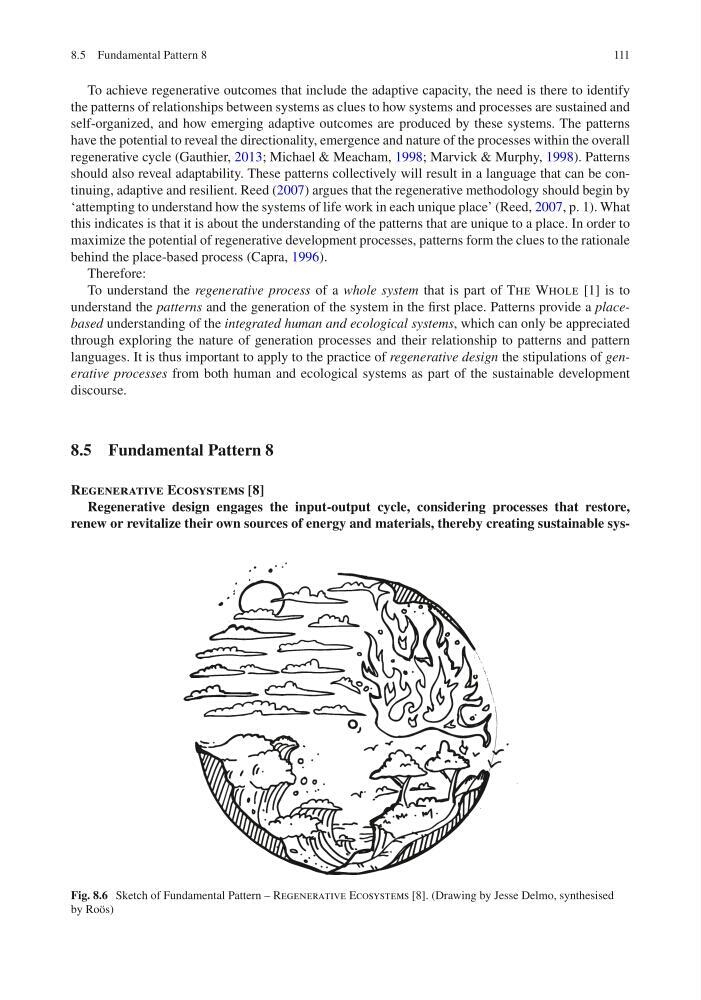
Regenerative design engages the input- output cycle, considering processes that restore,
renew or revitalize their own sources of energy and materials, thereby creating sustainable sysFig. 8.6 Sketch of Fundamental Pattern – Regenerative Ecosystems [8]. (Drawing by Jesse Delmo, synthesised
by Roös)
8.5 Fundamental Pattern 8
To achieve regenerative outcomes that include the adaptive capacity, the need is there to identify
the patterns of relationships between systems as clues to how systems and processes are sustained and
self-organized, and how emerging adaptive outcomes are produced by these systems. The patterns
have the potential to reveal the directionality, emergence and nature of the processes within the overall
regenerative cycle (Gauthier, 2013; Michael & Meacham, 1998; Marvick & Murphy, 1998). Patterns
should also reveal adaptability. These patterns collectively will result in a language that can be continuing, adaptive and resilient. Reed (2007) argues that the regenerative methodology should begin by
‘attempting to understand how the systems of life work in each unique place’ (Reed, 2007, p. 1). What
this indicates is that it is about the understanding of the patterns that are unique to a place. In order to
maximize the potential of regenerative development processes, patterns form the clues to the rationale
behind the place-based process (Capra, 1996).
Therefore:
To understand the regenerative process of a whole system that is part of The Whole [1] is to
understand the patterns and the generation of the system in the first place. Patterns provide a placebased understanding of the integrated human and ecological systems, which can only be appreciated
through exploring the nature of generation processes and their relationship to patterns and pattern
languages. It is thus important to apply to the practice of regenerative design the stipulations of generative processes from both human and ecological systems as part of the sustainable development
discourse.
8.5 Fundamental Pattern 8
Regenerative Ecosystems [8]
Regenerative design engages the input- output cycle, considering processes that restore,
renew or revitalize their own sources of energy and materials, thereby creating sustainable sysFig. 8.6 Sketch of Fundamental Pattern – Regenerative Ecosystems [8]. (Drawing by Jesse Delmo, synthesised
by Roös)
8.5 Fundamental Pattern 8