

100
Downward links:
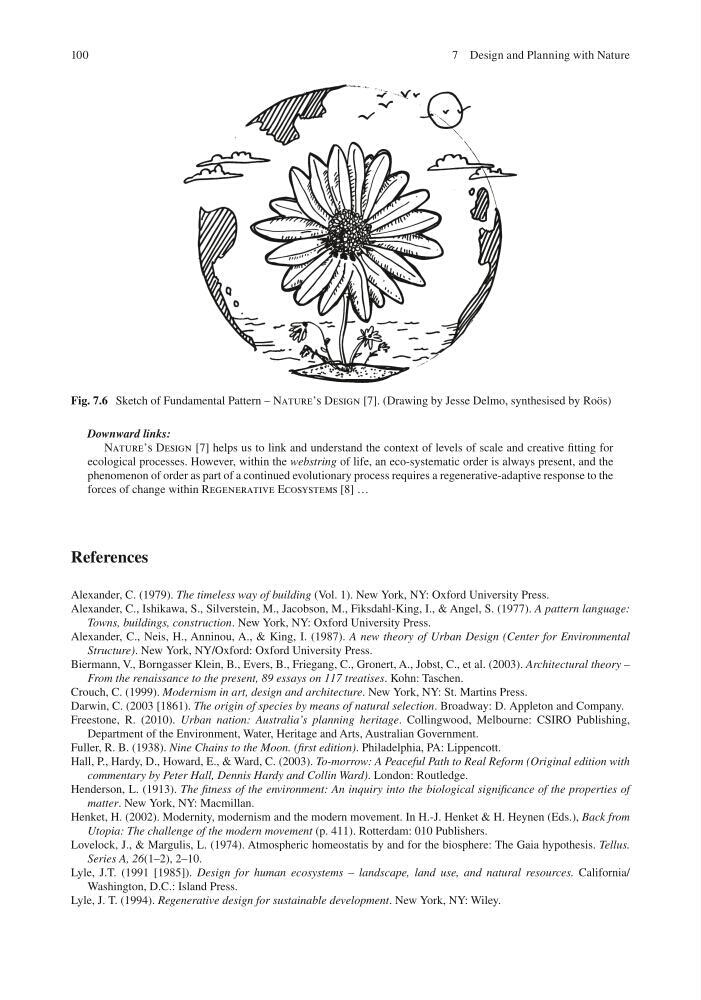
Nature’s Design [7] helps us to link and understand the context of levels of scale and creative fitting for
ecological processes. However, within the webstring of life, an eco-systematic order is always present, and the
phenomenon of order as part of a continued evolutionary process requires a regenerative- adaptive response to the
forces of change within Regenerative Ecosystems [8] …
References
Alexander, C. (1979). The timeless way of building (Vol. 1). New York, NY: Oxford University Press.
Alexander, C., Ishikawa, S., Silverstein, M., Jacobson, M., Fiksdahl-King, I., & Angel, S. (1977). A pattern language:
Towns, buildings, construction. New York, NY: Oxford University Press.
Alexander, C., Neis, H., Anninou, A., & King, I. (1987). A new theory of Urban Design (Center for Environmental
Structure). New York, NY/Oxford: Oxford University Press.
Biermann, V., Borngasser Klein, B., Evers, B., Friegang, C., Gronert, A., Jobst, C., et al. (2003). Architectural theory –
From the renaissance to the present, 89 essays on 117 treatises. Kohn: Taschen.
Crouch, C. (1999). Modernism in art, design and architecture. New York, NY: St. Martins Press.
Darwin, C. (2003 [1861). The origin of species by means of natural selection. Broadway: D. Appleton and Company.
Freestone, R. (2010). Urban nation: Australia’s planning heritage. Collingwood, Melbourne: CSIRO Publishing,
Department of the Environment, Water, Heritage and Arts, Australian Government.
Fuller, R. B. (1938). Nine Chains to the Moon. (first edition). Philadelphia, PA: Lippencott.
Hall, P., Hardy, D., Howard, E., & Ward, C. (2003). To-morrow: A Peaceful Path to Real Reform (Original edition with
commentary by Peter Hall, Dennis Hardy and Collin Ward). London: Routledge.
Henderson, L. (1913). The fitness of the environment: An inquiry into the biological significance of the properties of
matter. New York, NY: Macmillan.
Henket, H. (2002). Modernity, modernism and the modern movement. In H.-J. Henket & H. Heynen (Eds.), Back from
Utopia: The challenge of the modern movement (p. 411). Rotterdam: 010 Publishers.
Lovelock, J., & Margulis, L. (1974). Atmospheric homeostatis by and for the biosphere: The Gaia hypothesis. Tellus.
Series A, 26(1–2), 2–10.
Lyle, J.T. (1991 [1985]). Design for human ecosystems – landscape, land use, and natural resources. California/
Washington, D.C.: Island Press.
Lyle, J. T. (1994). Regenerative design for sustainable development. New York, NY: Wiley.
Fig. 7.6 Sketch of Fundamental Pattern – Nature’s Design [7]. (Drawing by Jesse Delmo, synthesised by Roös)
7 Design and Planning with Nature
Downward links:
Nature’s Design [7] helps us to link and understand the context of levels of scale and creative fitting for
ecological processes. However, within the webstring of life, an eco-systematic order is always present, and the
phenomenon of order as part of a continued evolutionary process requires a regenerative- adaptive response to the
forces of change within Regenerative Ecosystems [8] …
References
Alexander, C. (1979). The timeless way of building (Vol. 1). New York, NY: Oxford University Press.
Alexander, C., Ishikawa, S., Silverstein, M., Jacobson, M., Fiksdahl-King, I., & Angel, S. (1977). A pattern language:
Towns, buildings, construction. New York, NY: Oxford University Press.
Alexander, C., Neis, H., Anninou, A., & King, I. (1987). A new theory of Urban Design (Center for Environmental
Structure). New York, NY/Oxford: Oxford University Press.
Biermann, V., Borngasser Klein, B., Evers, B., Friegang, C., Gronert, A., Jobst, C., et al. (2003). Architectural theory –
From the renaissance to the present, 89 essays on 117 treatises. Kohn: Taschen.
Crouch, C. (1999). Modernism in art, design and architecture. New York, NY: St. Martins Press.
Darwin, C. (2003 [1861). The origin of species by means of natural selection. Broadway: D. Appleton and Company.
Freestone, R. (2010). Urban nation: Australia’s planning heritage. Collingwood, Melbourne: CSIRO Publishing,
Department of the Environment, Water, Heritage and Arts, Australian Government.
Fuller, R. B. (1938). Nine Chains to the Moon. (first edition). Philadelphia, PA: Lippencott.
Hall, P., Hardy, D., Howard, E., & Ward, C. (2003). To-morrow: A Peaceful Path to Real Reform (Original edition with
commentary by Peter Hall, Dennis Hardy and Collin Ward). London: Routledge.
Henderson, L. (1913). The fitness of the environment: An inquiry into the biological significance of the properties of
matter. New York, NY: Macmillan.
Henket, H. (2002). Modernity, modernism and the modern movement. In H.-J. Henket & H. Heynen (Eds.), Back from
Utopia: The challenge of the modern movement (p. 411). Rotterdam: 010 Publishers.
Lovelock, J., & Margulis, L. (1974). Atmospheric homeostatis by and for the biosphere: The Gaia hypothesis. Tellus.
Series A, 26(1–2), 2–10.
Lyle, J.T. (1991 [1985]). Design for human ecosystems – landscape, land use, and natural resources. California/
Washington, D.C.: Island Press.
Lyle, J. T. (1994). Regenerative design for sustainable development. New York, NY: Wiley.
Fig. 7.6 Sketch of Fundamental Pattern – Nature’s Design [7]. (Drawing by Jesse Delmo, synthesised by Roös)
7 Design and Planning with Nature