

79
I undertook this reconnaissance of the Malaysian coasts over a three-plus year
period. For some of the NE Peninsular Malaysia field work, I had help from staff
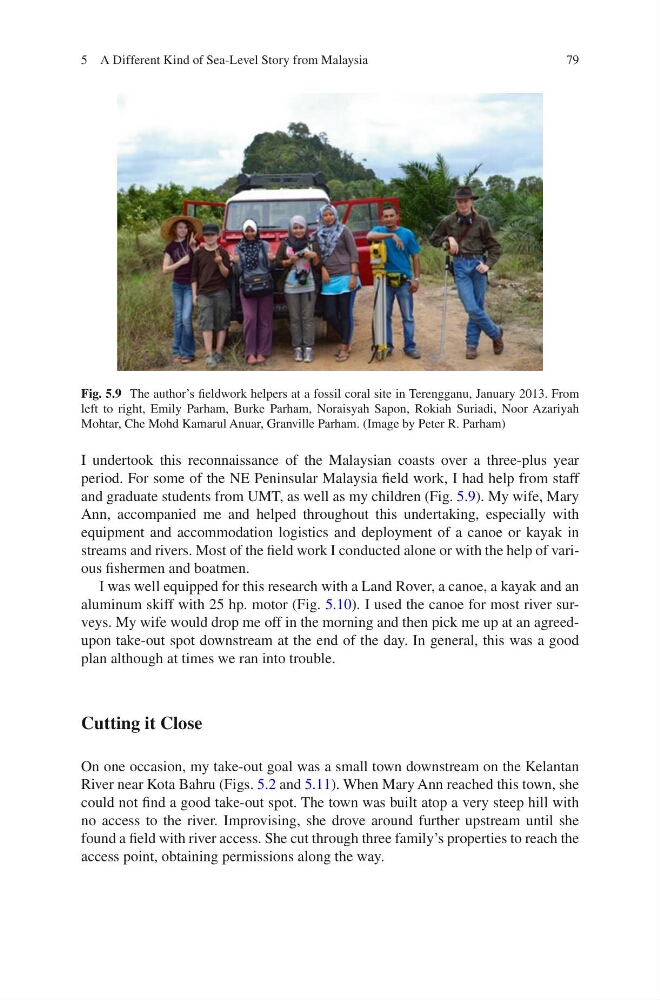
and graduate students from UMT, as well as my children (Fig. 5.9). My wife, Mary
Ann, accompanied me and helped throughout this undertaking, especially with
equipment and accommodation logistics and deployment of a canoe or kayak in
streams and rivers. Most of the field work I conducted alone or with the help of various fishermen and boatmen.
I was well equipped for this research with a Land Rover, a canoe, a kayak and an
aluminum skiff with 25 hp. motor (Fig. 5.10). I used the canoe for most river surveys. My wife would drop me off in the morning and then pick me up at an agreedupon take-out spot downstream at the end of the day. In general, this was a good
plan although at times we ran into trouble.
Cutting it Close
On one occasion, my take-out goal was a small town downstream on the Kelantan
River near Kota Bahru (Figs. 5.2 and 5.11). When Mary Ann reached this town, she
could not find a good take-out spot. The town was built atop a very steep hill with
no access to the river. Improvising, she drove around further upstream until she
found a field with river access. She cut through three family’s properties to reach the
access point, obtaining permissions along the way.
Fig. 5.9 The author’s fieldwork helpers at a fossil coral site in Terengganu, January 2013. From
left to right, Emily Parham, Burke Parham, Noraisyah Sapon, Rokiah Suriadi, Noor Azariyah
Mohtar, Che Mohd Kamarul Anuar, Granville Parham. (Image by Peter R. Parham)
5 A Different Kind of Sea-Level Story from Malaysia
I undertook this reconnaissance of the Malaysian coasts over a three-plus year
period. For some of the NE Peninsular Malaysia field work, I had help from staff
and graduate students from UMT, as well as my children (Fig. 5.9). My wife, Mary
Ann, accompanied me and helped throughout this undertaking, especially with
equipment and accommodation logistics and deployment of a canoe or kayak in
streams and rivers. Most of the field work I conducted alone or with the help of various fishermen and boatmen.
I was well equipped for this research with a Land Rover, a canoe, a kayak and an
aluminum skiff with 25 hp. motor (Fig. 5.10). I used the canoe for most river surveys. My wife would drop me off in the morning and then pick me up at an agreedupon take-out spot downstream at the end of the day. In general, this was a good
plan although at times we ran into trouble.
Cutting it Close
On one occasion, my take-out goal was a small town downstream on the Kelantan
River near Kota Bahru (Figs. 5.2 and 5.11). When Mary Ann reached this town, she
could not find a good take-out spot. The town was built atop a very steep hill with
no access to the river. Improvising, she drove around further upstream until she
found a field with river access. She cut through three family’s properties to reach the
access point, obtaining permissions along the way.
Fig. 5.9 The author’s fieldwork helpers at a fossil coral site in Terengganu, January 2013. From
left to right, Emily Parham, Burke Parham, Noraisyah Sapon, Rokiah Suriadi, Noor Azariyah
Mohtar, Che Mohd Kamarul Anuar, Granville Parham. (Image by Peter R. Parham)
5 A Different Kind of Sea-Level Story from Malaysia