

58
The Genesis and Evolution of a Research Project
I began to explore research possibilities during my second year at ECU. I am a
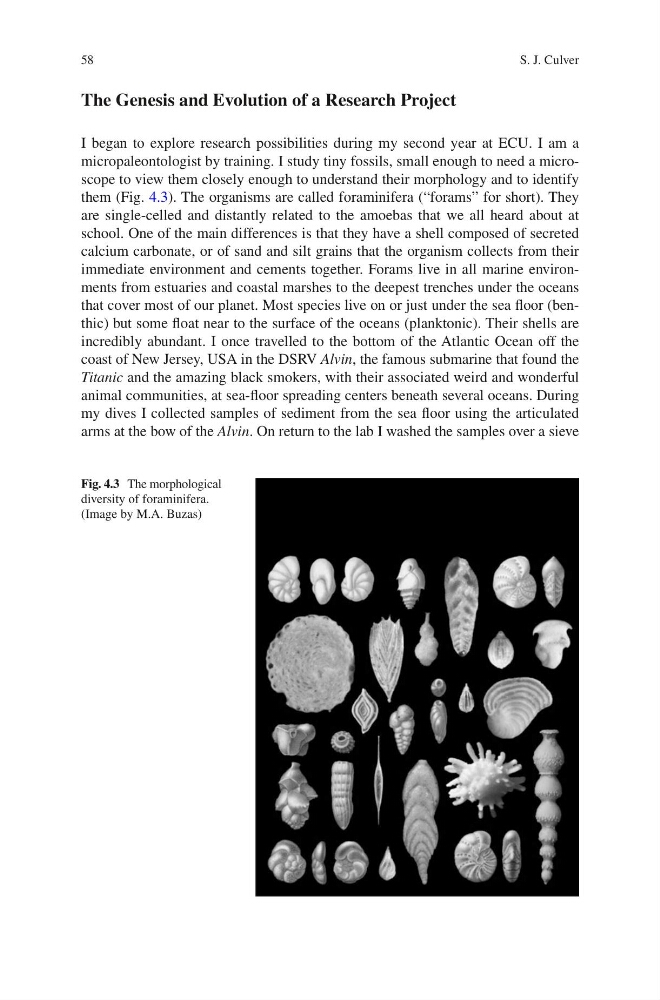
micropaleontologist by training. I study tiny fossils, small enough to need a microscope to view them closely enough to understand their morphology and to identify
them (Fig. 4.3). The organisms are called foraminifera (“forams” for short). They
are single-celled and distantly related to the amoebas that we all heard about at
school. One of the main differences is that they have a shell composed of secreted
calcium carbonate, or of sand and silt grains that the organism collects from their
immediate environment and cements together. Forams live in all marine environments from estuaries and coastal marshes to the deepest trenches under the oceans
that cover most of our planet. Most species live on or just under the sea floor (benthic) but some float near to the surface of the oceans (planktonic). Their shells are
incredibly abundant. I once travelled to the bottom of the Atlantic Ocean off the
coast of New Jersey, USA in the DSRV Alvin, the famous submarine that found the
Titanic and the amazing black smokers, with their associated weird and wonderful
animal communities, at sea-floor spreading centers beneath several oceans. During
my dives I collected samples of sediment from the sea floor using the articulated
arms at the bow of the Alvin. On return to the lab I washed the samples over a sieve
Fig. 4.3 The morphological
diversity of foraminifera.
(Image by M.A. Buzas)
S. J. Culver
The Genesis and Evolution of a Research Project
I began to explore research possibilities during my second year at ECU. I am a
micropaleontologist by training. I study tiny fossils, small enough to need a microscope to view them closely enough to understand their morphology and to identify
them (Fig. 4.3). The organisms are called foraminifera (“forams” for short). They
are single-celled and distantly related to the amoebas that we all heard about at
school. One of the main differences is that they have a shell composed of secreted
calcium carbonate, or of sand and silt grains that the organism collects from their
immediate environment and cements together. Forams live in all marine environments from estuaries and coastal marshes to the deepest trenches under the oceans
that cover most of our planet. Most species live on or just under the sea floor (benthic) but some float near to the surface of the oceans (planktonic). Their shells are
incredibly abundant. I once travelled to the bottom of the Atlantic Ocean off the
coast of New Jersey, USA in the DSRV Alvin, the famous submarine that found the
Titanic and the amazing black smokers, with their associated weird and wonderful
animal communities, at sea-floor spreading centers beneath several oceans. During
my dives I collected samples of sediment from the sea floor using the articulated
arms at the bow of the Alvin. On return to the lab I washed the samples over a sieve
Fig. 4.3 The morphological
diversity of foraminifera.
(Image by M.A. Buzas)
S. J. Culver