

44
day in the field! In 2012, we visited a field site on the White Sea in Russia, a 24-hour
train ride north from Moscow (and even then one of us fell asleep at the last minute
and we found ourselves in the sidings, fortunately our stop was the last stop!) followed by a long day of driving. We stayed in a village’s small wooden school
(Fig. 3.9) and experienced a community where people rely on one another and the
dairy offers fresh, warm milk in the morning, cream in the afternoon, and butter in
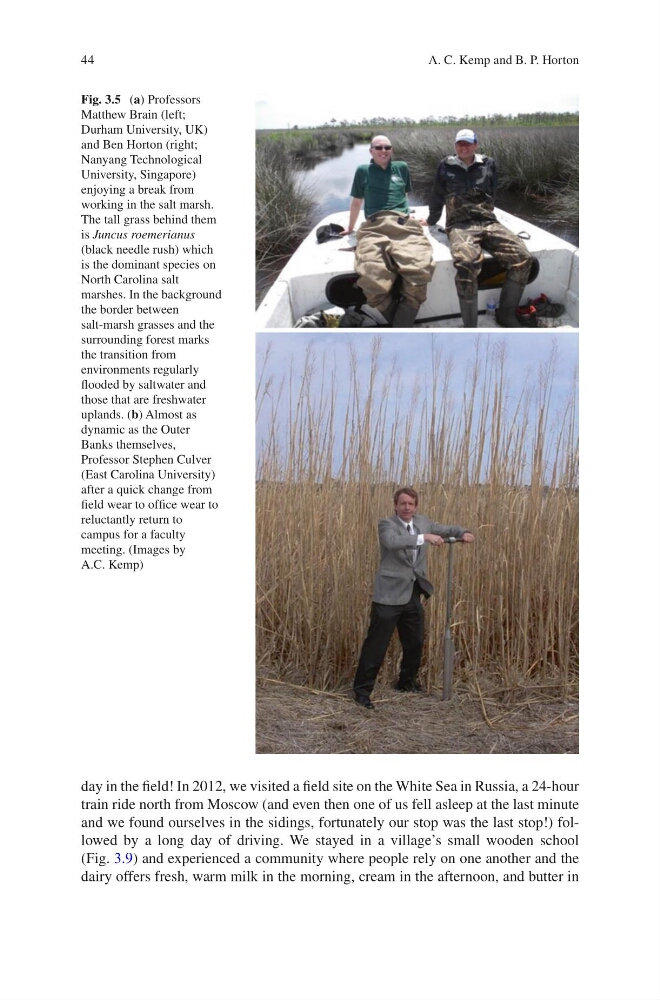
Fig. 3.5 (a) Professors
Matthew Brain (left;
Durham University, UK)
and Ben Horton (right;
Nanyang Technological
University, Singapore)
enjoying a break from
working in the salt marsh.
The tall grass behind them
is Juncus roemerianus
(black needle rush) which
is the dominant species on
North Carolina salt
marshes. In the background
the border between
salt-marsh grasses and the
surrounding forest marks
the transition from
environments regularly
flooded by saltwater and
those that are freshwater
uplands. (b) Almost as
dynamic as the Outer
Banks themselves,
Professor Stephen Culver
(East Carolina University)
after a quick change from
field wear to office wear to
reluctantly return to
campus for a faculty
meeting. (Images by
A.C. Kemp)
A. C. Kemp and B. P. Horton
day in the field! In 2012, we visited a field site on the White Sea in Russia, a 24-hour
train ride north from Moscow (and even then one of us fell asleep at the last minute
and we found ourselves in the sidings, fortunately our stop was the last stop!) followed by a long day of driving. We stayed in a village’s small wooden school
(Fig. 3.9) and experienced a community where people rely on one another and the
dairy offers fresh, warm milk in the morning, cream in the afternoon, and butter in
Fig. 3.5 (a) Professors
Matthew Brain (left;
Durham University, UK)
and Ben Horton (right;
Nanyang Technological
University, Singapore)
enjoying a break from
working in the salt marsh.
The tall grass behind them
is Juncus roemerianus
(black needle rush) which
is the dominant species on
North Carolina salt
marshes. In the background
the border between
salt-marsh grasses and the
surrounding forest marks
the transition from
environments regularly
flooded by saltwater and
those that are freshwater
uplands. (b) Almost as
dynamic as the Outer
Banks themselves,
Professor Stephen Culver
(East Carolina University)
after a quick change from
field wear to office wear to
reluctantly return to
campus for a faculty
meeting. (Images by
A.C. Kemp)
A. C. Kemp and B. P. Horton