

254
continents grow and shrink as the oceans fall and rise. The shore, the edge where
land meets sea meets sky, shifts in response to the volume of the sea, which largely
depends on the extent of ice on land. If it snows on a continent, and if the snow
sticks around year after year after year, growing glaciers and ice sheets, then the
balance of evaporation returned to the sea is broken, because the glaciers and ice
sheets don’t flow back to the ocean until they melt, thousands and tens of thousands
of years later. Water trapped in ice on land is water that is not in the sea, and sea
level, the reference datum, falls. When the ice melts and returns to the sea, sea level
rises. Should all of the Earth’s water, trapped as ice, be in the ocean, the level of the
sea would be at least 70 m (210 ft) higher than today, perhaps more if the water
warmed and expanded.
Only after gathering data on where sea level is, exactly, and where it has been in
the past, can we address where it might be headed now and why.
This book has told stories of seeking the coast, finding the data points of sea
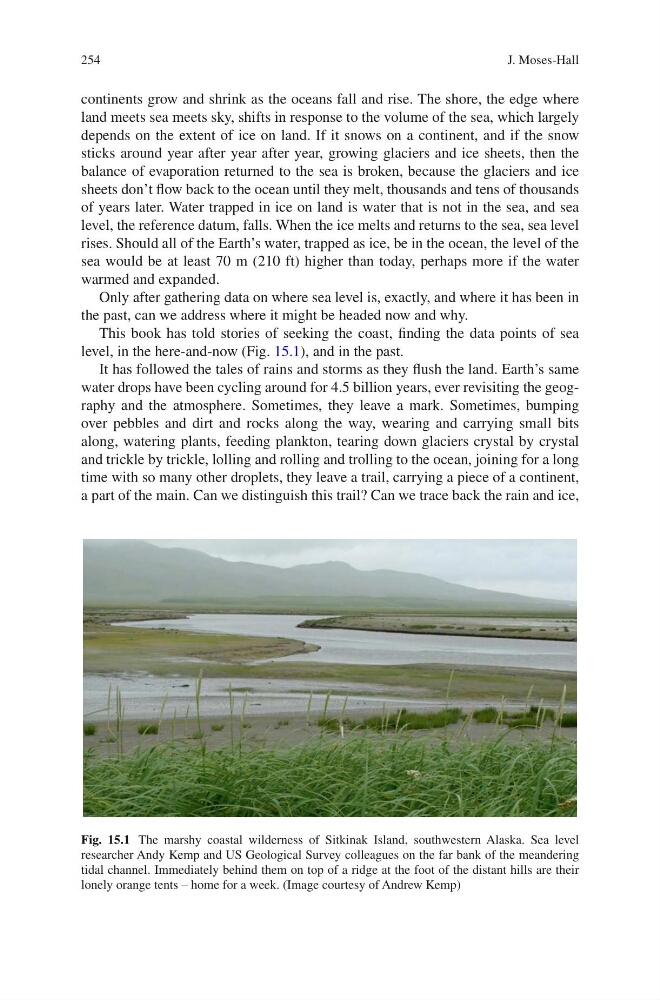
level, in the here-and-now (Fig. 15.1), and in the past.
It has followed the tales of rains and storms as they flush the land. Earth’s same
water drops have been cycling around for 4.5 billion years, ever revisiting the geography and the atmosphere. Sometimes, they leave a mark. Sometimes, bumping
over pebbles and dirt and rocks along the way, wearing and carrying small bits
along, watering plants, feeding plankton, tearing down glaciers crystal by crystal
and trickle by trickle, lolling and rolling and trolling to the ocean, joining for a long
time with so many other droplets, they leave a trail, carrying a piece of a continent,
a part of the main. Can we distinguish this trail? Can we trace back the rain and ice,
Fig. 15.1 The marshy coastal wilderness of Sitkinak Island, southwestern Alaska. Sea level
researcher Andy Kemp and US Geological Survey colleagues on the far bank of the meandering
tidal channel. Immediately behind them on top of a ridge at the foot of the distant hills are their
lonely orange tents – home for a week. (Image courtesy of Andrew Kemp)
J. Moses-Hall
continents grow and shrink as the oceans fall and rise. The shore, the edge where
land meets sea meets sky, shifts in response to the volume of the sea, which largely
depends on the extent of ice on land. If it snows on a continent, and if the snow
sticks around year after year after year, growing glaciers and ice sheets, then the
balance of evaporation returned to the sea is broken, because the glaciers and ice
sheets don’t flow back to the ocean until they melt, thousands and tens of thousands
of years later. Water trapped in ice on land is water that is not in the sea, and sea
level, the reference datum, falls. When the ice melts and returns to the sea, sea level
rises. Should all of the Earth’s water, trapped as ice, be in the ocean, the level of the
sea would be at least 70 m (210 ft) higher than today, perhaps more if the water
warmed and expanded.
Only after gathering data on where sea level is, exactly, and where it has been in
the past, can we address where it might be headed now and why.
This book has told stories of seeking the coast, finding the data points of sea
level, in the here-and-now (Fig. 15.1), and in the past.
It has followed the tales of rains and storms as they flush the land. Earth’s same
water drops have been cycling around for 4.5 billion years, ever revisiting the geography and the atmosphere. Sometimes, they leave a mark. Sometimes, bumping
over pebbles and dirt and rocks along the way, wearing and carrying small bits
along, watering plants, feeding plankton, tearing down glaciers crystal by crystal
and trickle by trickle, lolling and rolling and trolling to the ocean, joining for a long
time with so many other droplets, they leave a trail, carrying a piece of a continent,
a part of the main. Can we distinguish this trail? Can we trace back the rain and ice,
Fig. 15.1 The marshy coastal wilderness of Sitkinak Island, southwestern Alaska. Sea level
researcher Andy Kemp and US Geological Survey colleagues on the far bank of the meandering
tidal channel. Immediately behind them on top of a ridge at the foot of the distant hills are their
lonely orange tents – home for a week. (Image courtesy of Andrew Kemp)
J. Moses-Hall